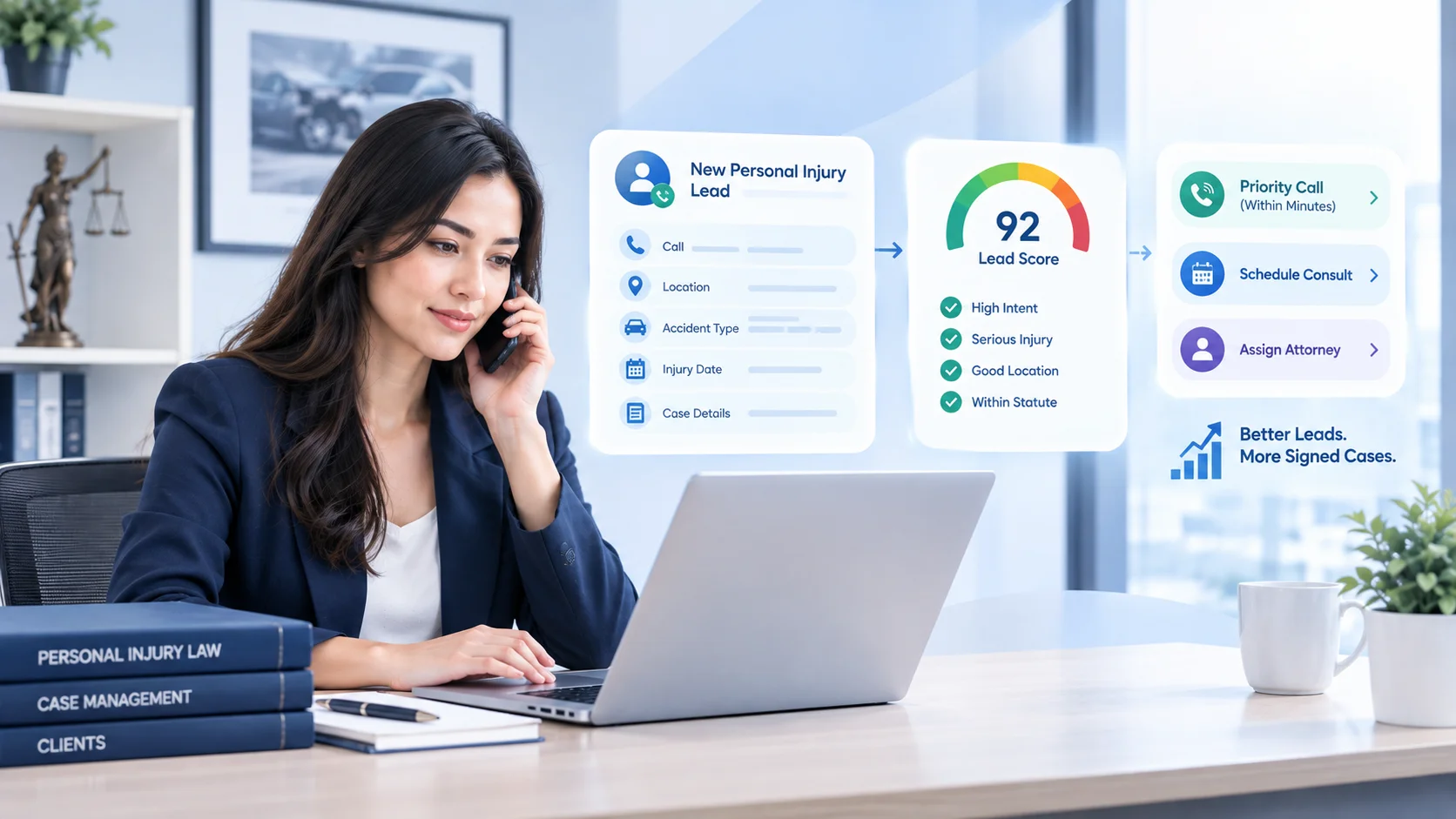
Key Takeaways
- A lead scoring model gives every intake inquiry a number, so your team calls the strongest potential cases first instead of working the queue in arrival order.
- For personal injury, the score rests on case facts: liability, injury severity, treatment, insurance coverage, and time left on the statute of limitations.
- Pair a case-fit score with an engagement score so a strong case with a slow-responding caller doesn't fall through the cracks.
- Start with a simple manual scorecard your intake team can apply in under five minutes, then automate it once you've tested the weights against signed cases.
- A scoring model is only as good as the people applying it. Trained intake specialists who answer around the clock make sure every lead gets scored and routed fast.
Most personal injury firms treat every phone call the exact same way. An intake agent might spend thirty minutes taking notes on a minor scrape with disputed fault. Meanwhile, a caller hit by a commercial truck sits on hold or waits hours for a callback.
The problem isn't the lead volume. It's the lead order. When intake works inquiries first-come, first-served, the most valuable claims get the same treatment as the weakest ones. In a practice area where injured people often call several firms in a single afternoon, a slow callback can mean losing the case to a competitor.
A lead scoring model fixes this by ranking each inquiry on how likely it is to become a signed, worthwhile case. This guide explains what lead scoring is, how it works in personal injury, which criteria matter most, and how to build a model your legal intake team will actually use.
What is a lead scoring model?
A lead scoring model is a system that ranks prospects by how likely they are to become customers. It assigns each lead a numerical score based on who they are and how they interact with your business, so your team can focus on the leads most likely to convert.
In practice, lead scoring replaces gut feel with a repeatable process that everyone on your team applies the same way. Most models look at two kinds of data:
- Explicit data (fit): facts about the prospect that signal whether they match your ideal customer. In sales, that might be job title or company size.
- Implicit data (engagement): behavior that signals interest, such as return website visits, content downloads, or quick replies to outreach.
Many models also use negative scoring, which subtracts points for signals that a lead is unlikely to convert. Scores can be calculated by hand with a points system or automatically inside a CRM, and more advanced predictive models use machine learning to find patterns in past conversions.
Whatever the method, the goal stays the same: make sure the best opportunities get attention first, and make sure everyone on the team agrees on what "best" means.
What is a lead scoring model in personal injury?
In a personal injury firm, a lead scoring model ranks each potential client by the strength and value of their claim, plus how ready they are to hire a lawyer. Instead of job titles and email opens, the score reflects the facts that decide whether a case is worth taking on contingency.
The two-part structure still applies, adapted for intake:
- Case fit (explicit): Is there clear liability? Is the injury serious and documented? Is there an insurance policy to recover from? Is the claim inside the statute of limitations?
- Client engagement (implicit): Did they call rather than fill in a form? Did they answer the callback? Are they already talking to another firm? Have they sent photos, a police report, or medical records?
A simple way to combine the two is a grid: grade case fit from A to D and engagement from 1 to 4, so an A1 lead is the most qualified and a D4 the least. In personal injury, an "A1" might be a rear-end collision with a hospital visit and a caller ready to sign today. A "B3" might be a solid slip-and-fall where the caller hasn't returned two messages.
The payoff is speed and consistency. High-scoring leads go straight to an attorney or senior intake specialist, mid-range leads get a structured follow-up sequence, and low-scoring leads receive a prompt, respectful decline or referral. No one waits because of the order they called in.
Core scoring criteria for personal injury claims
The best personal injury scoring models focus on a handful of criteria that predict both signing and case value. Keep it simple at first: score too many criteria and it becomes hard to see what's actually driving the result.
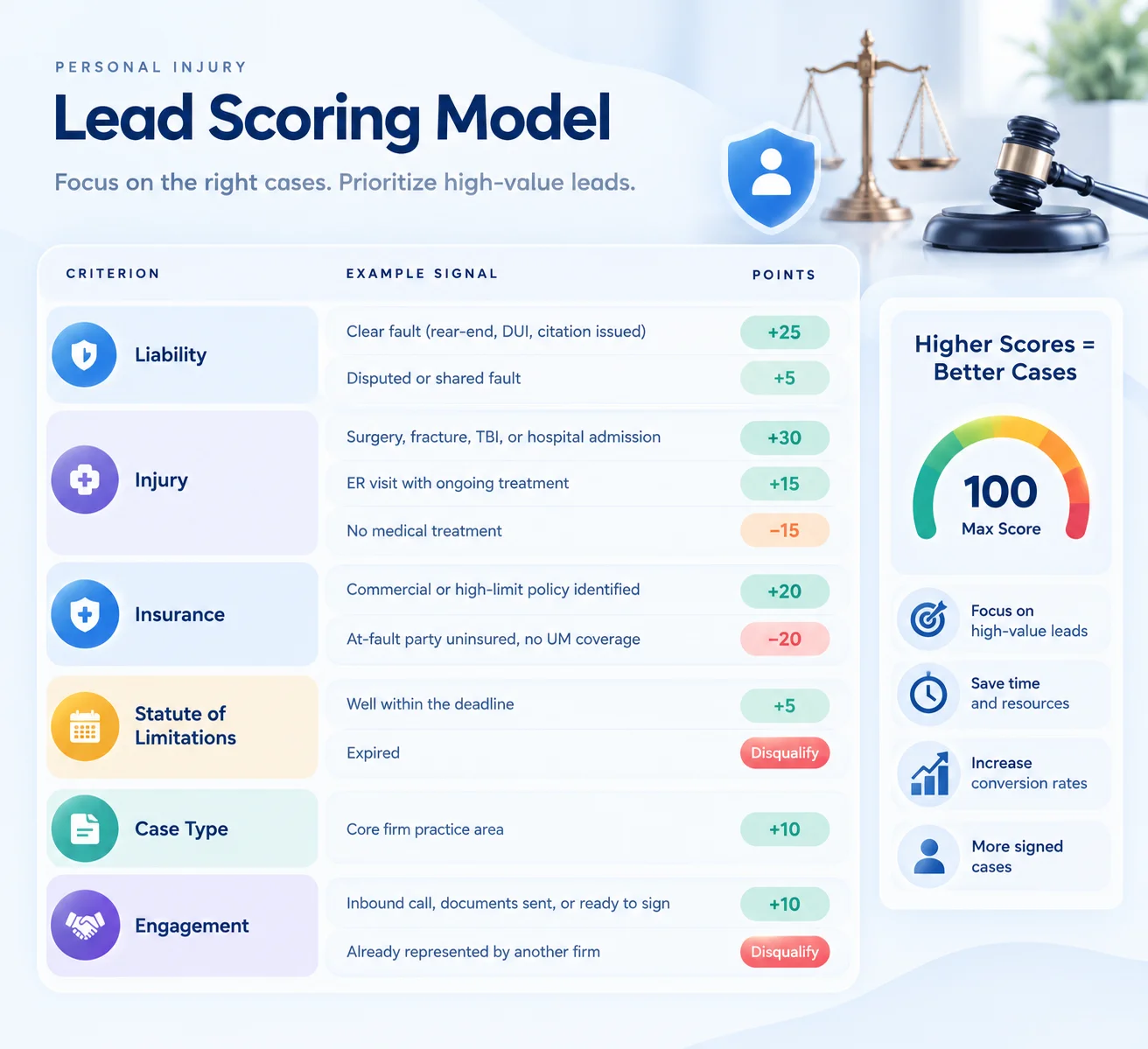
Liability
Who was at fault, and how clearly? Rear-end collisions, drunk drivers, and commercial vehicles with clear violations score high. Disputed fault or shared negligence scores lower, especially in states with strict contributory negligence rules.
Injury severity and treatment
Damages drive case value. Fractures, surgery, traumatic brain injury, and hospital admission score highest. Ongoing treatment with a doctor matters too, because gaps in treatment are one of the most common ways insurers argue down a claim.
Insurance and recovery sources
A strong case with no one to collect from is a hard case. Commercial policies, trucking carriers, businesses, and government entities with known coverage add points. An uninsured at-fault driver with no underinsured motorist coverage on the client's side subtracts them.
Statute of limitations
Check the date of the incident immediately. A claim with plenty of time scores normally. A claim near its deadline needs urgent attorney review, not a lower score. A claim that has already expired is disqualified. Notice deadlines for claims against government entities can be much shorter than the general limit, so flag them separately.
Case type and practice fit
Weight the case types your firm handles best and profits from most. A firm built around trucking and wrongful death should score those higher than minor property-damage-only claims.
Engagement and urgency
Inbound calls usually outscore form fills. Callers who answer quickly, provide documents, or say they're comparing firms signal readiness and should move to the front of the line.
Negative signals
Subtract points when the caller already has a lawyer, the incident happened out of your jurisdiction, there's no injury, or the story changes significantly between calls.
Here's a sample points scale to adapt. Treat the numbers as a starting point, not a standard.
Manual vs automated lead scoring models
Most firms should start manual and automate once the model is proven. Both approaches score the same criteria. The difference is who does the math and how fast the score reaches the right person.
Manual scoring uses a scorecard or checklist your intake specialists fill in during the first call. It's cheap, fast to set up, and easy to adjust. It also keeps a human listening for details a form can't capture, like a caller who downplays their pain. The downside is inconsistency: two intake staff can score the same call differently, and busy nights mean skipped scorecards.
Automated scoring calculates the score inside your intake software or CRM as answers are entered, from web forms, chat, or call notes. Scores update in real time as new information arrives, and high scores can trigger instant alerts or routing to an attorney. Predictive models go further and learn from your past signed and declined cases, but they need a meaningful volume of clean historical data to be reliable.
How to build a lead scoring model for your firm
You can have a working first version in a few weeks by following these seven steps.
1. Study your signed cases
Pull your last 12 to 24 months of signed cases and settlements, plus a sample of declined leads. Look for the facts that separated strong outcomes from weak ones: case type, injury, liability, insurance, and lead source. This is your evidence base.
2. Get attorneys and intake in the same room.
Lead scoring only works when the people answering the phones and the people signing the cases agree on what a "good case" looks like. Settle that definition before anyone assigns points.
3. Pick four to six criteria and assign points.
Use the criteria above and weight them by how much they predicted outcomes in step 1. Add negative points and hard disqualifiers, such as an expired statute of limitations or existing representation.
4. Combine fit and engagement.
Score case fit and client engagement separately, then map the combination to a tier, like A1 to D4. This keeps a great case with a hard-to-reach caller from being buried.
5. Map every tier to an action and a response time.
Top-tier leads should reach an attorney within minutes and get a same-day signing appointment. Mid-tier leads get a scheduled follow-up sequence by call and text. Low-tier leads get a prompt decline or referral. Write these response times down so every shift follows them.
6. Build the questions into your intake script.
Each scoring criterion should map to a specific question on your call script and web form. If intake never asks about insurance, the model can't score it. Train your intake specialists on the scorecard so they gather every answer on the first call, without giving legal advice.
7. Measure, then adjust every quarter.
Track signing rate, average case value, and response time by score tier. If B-tier leads sign as often as A-tier leads, your weights are off. The share of scored leads your attorneys accept is the best single health check for the whole model.
Two guardrails are worth building in from day one. First, the score is a prioritization tool, not a substitute for attorney judgment on whether to accept a case. Second, make sure every declined lead receives a clear written non-engagement notice that tells them about their deadline, so no one assumes you're handling their claim. Check your state bar's rules on declining representation and referral arrangements before you finalize your workflow.
How Legal Intaker helps personal injury firms put lead scoring to work
A lead scoring model only pays off when every call is answered, every question is asked, and every high-value lead reaches an attorney fast. Legal Intaker gives personal injury firms the intake team to make that happen.
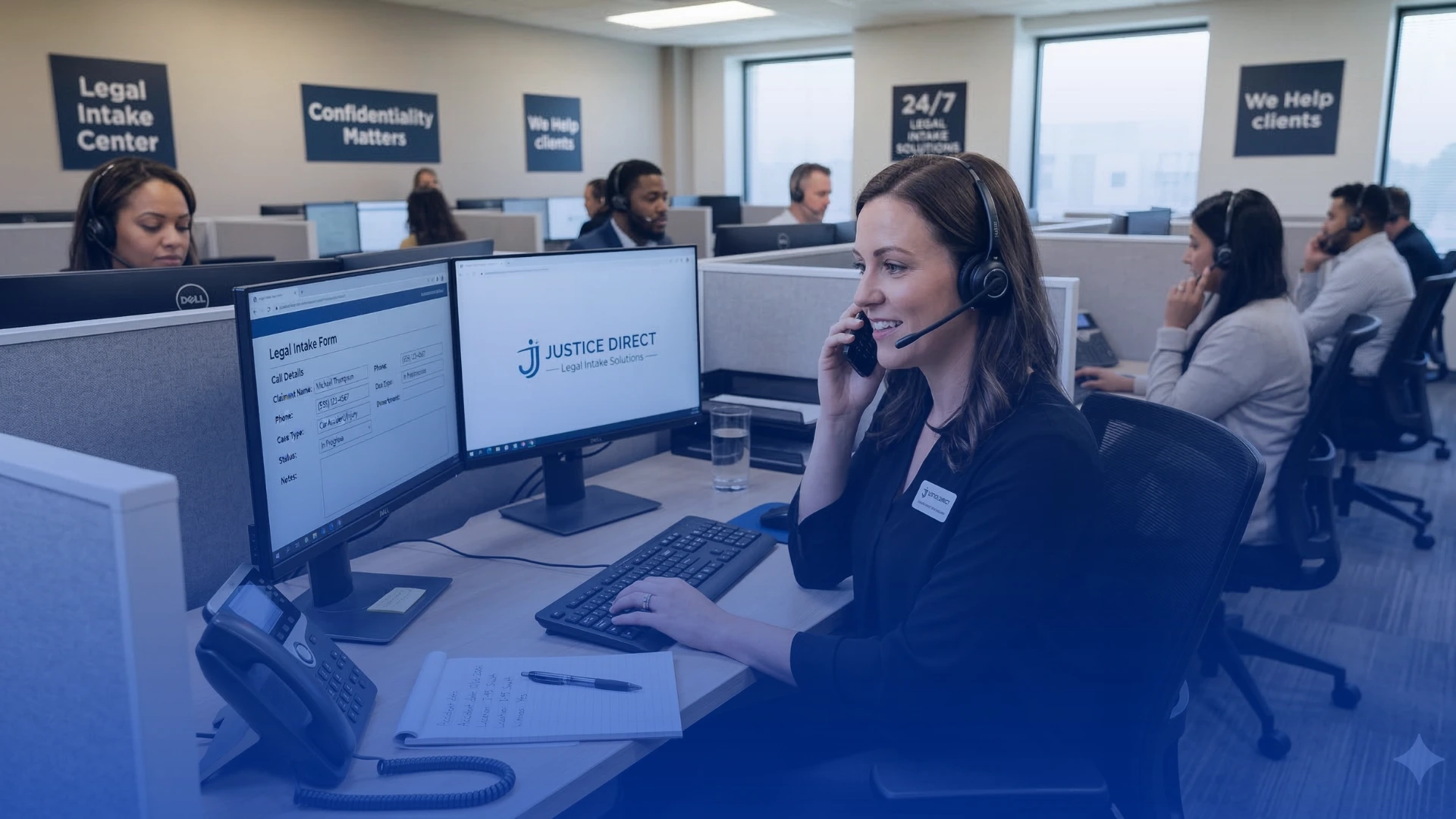
- Every lead gets scored, day or night. Our virtual intake specialists cover after-hours and weekend calls, when many accident victims reach out, so strong cases don't sit in voicemail.
- Specialists trained for legal intake. Our specialists are pre-vetted and trained by U.S.-based attorneys in legal terminology and practice-area screening, so they collect liability, injury, insurance, and deadline details consistently on the first call
- English and Spanish coverage. Bilingual specialists help you score and sign Spanish-speaking clients with the same speed and care.
- Fast routing to your attorneys. Specialists follow your scorecard and response-time rules, sending top-tier leads to your team right away and keeping mid-tier leads moving with structured follow-up.
- Clean data for better models. Intake answers are logged in your case management system, and our platform lets you monitor calls, inquiries, and follow-ups in real time, giving you the data you need for quarterly model reviews.




.png)
.png)












.webp)














.webp)

.webp)








.webp)