.webp)
Key Takeaways
- An intake specialist is the frontline revenue protector for law firms.
- Fast, professional intake significantly increases signed cases.
- Legal intake requires compliance‑focused training, not generic call handling.
- Outsourcing intake to specialists like Legal Intaker improves ROI and scalability.
In the legal industry, an intake specialist is the first point of contact between a law firm and a potential client. In the legal industry, this role is critical, because intake specialists do not just answer phones; they qualify leads, protect compliance, gather legally relevant facts, and convert inquiries into signed cases.
💡 In an era where 79% of consumers expect immediate responses and legal leads often cost $100–$1,000+ per inquiry (Clio Legal Trends Report), a strong intake process is no longer optional, it is a revenue driver.
This article explains what an intake specialist is, what they do, why the role is essential in law firms, required skills, salary data, legal compliance considerations, and how professional legal intake services like Legal Intaker help firms grow.
What Is an Intake Specialist?
An intake specialist is a trained professional responsible for:
- Answering inbound calls, chats, or form submissions
- Screening potential clients (leads)
- Collecting case details
- Determining legal eligibility
- Scheduling consultations or transferring qualified leads
In law firms, intake specialists serve as the gatekeepers of the client acquisition funnel.
Legal Definition (Industry Usage)
A legal intake specialist evaluates potential clients by collecting factual information, identifying legal issues, and determining whether a case meets the firm’s criteria before attorney review.
Unlike paralegals or attorneys, intake specialists do not provide legal advice, but they play a crucial role in protecting attorneys’ time and maximizing conversions.
📚 Also Read: When to Hire a Legal Intake Specialist for Your Law Firm
Why Intake Specialists Matter in Law Firms
Law firms lose revenue not because of poor legal skills, but because of missed calls, poor follow‑up, and weak screening.
Key Industry Statistics
- 42% of law firms fail to respond to new leads (Clio Legal Trends Report)
- 78% of clients hire the first attorney who responds (Martindale‑Avvo)
- Legal leads contacted within 5 minutes are 21x more likely to convert (Harvard Business Review)
An intake specialist ensures speed, consistency, and compliance, especially for high‑volume practice areas such as:
- Personal injury
- Mass torts
- Employment law
- Immigration
- Criminal defense
- Family law
📚 Also Read: 5 Signs You Need a Law Firm Intake Specialist
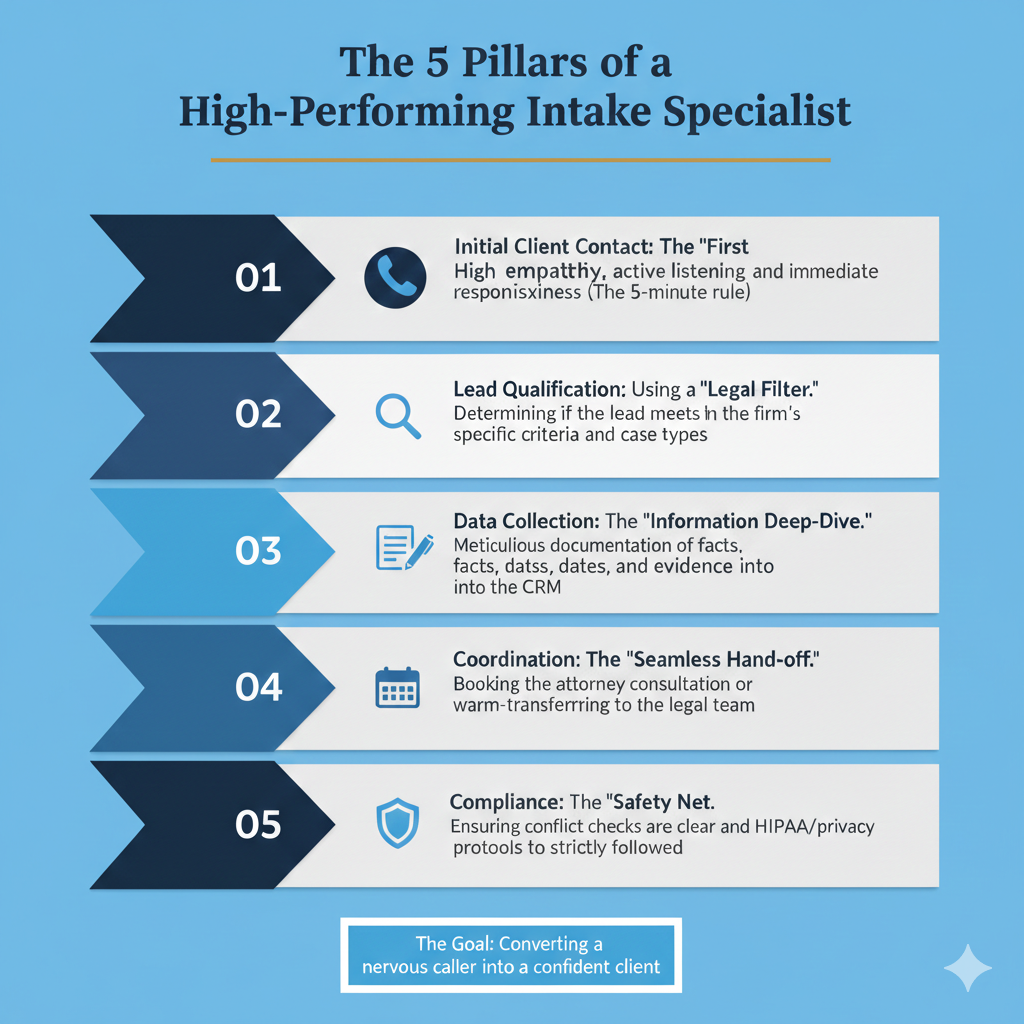
5 Pillars of High-Performing Intake Specialist
1. Initial Client Contact
Intake specialists handle:
- Phone calls
- Website chats
- Contact forms
- SMS or email follow‑ups
Their goal is to make a strong first impression while gathering essential information.
2. Lead Qualification & Case Screening
They evaluate whether a case fits the firm’s criteria based on:
- Jurisdiction
- Statute of limitations
- Type of legal issue
- Severity and damages
- Conflict checks
This prevents attorneys from wasting time on non‑viable cases.
3. Information Collection & Documentation
Intake specialists document:
- Names and contact details
- Incident timelines
- Involved parties
- Injuries, damages, or losses
- Insurance or employer details
Accurate intake data improves case strategy and compliance.
4. Appointment Scheduling & Transfers
Qualified leads are:
- Scheduled for attorney consultations
- Warm‑transferred to legal teams
- Routed to the correct department
Speed here directly impacts retention rates.
5. Compliance & Risk Mitigation
A trained intake specialist helps law firms avoid:
- Unauthorized practice of law (UPL)
- Misrepresentation
- Ethical violations
- Improper guarantees
This is especially important in regulated jurisdictions.
Intake Specialist vs. Legal Assistant vs. Paralegal

Intake specialists focus exclusively on client acquisition and qualification, not case strategy.
Skills Required to Be a High‑Performing Intake Specialist
Essential Skills
- Active listening
- Clear communication
- Empathy and professionalism
- Legal issue recognition
- CRM and intake software proficiency
Advanced Legal Intake Skills
- Understanding statutes of limitations
- Multi‑jurisdiction screening
- Mass tort qualification logic
- Insurance and liability awareness
According to ABA research, firms with standardized intake training experience 30–40% higher lead conversion rates.
Intake Specialist Salary & Job Outlook
Salary Data (U.S.)
According to Glassdoor and Indeed (2024 data):
- Average intake specialist salary: $45,000 – $65,000/year
- Experienced legal intake specialists: $70,000+
- Performance‑based bonuses common
Job Outlook
The demand for intake specialists is growing due to:
- Rising digital legal advertising
- Increased competition for legal leads
- Client expectations for 24/7 availability
The U.S. Bureau of Labor Statistics projects continued growth in legal support roles through 2032.
In‑House vs. Outsourced Intake Specialists
In‑House Intake Teams
Pros
- Firm‑specific knowledge
- Full control
Cons
- High payroll costs
- Limited availability
- Training overhead
Outsourced Legal Intake Services (Like Legal Intaker)
Pros
- 24/7 coverage
- Trained legal intake specialists
- Scalable for high lead volume
- Lower cost than full‑time staff
Cons
- Requires strong vendor alignment
Why Law Firms Outsource Intake to Legal Intaker
Legal Intaker specializes exclusively in legal intake services, not generic call answering.
What Makes Legal Intaker Different
- Intake specialists trained for law firms only
- Practice‑area‑specific screening scripts
- Real‑time lead qualification
- CRM and case management integration
- Compliance‑focused intake protocols
This ensures that every lead is handled professionally, ethically, and efficiently, even after hours.
How Intake Specialists Improve Law Firm ROI
Revenue Impact
A well‑trained intake specialist:
- Increases lead‑to‑client conversion
- Reduces cost per signed case
- Improves attorney productivity
According to Clio, firms with optimized intake processes grow 2x faster than competitors.
📚 Also Read: Why Remote Intake Specialists Are Fueling Law Firm Growth
Technology Used by Intake Specialists
Modern intake specialists rely on:
- Legal CRMs (Clio, Lawmatics, Salesforce)
- Call tracking software
- AI‑assisted intake workflows
- Secure data storage (HIPAA & GDPR aligned when applicable)
Legal Intaker integrates seamlessly with these platforms to ensure zero data loss.
Common Mistakes Law Firms Make Without Intake Specialists
- Missed calls during off‑hours
- Inconsistent lead screening
- Poor follow‑up
- Unqualified consultations
- Compliance risks
Each missed call can represent thousands of dollars in lost case value.
Why Intake Specialists Are the Backbone of Modern Law Firms
In today’s competitive legal market, winning cases starts before the attorney ever speaks to a client. Intake specialists ensure that every inquiry is answered, every lead is evaluated correctly, and every opportunity is maximized.
For law firms looking to scale without sacrificing quality, Legal Intaker provides dedicated legal intake specialists who convert leads into signed cases—day or night.
👉 Ready to stop losing qualified legal leads? Contact Legal Intaker today and turn every inquiry into an opportunity.

FAQs About What is an intake specialist?
1. What does an intake specialist do in a law firm?
An intake specialist screens potential clients, gathers case information, and qualifies leads before they speak with an attorney.
2. Is an intake specialist allowed to give legal advice?
No. Intake specialists cannot provide legal advice and must follow strict compliance guidelines to avoid unauthorized practice of law.
3. How much does a legal intake specialist make?
Legal intake specialists typically earn between $45,000 and $65,000 annually, with higher pay for experience and performance.
4. Should law firms outsource intake services?
Yes. Outsourcing intake services provides 24/7 coverage, trained specialists, and higher conversion rates at a lower cost than in‑house teams.






.png)
.png)














.webp)















.webp)

.webp)