.webp)
Key Takeaways
• Officially called the First-Year Law Students' Examination (FYLSX), the Baby Bar Exam is a California-specific checkpoint non-traditional law students must pass to continue receiving credit toward bar eligibility.
• The exam is widely regarded as one of the most challenging exams in legal education, with a pass rate consistently between 20–26% lower than the full California Bar Exam itself.
• Students taking the exam who fail three times forfeit their entire first year of law school credit and cannot continue on their current path to practice law in California.
• Law firms supporting staff on alternative legal education paths can keep operations at full capacity by staffing virtual legal professionals through Legal Intaker while their team pursues this significant milestone.
The Baby Bar Exam sounds informal almost friendly. It's anything but.
With a pass rate that consistently sits below 30%, the First-Year Law Students' Examination officially called the FYLSX by the State Bar of California routinely humbles even well-prepared candidates. Kim Kardashian, arguably the most famous person to take the Baby Bar, failed three times before passing on her fourth attempt in 2021. She was studying under attorney Van Jones with a dedicated private tutor.
If you're on a non-traditional path toward California bar admission and looking to eventually practice law, understanding what the Baby Bar is, who must take the Baby Bar, and how it differs from the full California Bar Exam is foundational not optional.
What Is the Baby Bar Exam?
The First-Year Law Students' Examination (FYLSX) officially called the Baby Bar Exam is a one-day standardized test administered by the State Bar of California through its Committee of Bar Examiners. It is given twice per year: June and October.
It exists as a quality checkpoint embedded within California's alternative legal education system. California is one of the only states in the U.S. that allows individuals to study law and pursue bar admission without attending law school accredited by the American Bar Association (ABA). The Baby Bar ensures that California law students on these non-traditional tracks have achieved command of general legal principles covered in a standard first year of law before they can continue receiving credit toward bar eligibility.
The exam is widely regarded as one of the most difficult gatekeeping mechanisms in U.S. legal studies not because the subjects are exotic, but because the depth of analysis demanded on this single day exam is identical to what the general bar exam expects, compressed into just three subjects.
It is not required for students attending law school accredited by the ABA.
Who Has to Take the Baby Bar Exam?
Under California Business and Professions Code § 6060(h), taking the Baby Bar is mandatory for:
• Students enrolled at unaccredited law schools, including online or distance-learning institutions not accredited by the ABA or State Bar of California
• Students attending California-accredited law schools that have not received ABA accreditation
• Candidates in a law office study program also called a law reader program where an individual studies law under the direct supervision of a licensed attorney or sitting judge in a law office
Who Is Generally Exempt from the Baby Bar:
• Graduates of accredited law schools with ABA recognition (e.g., UC Berkeley School of Law, UCLA School of Law, USC Gould School of Law) are generally exempt
• Attorneys licensed in another jurisdiction seeking California admission through reciprocity or the Attorneys' Examination
The distinction matters significantly. Students attending accredited law schools skip this hurdle entirely. The Baby Bar sits exclusively on the path of those pursuing alternative legal education routes — a California-specific law requirement with virtually no equivalent in any other state.
What Subjects Are Tested on the Baby Bar Exam?
The exam tests exactly three subjects all drawn from the first year of law school curriculum:
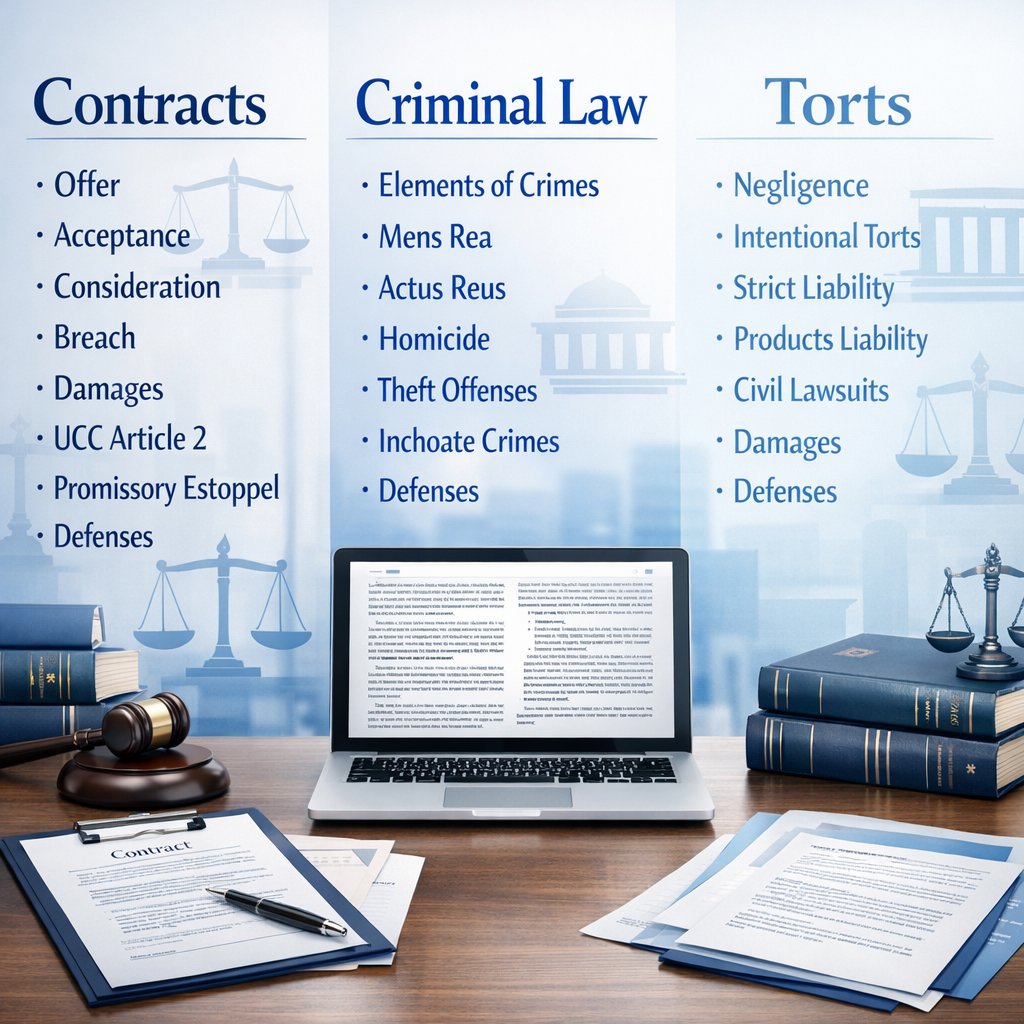
Contracts, criminal law and torts are the foundation of any first-year legal education. The exam tests general legal principles within each subject — not California-specific law nuances. Candidates need to demonstrate command of both the black-letter rules and their application to fact patterns that mirror real civil lawsuits and criminal prosecutions.
The scope of contracts, criminal law and torts mirrors what students at accredited law schools study in their 1L year — the Baby Bar simply makes that legal knowledge a gated requirement rather than a stepping stone.
How the Baby Bar Exam Is Structured
Contrary to a common misconception, the Baby Bar is not a half-day test. It is a full one-day test administered across two sessions on a single day. Approaching it as a half day test will cause you to under-prepare.
Morning Session — Essay Portion (approximately four hours)
• 4 essay questions
• One question each from Contracts, Criminal Law, and Torts, plus one additional question from any of the three subjects
• Each essay is independently scored by two graders on a scale of 40–100
• Answers must demonstrate IRAC methodology (Issue, Rule, Analysis, Conclusion)
• The essay portion rewards depth, precision, and time management
Afternoon Session — Multiple Choice Questions (approximately three hours)
• 100 multiple-choice questions
• Structured in the style of the Multistate Bar Examination (MBE)
• The exam includes questions from all three subject areas proportionally
• Tests both rule recognition and application under timed pressure
Scoring
• The minimum passing score is approximately 560 out of a possible 800
• Essay and multiple-choice sections are weighted equally at 50/50
• Scores are released roughly 10–12 weeks post-exam via the California website (State Bar of California's official portal)
Past exam questions and model answers published on the California website by the Committee of Bar Examiners are the most authoritative and accurate study material for students taking the exam.
Baby Bar vs. California Bar Examination: Key Differences
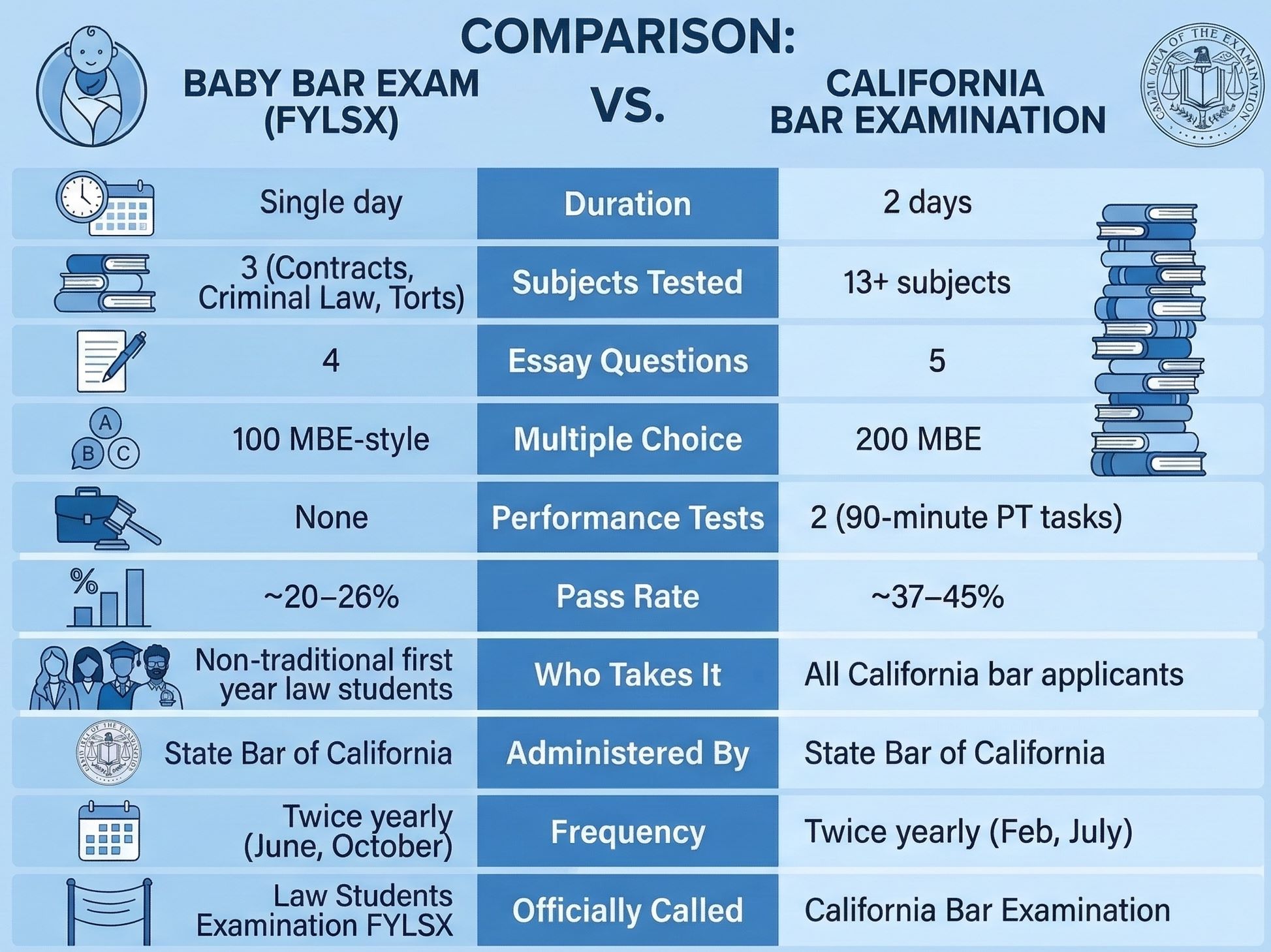
The California bar examination tests Constitutional Law, Evidence, Civil Procedure, Professional Responsibility, Real Property, Wills and Succession, Business Associations, Community Property, and more building on the three Baby Bar subjects. The scope jump from the Baby Bar to the full California bar is enormous.
Passing the Baby Bar is a significant milestone on the non-traditional path but the finish line is still years away.
Is the Baby Bar a Challenging Exam?
Objectively yes. The data confirms it.
According to the State Bar of California, the FYLSX pass rate has historically ranged between 20% and 26% across all administrations. In June 2022, only 21% of test takers passed. By comparison, the California bar already one of the hardest general bar exams in the country passes approximately 37–45% of first-time candidates.
Why is passing the Baby Bar so difficult for so many law students?
• Narrow subjects, maximum depth. The exam includes only three subjects but demands the same level of analytical rigor as the full bar examination. There is no room to compensate for weakness in one area.
• No performance test buffer. The general bar exam includes performance tests that reward methodical practical analysis. The Baby Bar has no such component pure legal knowledge dominates entirely.
• Limited prep resources. Because this is a California-specific law exam outside the mainstream bar prep ecosystem, far fewer study tools exist for legal studies prep compared to standard MBE resources.
• The profile of students taking the exam. Many test takers are working full-time, enrolled part-time at unaccredited schools, and lack the structured academic scaffolding of traditional law school environments.
• The attempt rule. Candidates who fail three times do not just lose a testing opportunity they lose their entire year of law school credit and cannot continue toward bar eligibility on that path.
California is the only state in the country with this specific exam requirement, which makes it a uniquely high-pressure California-specific law challenge for those on alternative paths.
How to Prepare for the Baby Bar Exam
Effective preparation for this challenging exam mirrors bar exam prep methodology with the scope compressed to three subjects and the urgency amplified by the three-attempt rule.
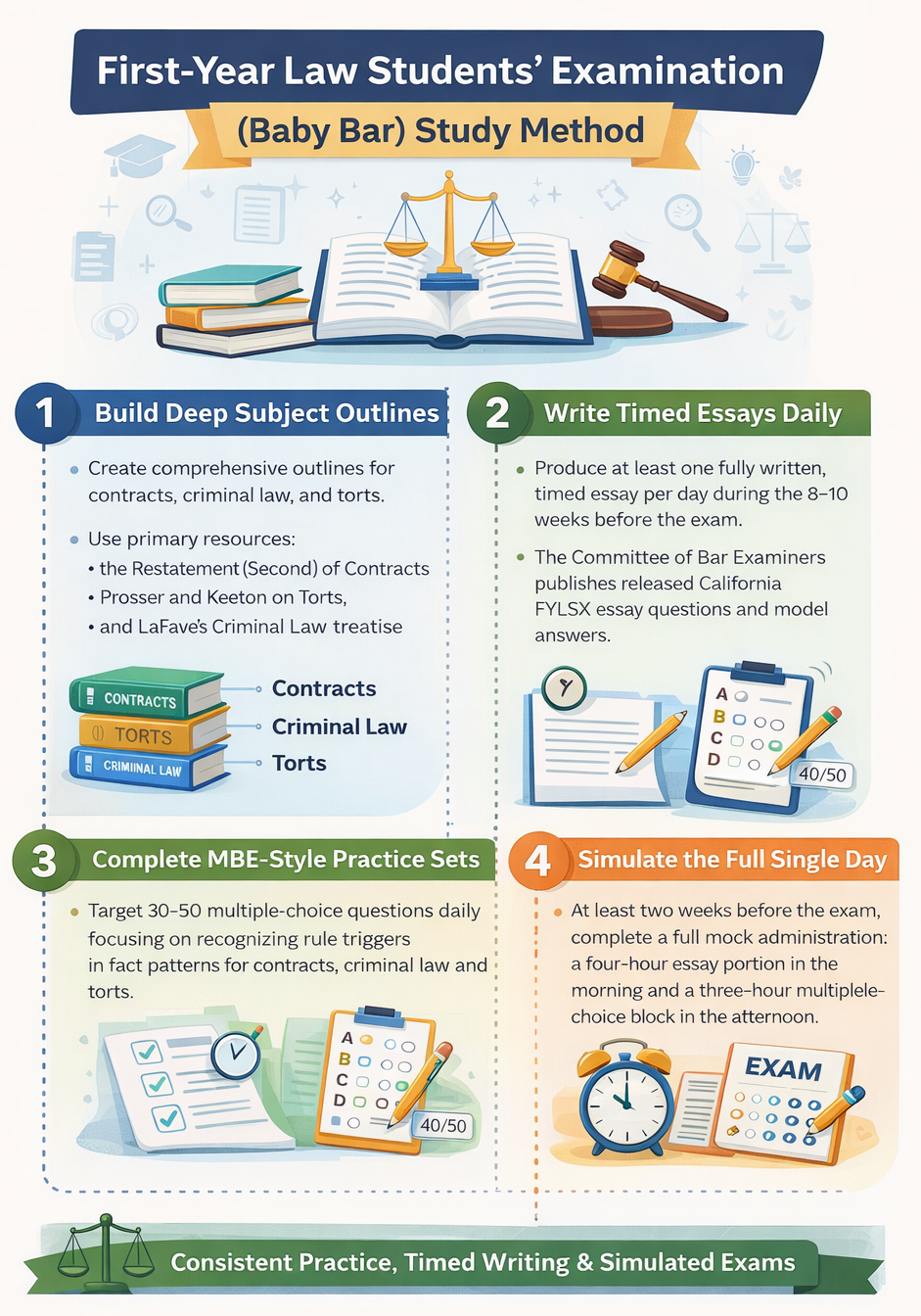
Recommended Resources
• State Bar of California official website — released past exams, scoring rubrics, and model answers
• Themis Bar Review — FYLSX-specific prep course
• Adapt Bar — adaptive MBE-style question bank
• Barbri 1L Mastery — foundational legal education course structure
Attempt Rules: What Happens If You Don't Pass
Under California rules, first year law students must pass the FYLSX within their first year of law study specifically within the first three semesters or four quarters. Failure to pass within three attempts results in forfeiture of all credit for the year of law school already completed.
Strategic Planning Considerations
• Time your first attempt for the first available administration after completing your year of law school coursework
• Failing on the first try is statistically common data shows a significant portion of those who eventually pass do so on Attempt 2 or 3
• Candidates at unaccredited schools or in a law office study program typically lack institutional exam guidance proactive self-preparation is essential
• Some candidates who exhaust their attempts choose to attend an ABA-accredited law school to earn a full law degree, resetting their path under a different track
The requirement to receive credit only after passing and the cap at three attempts s what makes passing the Baby Bar so consequential for California law students on alternative paths.
Traditional Law School vs. Alternative Paths to Becoming a Licensed Attorney
California is the only state in the U.S. where you can study law entirely through a law office study program without ever attending law school and still sit for a bar examination. Here's how the paths to becoming a licensed attorney compare:
.png)
The tradeoff is real: alternative paths offer lower tuition and greater scheduling flexibility in exchange for the Baby Bar requirement, California-only bar eligibility, and a longer road to receiving a law degree with national portability. The American Bar Association does not accredit unaccredited schools or law office study programs, which limits reciprocity with other states.
For candidates committed to practice law in California, the non-traditional route remains legitimate. The Baby Bar is not designed to prevent success — it is designed to confirm readiness.
What Comes After Passing the Baby Bar
Passing the Baby Bar does not make you a licensed attorney. It confirms your right to continue receiving credit toward bar eligibility — a significant milestone, but an intermediate one.
After passing, California law students on non-traditional tracks must:
1. Complete the remainder of their legal studies (typically three additional years of law study)
2. Accumulate required law study hours under California's law degree equivalency rules
3. Submit a Law Student Registration with the State Bar
4. Clear the Moral Character Determination process administered by the bar examiners
5. Pass the full California Bar Examination
The total timeline from passing the Baby Bar to California bar admission as a licensed attorney typically spans 5–6 years for part-time students often longer for those in a law office study program balancing full-time work.
Keeping Your Law Firm Running While Your Team Pursues Their Legal Education
Non-traditional attorneys and the firms that support them through a law office study program or unaccredited law face a practical staffing challenge: the path to practice law is long, and your caseload doesn't pause while someone sits for a challenging exam.
Law firms that invest in law reader candidates or staff pursuing alternative legal studies often experience operational gaps at exactly the wrong moments when those future attorneys are in intensive preparation for this significant milestone.
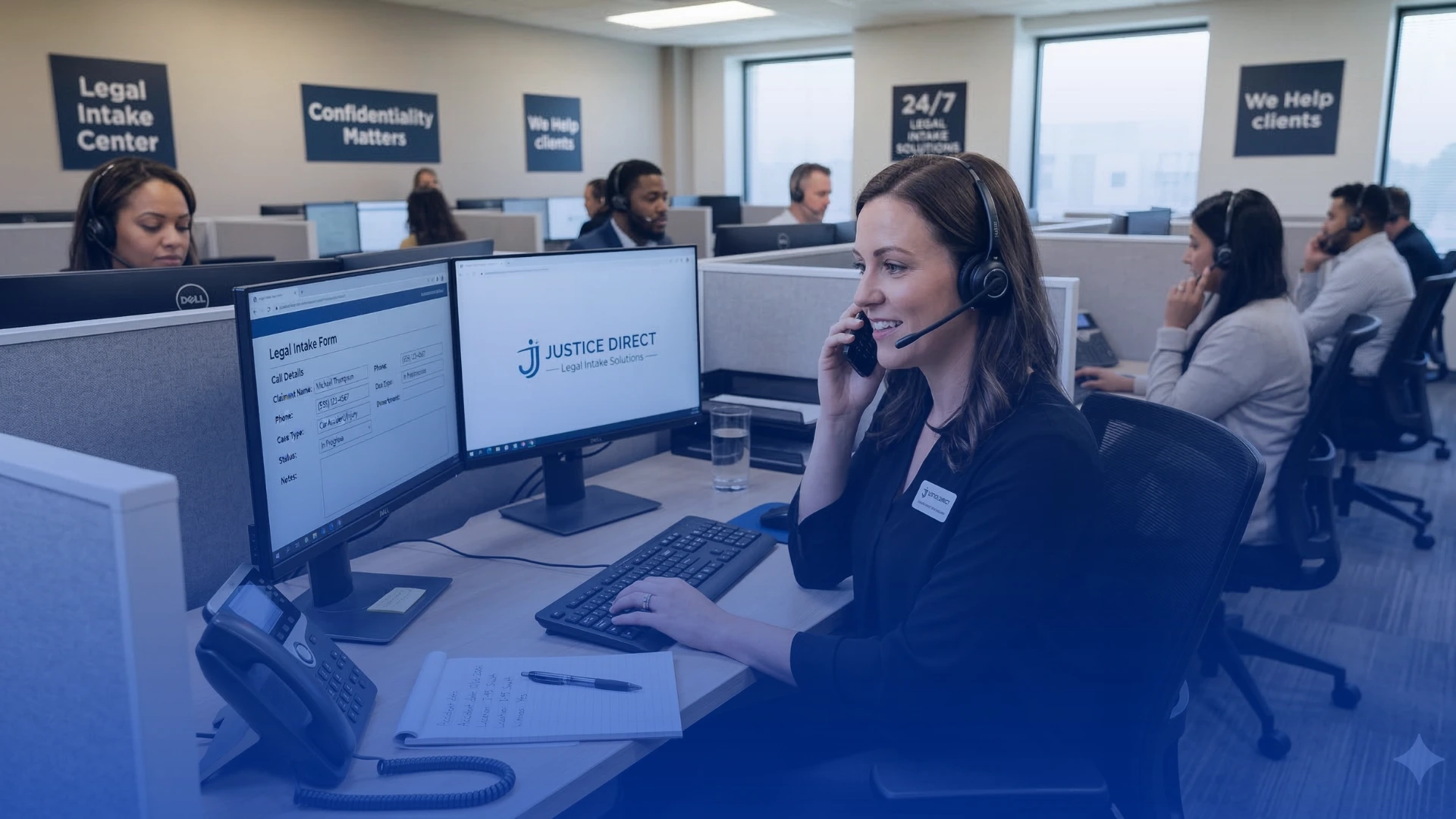
Legal Intaker's virtual legal staff provide a direct solution. Whether your firm needs a virtual paralegal to manage case documentation and filings, a remote legal intake specialist to handle incoming client consultations, or a virtual legal assistant to keep daily operations moving, Legal Intaker provides trained, vetted remote professionals across practice areas including personal injury, immigration, family law, and workers' compensation.
This isn't a workaround. It's a deliberate staffing strategy built for law firms that think ahead and one that lets your credentialing staff focus on passing the Baby Bar while your firm's client service never misses a beat.
The Baby Bar Is a Gate Here's How to Walk Through It
The FYLSX is a rigorous, high-stakes checkpoint built into California's unique alternative legal education system. It filters candidates with genuine legal knowledge and command of general legal principles from those who aren't ready to continue. For students taking this exam, that is the point.
But passing the Baby Bar is achievable with structured preparation, consistent essay practice, and disciplined legal studies. Thousands of California law students on alternative paths have cleared this significant milestone and gone on to become licensed attorneys who practice law in California.
For law firms watching colleagues navigate the long road through a law office study program or attending law school on a non-traditional path: your operations cannot afford to stall during someone else's exam prep.
Legal Intaker specializes in virtual legal staffing built for exactly this kind of firm. Our remote paralegals, virtual legal assistants, and intake specialists close the gap so your team can focus on legal studies and this challenging exam without your practice falling behind.
Schedule a free consultation with Legal Intaker today learn how virtual legal staff can keep your firm operating at full capacity, no matter where your team is in their legal education journey.

FAQs About Baby Bar Exam
What happens if you fail the Baby Bar three times?
If first year law students fail the FYLSX three times, they forfeit all academic credit for their year of law study under California Business and Professions Code § 6060(h). They cannot continue receiving credit toward California bar admission on that educational path. Some candidates choose to enroll in accredited law schools to earn a proper law degree, effectively restarting their legal education on a different track. The three-attempt rule is the most consequential structural feature of this challenging exam for students in unaccredited law or a law office study program.
Is the Baby Bar harder than the California bar examination?
By pass rate, yes. The law students examination FYLSX consistently passes only 20–26% of test takers; the California bar examination passes roughly 37–45%. The difficulty of the Baby Bar stems from its depth-per-subject demands, limited legal studies prep resources, and the profile of its candidates — many of whom are self-directed students at unaccredited schools without formal academic support. The general bar exam, while broader in scope, benefits from a more institutionally supported candidate pool.
Can you take the Baby Bar Exam outside of California?
No. The FYLSX is administered only in California and is a California-specific law requirement. It is not recognized or required in any other U.S. jurisdiction. If you are pursuing a law degree and bar admission in another state, the Baby Bar has no relevance to your path — unless you also intend to practice law in California at some point.
Does Kim Kardashian's experience reflect what most candidates go through?
More accurately than most people assume. Kim Kardashian's journey — four attempts, dedicated tutoring support, and a final-attempt passage under real consequences — mirrors the reality that many California law students on the non-traditional track face. The three-attempt cap meant her path through this challenging exam carried genuine risk. Her experience accurately illustrates both the difficulty of passing the Baby Bar and the legitimacy of alternative paths to legal studies and bar admission in California.




.png)
.png)










.webp)














.webp)








.webp)