Key Takeaways
- Only 4 U.S. states — California, Vermont, Virginia, and Washington — allow aspiring lawyers to sit for the bar exam without attending an ABA-accredited law school through formal legal apprenticeship programs.
- The Baby Bar exam in California carries a historical first-time pass rate below 25%, making this route statistically harder than most people expect going in.
- Unauthorized practice of law is a criminal offense in all 50 states — and law firms are not automatically shielded from liability just because they supervise the work.
- Non-attorney roles like legal intake specialist, paralegal, and compliance officer offer meaningful, well-compensated careers inside law firms — no bar admission required.
Let's Address This Directly
If you run a law firm or manage a legal team, you've probably heard this question more than once — from a paralegal who's been carrying files for years, a sharp legal assistant who knows your practice area cold, or a candidate with an unconventional background you're not sure how to evaluate.
It's a fair question, and the answer has real implications — not just for the person asking it, but for how you structure your team and manage your firm's liability exposure.
Here's what you actually need to know.
What "Practicing Law" Legally Means And Why Your Firm Needs to Care
Before getting into alternative paths, it's worth being precise about what the law prohibits, because unauthorized practice of law is a liability category that many law firms consistently underestimate.
Under state statutes and ABA Model Rules adopted across all 50 jurisdictions, practicing law includes:
- Giving legal advice about someone's specific legal situation
- Drafting legal documents for compensation
- Representing clients in any legal proceeding
- Holding yourself out as a licensed attorney
Here's the part most directly relevant to your firm: supervising non-attorney staff does not automatically protect you from UPL exposure. Courts have found unauthorized practice in situations where firms allowed unlicensed staff to independently advise clients, finalize documents without attorney review, or communicate legal strategy without direct oversight from a licensed attorney.
The line between legal support and legal practice isn't always obvious. The consequences of crossing it are.
Can You Become a Lawyer Without Going to Law School?
In most of the country, no. Without attending an accredited law school, you cannot sit for the bar exam or legally represent clients. In only a few states does a legitimate, regulated alternative exist.
As of 2025, only four states permit bar exam eligibility without a law degree through structured legal apprenticeship programs:
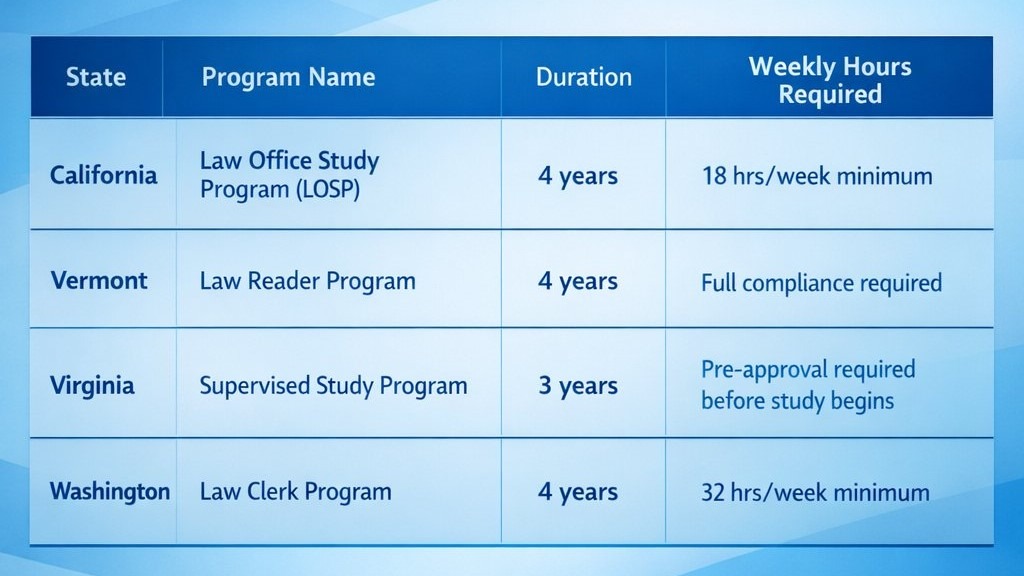
Every program follows the same basic structure: the candidate studies under a supervising attorney inside a functioning legal office, follows a prescribed curriculum covering core subjects constitutional law, criminal justice, family law, corporate law, civil procedure — and submits bi-annual progress reports to the state bar throughout. At the end, they sit for the same bar exam as everyone else. No shortcuts, no separate standard.
Worth noting for anyone advising staff: New York eliminated its law reader program in 2020. Always verify current requirements directly with each state's Board of Bar Examiners. This is an area where outdated information is everywhere online.
What the Law Office Study Program Actually Demands
For California firms especially, the Law Office Study Program comes up regularly, either because a staff member wants to pursue it while working, or because you're evaluating a candidate already enrolled.
What the legal apprentice is responsible for:
- A minimum of 18 structured hours per week inside an active law office — not self-directed reading at home
- Passing the First-Year Law Students' Examination (FYLSX), commonly called the Baby Bar, after the first year of study. This is not optional and not easy — more on the numbers below
- Failing the Baby Bar three times ends program eligibility entirely
- Four full years of documented work before applying to sit for the full California bar
- Monthly study logs with detailed subject documentation and supervising attorney sign-off each month
What the supervising attorney is responsible for:
- Active California bar membership in good standing
- Formal supervisory responsibility documented with the State Bar — this is a legal commitment, not informal mentoring
- Consistent direct supervision on substantive work, not periodic check-ins
- Bi-annual progress reports filed with the California State Bar
If you're a solo practitioner or managing partner considering sponsoring someone through this program, that supervisory obligation is real and ongoing. It's closer to formally mentoring a junior associate than letting someone shadow you.
The Pass Rate Data Every Legal Professional Should See
This is where the legal apprenticeship route shows its actual limitations — and why many legal apprentices find it harder than anticipated.
California Bar Exam pass rates by candidate background (2023, California State Bar):
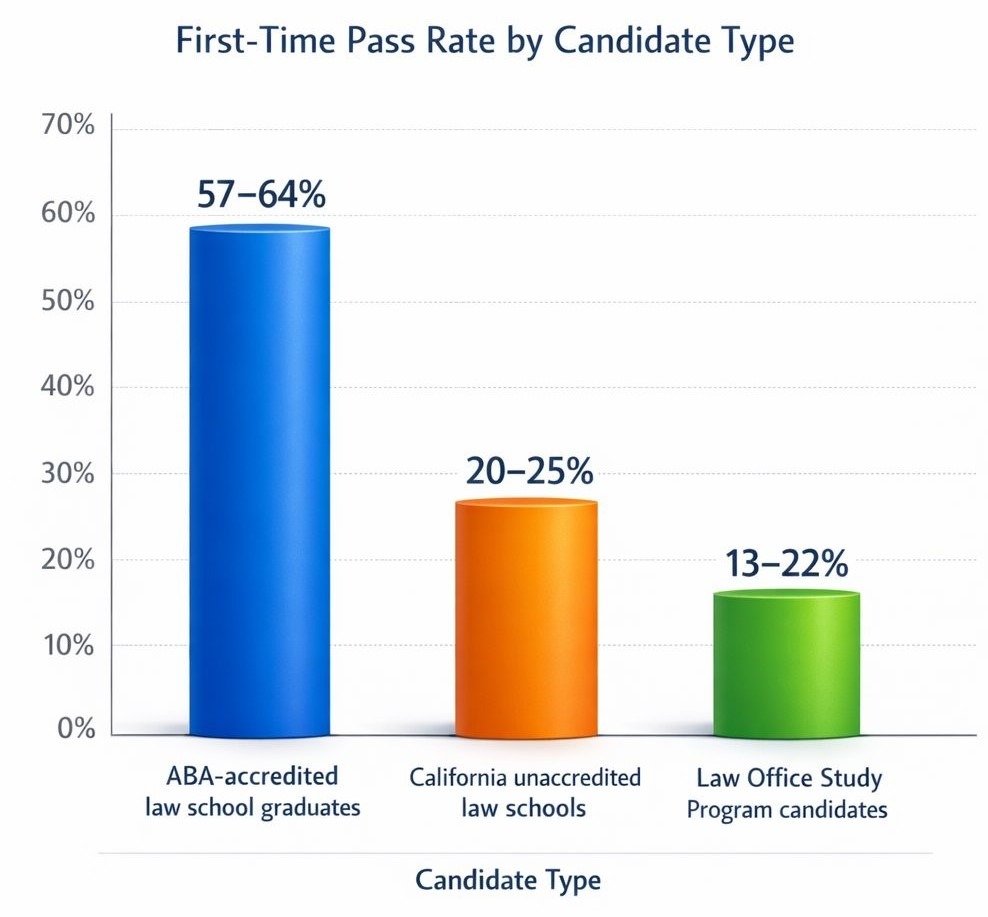
Baby Bar (FYLSX) decade-average first-time pass rate: below 25%
According to the National Conference of Bar Examiners (NCBE), the national first-time bar passage rate for ABA graduates was approximately 57% in 2023. LOSP candidates pass at roughly one-third that rate.
The apprenticeship path is not a faster or easier way to become a licensed attorney. In most measurable ways, it's harder — with less structured legal education, no peer learning environment, no career placement resources, and bar passage rates that reflect all of those gaps.
For law firms thinking about sponsoring staff through this process, or evaluating a candidate who pursued it: these numbers are a meaningful part of that conversation.
Lawyers Who Never Attended Law School And What That History Actually Tells Us
It's worth acknowledging that formal legal education as a licensing requirement is a relatively modern development. Several figures central to American legal history never attended law school:
- Abraham Lincoln — Admitted to the Illinois bar in 1836 after self-directed study; widely regarded as one of the finest trial lawyers of his era before his political career
- John Marshall — Fourth Chief Justice of the United States; received approximately six weeks of formal legal instruction in his entire life
- Clarence Darrow — Attended law school for only one year before completing his legal education in a practicing attorney's office
These examples are historically significant. They are not a current template. Mandatory bar exams, state licensing requirements, and ABA accreditation standards didn't exist in Lincoln's era. The four-state apprenticeship pathway today is a narrow, tightly regulated carve-out — not a reflection of that older flexibility.
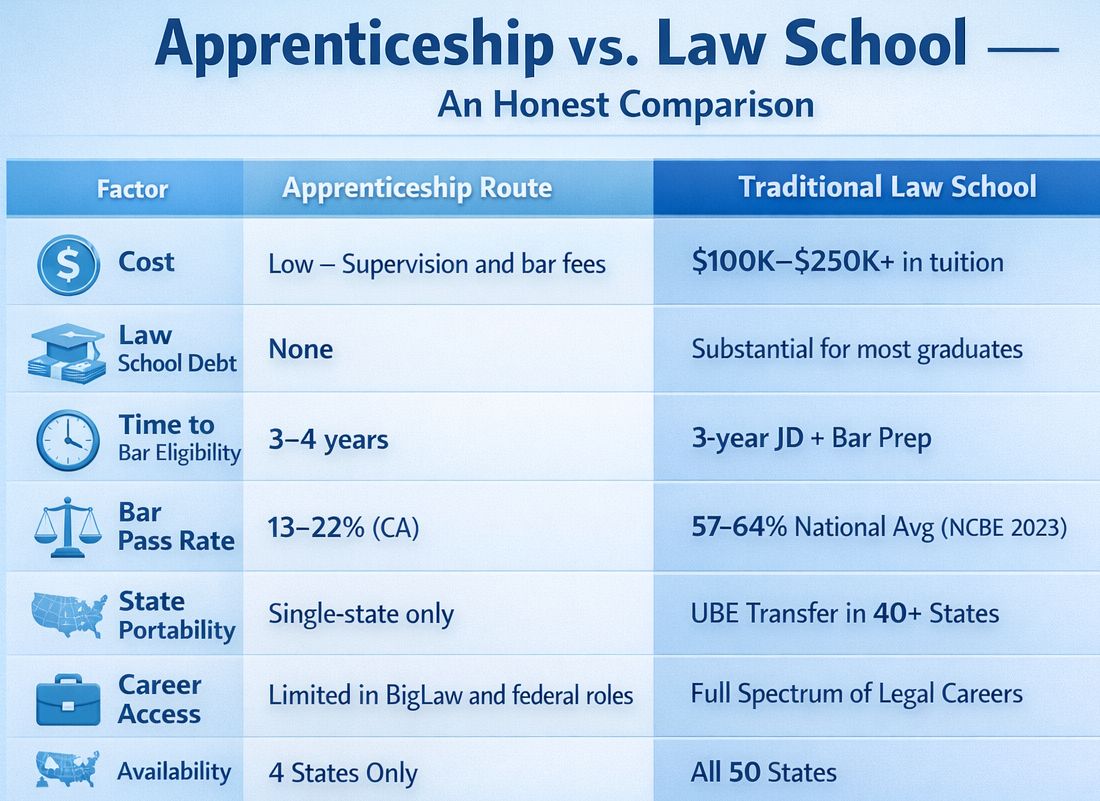
The apprenticeship route makes sense for a specific candidate: disciplined, already embedded in a law office environment, located in one of the four qualifying states, and clear-eyed about the bar passage odds. It's not a shortcut. It's a legitimate but demanding alternative with real, documented tradeoffs.
Legal Careers That Don't Require a Bar License And Why Law Firms Depend on Them
Here's where the conversation becomes most practically useful. The majority of people who want meaningful careers in law don't need to become licensed attorneys. They need strong legal knowledge, professional communication skills, and practice-area fluency in a role that creates direct value for a firm.
Many of the most impactful people inside law firms don't carry a JD. They carry expertise in exactly what the firm needs done.
Paralegal / Legal Assistant
- Median annual salary: $60,370 (BLS, May 2023); projected job growth of 4% through 2033
- Core responsibilities: legal research, drafting documents under attorney supervision, case file management, client coordination
- Common certifications: NALA Certified Paralegal (CP), NFPA PACE
- Manages inbound client inquiries, qualifies case prospects, gathers preliminary facts, and schedules attorney consultations
- In plaintiff-side practices, a single mishandled intake call can cost the firm a six-figure contingency case
- No bar license required — but legal terminology fluency, empathy, and process consistency are non-negotiable
- High demand across personal injury, family law, immigration, and mass tort practices
Compliance Officer / Analyst
- Regulatory adherence role across corporate law, healthcare, finance, and technology sectors
- Certifications like CCEP and CRCM often sufficient for entry; compensation ranges $70,000–$120,000+ for experienced professionals (LinkedIn Salary, 2024)
Legal Secretary
- Manages filings, attorney calendars, correspondence, and court deadlines
- Deep working knowledge of legal terminology and procedure is essential
- Often the operational backbone of solo and small firm practices
Legal Operations Manager
- Manages firm technology, vendor relationships, and workflow systems
- Demand has grown sharply as law firms invest in operational infrastructure post-2020
- No bar admission required; high value in mid-size practices scaling without adding headcount
How This Applies to Building Your Legal Team
Law firms that build strong support infrastructure around properly trained, well-supervised non-attorney professionals consistently outperform those that don't — on intake conversion, case throughput, and overhead efficiency.
The key word is properly. That means written role definitions that distinguish legal support from legal practice, formal onboarding training, direct supervision on all substantive work, and regular performance reviews that address legal skills development alongside professional conduct.
The legal professionals who create the most leverage inside your firm aren't always the ones with JDs. They're the ones with the right training, clear expectations, and a supervising attorney who takes the oversight role seriously.
Where Legal Intaker Fits Into This
Intake is the front door of every law firm. For plaintiff-side practices handling personal injury, family law, immigration, and mass tort cases, how well intake operates determines case acquisition volume more than almost any other variable. A missed call is a missed case. A poorly qualified intake wastes an attorney consultation and can create compliance exposure.
Legal Intaker's virtual legal intake specialists are trained specifically for the intake function in legal offices: screening inbound calls, qualifying prospects against attorney-defined case criteria, gathering preliminary facts, and scheduling consultations — all within proper legal support boundaries, all without requiring bar admission.
For law firms looking to scale intake without adding fixed overhead, Legal Intaker provides pre-vetted specialists with practice-area-specific training, supervision frameworks that keep intake operations within UPL-safe boundaries, and consistent intake quality that reflects your firm's standards at every client touchpoint.
For legal professionals who want to build a substantive career in law — without law school debt and without waiting years to find out whether they passed the bar — virtual legal intake is a direct, professionally structured path into the legal industry.
[Explore virtual legal staffing solutions for your firm →]
The Bottom Line
Can you practice law without a degree? In 46 states, no — and attempting to do so is a criminal offense. In four states, yes — through a multi-year apprenticeship with demanding requirements and significantly lower bar passage rates than the traditional law school route.
But the more useful question for most legal professionals and law firm leaders is: what kind of legal career actually fits your circumstances, your state, and what your firm needs?
For many people, the answer isn't a law degree. It's the right role, the right training, and a firm that values what strong non-attorney professionals bring to the table.
The Degree Isn't Always the Door — Know Which One Opens for You
The legal profession has always had more than one way in. But in 2025, most of those doors require a law degree, a bar license, and years of formal legal education to open. The four-state apprenticeship pathway is real and legitimate — but the data is honest: lower bar passage rates, single-state licensing, and limited access to certain legal career tracks are tradeoffs that come with the territory. Go in with clear eyes or don't go in at all.
What the legal world doesn't talk about enough is the other door — the one that doesn't require you to choose between a law degree and a meaningful career in law. Paralegals who know a case file better than the associate. Legal intake specialists who can qualify a prospect, build rapport, and lock in a retained client in a single call. These aren't supporting roles. In many firms, they are the operational core — and the firms that invest in them properly consistently outperform those that don't.
For law firms building that kind of team, or for legal professionals looking for a substantive path into the legal world without the six-figure debt, LegalIntaker is where that conversation starts. Our virtual legal intake specialists are trained, pre-vetted, and ready to become the front line of your firm's client acquisition — from day one.
[Find Your Virtual Legal Intake Specialist Today →]

Frequently Asked Questions
Can someone become a licensed lawyer in the U.S. without attending law school? O
nly in four states — California, Vermont, Virginia, and Washington — through formal legal apprenticeship programs requiring years of supervised study under a licensed attorney, passage of the Baby Bar (California), and ultimately passing the full state bar exam. In all other 46 states, an ABA-accredited law degree is required to sit for the bar.
What is the Baby Bar exam and why does it matter?
The Baby Bar — formally the First-Year Law Students' Examination (FYLSX) — is required for California Law Office Study Program participants after their first year. It covers contracts, criminal law, and torts, and carries a historical first-time pass rate below 25%. Failing it three times ends program eligibility, making it a significant early barrier in the California apprenticeship path.
How does unauthorized practice of law affect law firms directly?
Firms face UPL liability when unlicensed staff independently advise clients, finalize legal documents without attorney review, or handle proceedings without direct supervision from a licensed attorney. Beyond criminal exposure for the individual, firms face malpractice claims, bar discipline for the supervising attorney, fee disgorgement, and civil liability to harmed clients.
What legal careers are available without a law degree?
Legal professionals without bar admission can build strong careers as legal intake specialists, paralegals, compliance officers, legal secretaries, and legal operations managers — with compensation ranging from $60,000 to $120,000+ and clear advancement paths inside law firms.






.png)
.png)













.webp)















.webp)

.webp)








.webp)