Key Takeaways
- The traditional route takes seven years minimum: four years of undergraduate study plus three years of attending law school, then bar prep before you're licensed to practice law.
- Roughly 1 in 5 lawyers don't pass the bar on their first attempt, meaning the realistic career trajectory for many attorneys stretches to 8–9 years before full licensure.
- Alternative paths exist, dual degree programs, part-time programs, and accelerated JD programs, but none of them make the legal journey short.
- The JD degree is just the credential, what prepares lawyers to actually serve clients is built in practice, which is why law firms need the right support structure from day one.
Short answer: seven years, minimum and that's only if everything goes according to plan.
If you've already made the journey, you know how much that number undersells the reality. For prospective law students, aspiring lawyers weighing their options, or law firms trying to understand the talent pipeline feeding their next hire, here's the full picture, without the spin.
The process of becoming a lawyer is often described as a confusing process, and honestly, that's fair. Several factors affect the timeline, and most guides gloss over the ones that actually cause unexpected delays.
The Full Lawyer Timeline: No Sugarcoating
You already know how long this road is. For everyone else in the room, here's what the legal education pipeline actually looks like:
That table is clean. Reality is messier. Let's go stage by stage.
Undergraduate Degree: The Four-Year Foundation
The legal journey starts long before anyone sets foot inside an accredited law school. Most law schools require applicants to hold a bachelor's degree, four years of undergraduate study before the law school admissions process even begins.
There's no required pre-law major, which surprises a lot of prospective law students. Law school admissions committees care far more about your GPA and critical reasoning skills than your declared field. That said, patterns exist. Political science, English, philosophy, and history are consistently the most common majors among admitted law students, according to LSAC data, and it makes sense. These fields build the analytical thinking, legal writing foundations, and oral communication skills that law school curriculum demands from day one.
What matters most heading into law school admissions:
- Cumulative GPA — Median GPA at top-14 law schools ranges from 3.7 to 3.97 (LSAC, 2023)
- Extracurricular activities — Paralegal work, legal clinics volunteering, debate, or criminal justice internships carry real weight
- Writing and reasoning ability — Tested directly on the standardized test you'll take next; rewarded in every year of law school after
One shortcut worth knowing: some universities offer dual degree programs or accelerated 3+3 tracks that let qualifying students compress undergraduate study and roll directly into a JD program, trimming the combined timeline to six years for the right candidate.
The Law School Admissions Test (LSAT): Your Gateway (3–12 Months)
Before you go to law school, you'll need a competitive score on the Law School Admissions Test, the LSAT. This standardized test is the single greatest gating factor in the law school admissions process, and the single biggest source of timeline delays for aspiring lawyers who underestimate it.
Key numbers every prospective law student should know:
- LSAT score range: 120–180; the national median is 152
- Top law school medians: Harvard, Columbia, and Yale all sit around 174 (LSAC, 2023–24 cycle)
- Average prep time: Most competitive applicants study 150–300 hours over 3–6 months using practice exams and structured coursework
- Students who prep for 6+ months score 6–7 points higher on average than those who study for under a month — LSAC's own research confirms this
- The school admissions test LSAT can be taken up to 5 times total across testing dates, with a 3-per-year cap
Every retake adds months to the timeline. The lawyers at your firm who got into strong programs on the first attempt treated LSAT prep like a second job, and that same discipline tends to show up in how they practice law later.
Attending Law School: Three Years of Controlled Chaos
A Juris Doctor from an ABA-accredited school specifically, a school accredited by the American Bar Association, is the standard requirement to sit for the bar exam in 49 states. The American Bar Association currently accredits 197 law schools in the U.S., with total law students enrollment around 115,000 (ABA, 2023).
Full-time JD programs take three years. Part-time programs, built for working legal professionals, run four. Here's how a typical year of law school breaks down across the full JD degree:
1L (First Year) Core doctrine: Torts, Contracts, Civil Procedure, Property law, Constitutional Law, Criminal Law, and Criminal Justice fundamentals. This is where legal education either grabs people or breaks them.
2L (Second Year) Evidence, Employment law, Intellectual Property introductions, electives, law review, moot court, and legal clinics. Many law students begin their specialization here, whether that's entertainment law, IP, or litigation.
3L (Final Year) Advanced coursework, externships, bar exam prep electives, and practice exams. Most law students already have one eye on the job market and the other on bar preparation by this point.
What law school curriculum actually builds: Beyond doctrine, strong JD programs develop essential legal skills, analytical thinking, legal writing under pressure, oral communication in mock hearings, and time management across competing deadlines. These are what aspiring lawyers carry into practice.
Cost reality check: Average private law school tuition is $54,823/year (ABA, 2023). Public in-state law schools average $27,591/year. Total financial investment , tuition, fees, living expenses, regularly exceeds $200,000 for most law students.
For law firms thinking about the attorneys you hire: these candidates arrive with significant debt loads and steep initial learning curves. The financial investment they've made is enormous. The last thing they need is to manage intake phones on top of learning to practice law.
Hidden Steps Most Guides Skip
Most articles on this topic stop at bar prep. Here are the steps that actually cause unexpected delays and extend the legal journey for many lawyers.
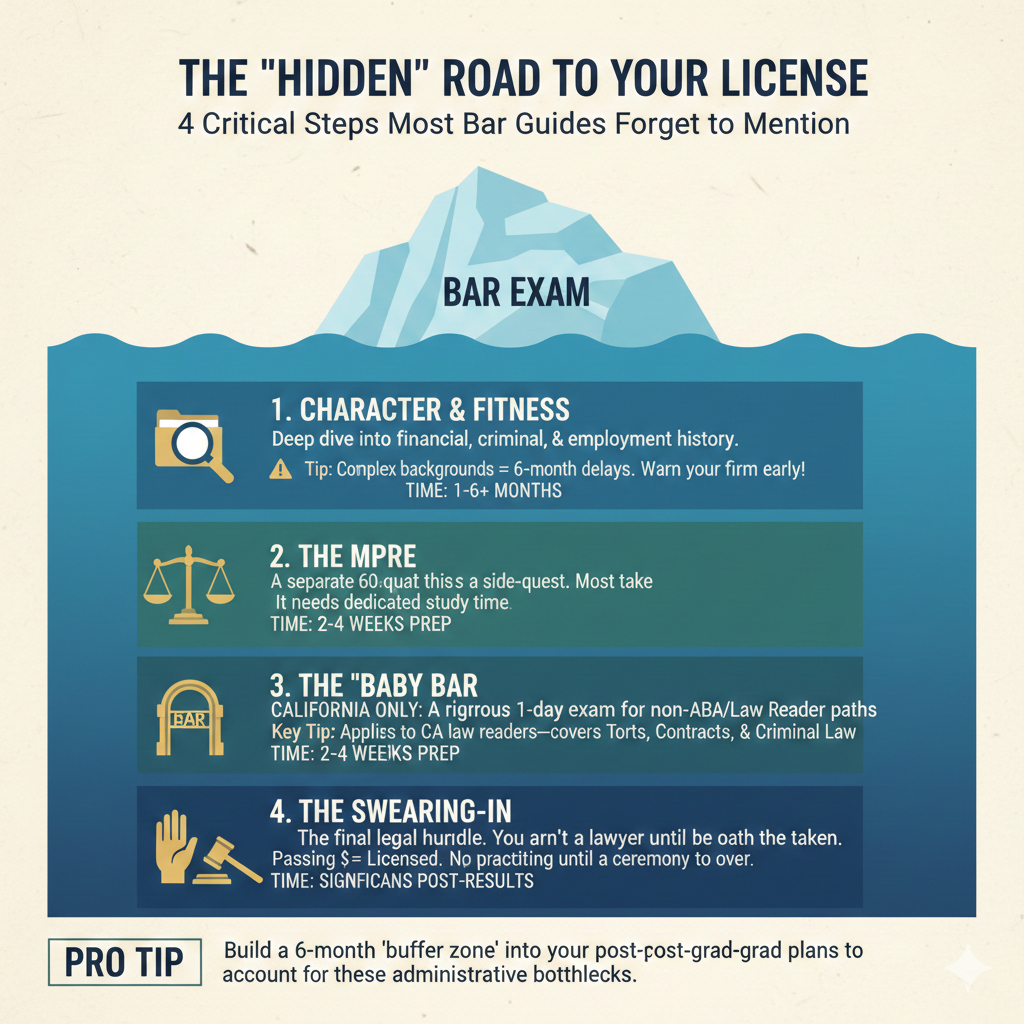
Character and Fitness Review
Every bar applicant submits detailed background documentation, employment history, financial records, prior criminal or disciplinary history. Simple applications clear in 1–2 months. Complex ones with prior issues can run 4–6 months or longer. Law firms planning start dates for new associates should build this window into their timeline.
Multistate Professional Responsibility Examination (MPRE)
Most states require this separate 60-question legal ethics exam before or alongside bar admission.
It's a distinct standardized test from the bar examination itself and demands its own dedicated prep, typically 2–4 weeks. Many law students sit for the MPRE during their second year of law school.
Baby Bar (First-Year Law Students' Examination)
This applies specifically to California law students in non-ABA programs or those on the law reader path.
The Baby Bar is a one-day examination covering Contracts, Torts, and Criminal Law. Many students find it an unexpected hurdle that adds months to their legal studies timeline.
Swearing-In Ceremony
After passing the bar exam and clearing character review, attorneys are formally admitted during a swearing-in ceremony, typically 4–8 weeks after results are released.
Legal professionals aren't licensed to practice law until that moment, full stop.
Passing the Bar Exam: The Final Test (2–6 Months)
Most JD graduates spend 8–12 weeks in intensive bar exam preparation through programs like Barbri, Themis, or Kaplan, loading up on practice exams and multistate simulations before the testing date.
Bar formats by jurisdiction:
- Uniform Bar Exam (UBE): Adopted by 41 states and D.C. One exam, portable scores across jurisdictions — a major strategic advantage for legal professionals considering multi-state practice
- State Bar Exam (Non-UBE states): California, Louisiana, and a few others use their own bar examination formats; California's is consistently among the most difficult
- Louisiana: Civil law principles apply; requires different preparation than most law schools emphasize
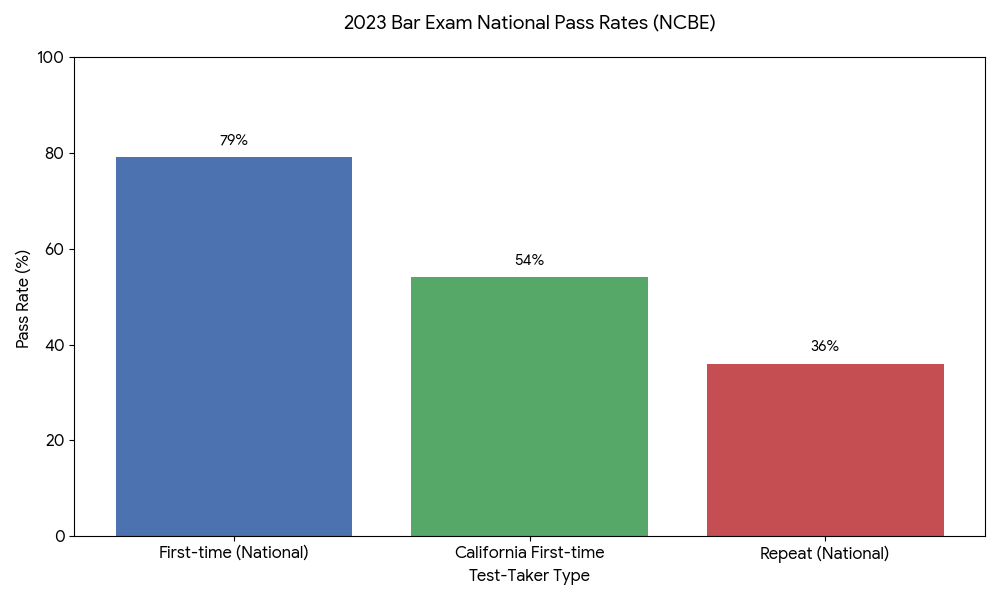
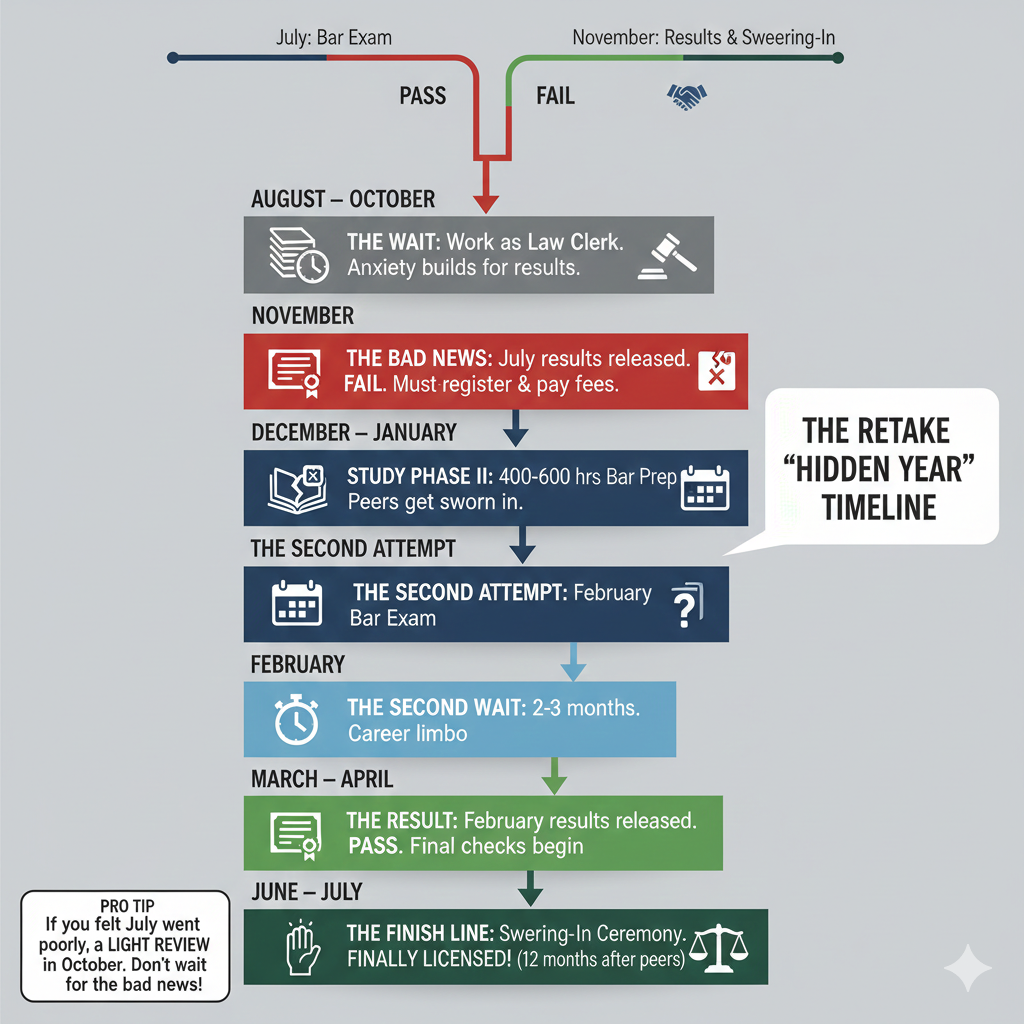
Passing the bar on the first attempt is the goal , but failing the bar is a reality for roughly 1 in 5 law graduates nationally. Each failed attempt adds another 3–6 months to the timeline, plus the financial investment of repeat bar prep courses.
Bar examiners aren't just testing legal knowledge. They're testing whether a candidate has the stamina, structure, and discipline to function under pressure, which is, ultimately, exactly what practicing law requires.
Can You Become a Lawyer Without Going to Law School?
Yes. Almost nobody does it this way — but alternative paths exist.
The Law Reader Path A handful of states — California, Vermont, Virginia, and Washington — allow candidates to substitute supervised law office study for a formal law degree. California's program requires a minimum of four years of supervised study at 18+ hours per week, plus passing the Baby Bar before the full state bar exam.
Reality check:
- Fewer than 60 people per year nationwide become lawyers through this route
- Pass rates for law readers on bar exams are substantially lower than JD graduates
- Most law firms won't recognize or hire through this path
This isn't a shortcut. For most aspiring lawyers, attending an accredited law school and earning a JD degree remains the only practical career trajectory to practice law.
Smart Ways to Accelerate the Legal Journey
For aspiring lawyers, law students, or firms building a hiring pipeline:
- 3+3 accelerated programs — eliminate one full year of undergraduate study for qualifying applicants, cutting the combined timeline to six years
- Invest in the LSAT upfront — every retake is a 3–6 month delay; treat the school admissions test like the most important exam of the first phase of your legal career
- Enroll in bar prep during the final year of law school — starting during 3L demonstrably improves first-attempt pass rates
- Choose UBE states strategically — one score valid across 41 jurisdictions gives legal professionals maximum flexibility in where they ultimately practice law
- Be proactive about character and fitness disclosures — transparency upfront prevents the delays that blindside many lawyers post-bar
Realistic Timeline Scenarios Side by Side
From Bar Card to Billable Hour: Where Law Firms Drop the Ball
After seven to ten years of legal education, significant financial investment, and rigorous skill development, newly licensed attorneys often begin their careers juggling intake calls, client screening, scheduling, and follow-ups on top of practicing law. It is an inefficient model, and most firm owners recognize the cost. When qualified leads go unanswered or prospective clients hire another firm simply because someone else responded faster, the revenue loss is real and entirely preventable.
Most lawyers did not dedicate a decade to legal training to function as intake coordinators. Legal Intaker’s virtual legal intake specialists are trained specifically for law firm environments, managing first-contact intake, initial case screening, consultation scheduling, and structured follow-ups. This allows your attorneys to focus on billable legal work while ensuring your client pipeline remains active and professionally managed.
Whether you are a solo practitioner newly licensed or a growing multi-attorney firm expanding into areas like employment law, intellectual property, or entertainment law, our virtual legal staffing solutions integrate seamlessly into your existing workflow without added overhead or lengthy onboarding. Your attorneys earned their licenses. Make sure your firm is structured to put them to work. Connect with a Legal Intaker specialist today →

FAQs: What People Actually Want to Know
1. How long does it take to become a lawyer after high school?
At minimum, seven years, four years of undergraduate study, three years of attending law school, then bar exam prep and the admissions process. Realistically, most lawyers reach licensure closer to 8 years from high school graduation once you account for the LSAT cycle, bar prep, character review, and swearing-in timeline.
2. Can you become a lawyer in 3 years?
No, not starting from scratch. The JD degree itself is three years of law school, but that comes after a four-year bachelor's degree. Accelerated 3+3 dual programs bring the combined total to six years for qualifying applicants, that's about as fast as the current legal education system allows.
3. Is the bar exam harder than law school?
Law school and the bar exam measure different competencies. Law school develops foundational legal reasoning and analytical skills over several years of structured study. The bar exam, by contrast, is a high-pressure, time-limited assessment that requires broad subject knowledge and strong recall across multiple core areas of law. Its pass rates reflect the rigor and intensity of the licensing process.
4. What is the fastest way to become a lawyer in the United States?
An ABA-accredited 3+3 accelerated program, combined with first-attempt bar passage after intensive prep, puts licensure at approximately 6–6.5 years from the start of undergraduate study. Beyond that, the application process and legal education requirements don't bend much , seven years is the realistic floor for most aspiring lawyers.






.png)
.png)












.webp)















.webp)

.webp)








.webp)