
Key Takeaways
- A personal injury intake form protects a case by capturing time-sensitive facts, deadlines, and liability details from day one.
- The best intake forms collect incident, injury, treatment, insurance, and evidence data in a standardized workflow.
- Strong intake processes reduce missing documentation, improve case screening accuracy, and increase settlement readiness.
- Using trained legal intake specialists improves speed, consistency, and client experience, especially for high-volume PI firms.
A personal injury case is only as strong as the information collected at the beginning. That first call, when a potential client is in pain, stressed, and unsure what to do, is when critical details can be lost forever. That’s why the personal injury intake form matters.
A properly built intake form does more than gather contact information. It captures the facts that determine liability, damages, insurance coverage, and case value. It also helps your firm identify red flags early (like missed deadlines or disputed causation), ensuring attorney spend time only on claims that meet your criteria.
In high-volume personal injury practices, intake is not “admin work.” It’s a risk management system, a case evaluation tool, and a client experience driver.
And the numbers show how widespread injury claims can be: the National Safety Council reports that 62 million people sought medical attention for an injury in 2023—about 1 in 5 people. This makes personal injury intake one of the most consistently active pipelines in law.
What Is a Personal Injury Intake Form?
A personal injury intake form is a structured document (digital or paper) used by law firms to collect information from potential or current clients about:
- The accident or incident
- Injuries and medical treatment
- At-fault parties and witnesses
- Insurance coverage
- Employment and wage loss
- Evidence and documentation
- Prior injuries or related conditions
Its primary purpose is to help the firm:
- Determine eligibility (does the claim meet criteria?)
- Identify deadlines (statute of limitations, notice requirements)
- Preserve evidence early
- Create a case roadmap from the first interaction
For personal injury firms, this intake form becomes part of the “case spine”, the foundation your legal team builds on for demand packages, negotiations, or litigation.
📚 Also Read: 5 Signs You Need a Law Firm Intake Specialist
Why Personal Injury Intake Forms Matter
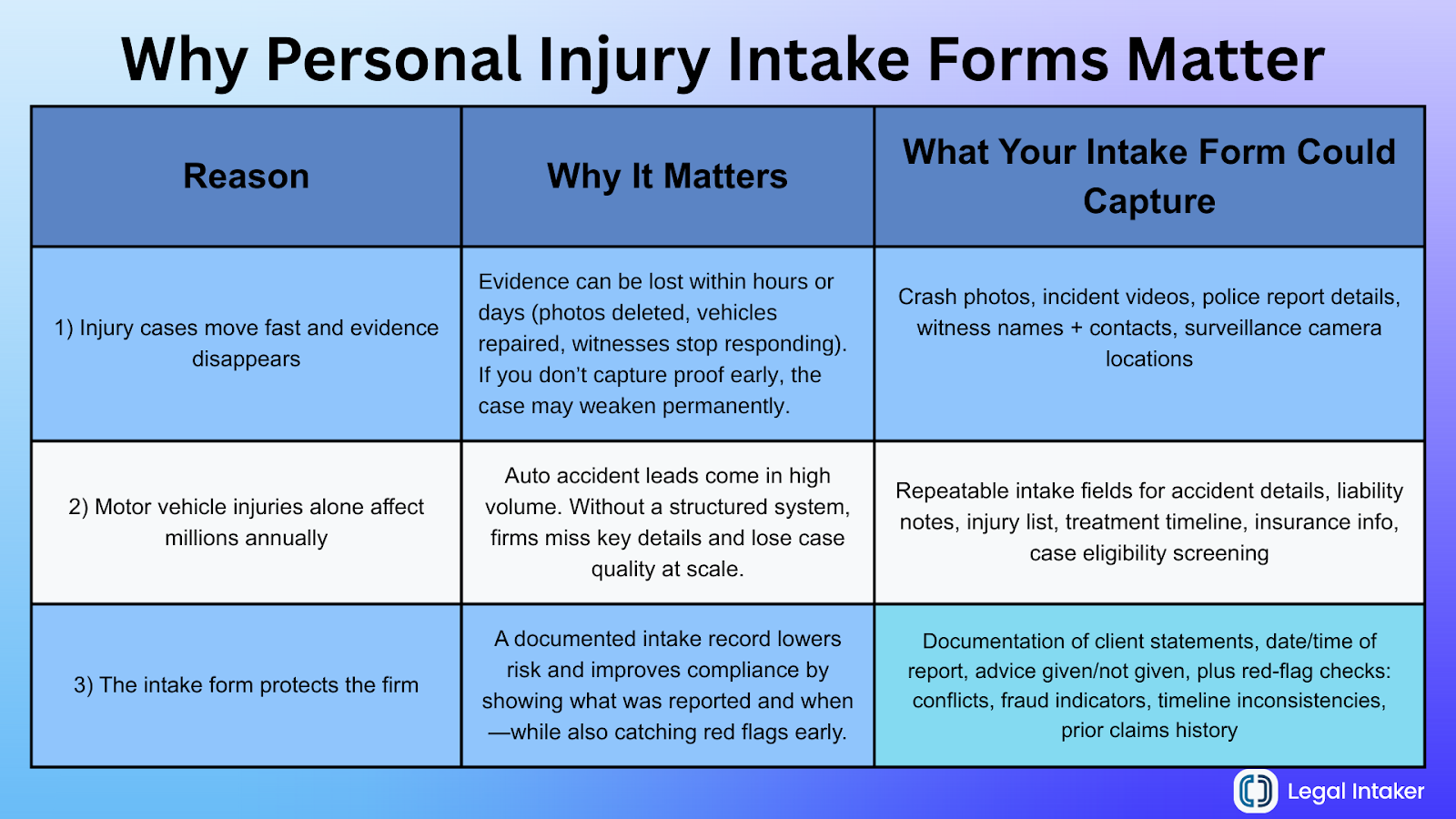
1) Injury cases move fast—and evidence disappears
Photos get deleted. Vehicles get repaired. Witnesses stop responding. A good intake form asks for evidence immediately, including:
- crash photos
- incident videos
- police report info
- witness contacts
- surveillance camera locations
If you don’t capture these within the first 24–72 hours, you may never get them again.
2) Motor vehicle injuries alone affect millions annually
If your firm handles auto accidents, the volume alone requires a system. NHTSA estimates 2.44 million people were injured in motor vehicle traffic crashes in 2023.
That means intake must be repeatable, consistent, and scalable—or your team will miss key details.
3) The intake form protects the firm
A complete intake record reduces malpractice exposure by documenting:
- what the client reported
- when they reported it
- what your firm advised or did not advise
It also helps catch:
- conflicts of interest
- potential fraud flags
- inconsistencies in medical timeline
- prior claims history
What Should Be Included in a Personal Injury Intake Form?
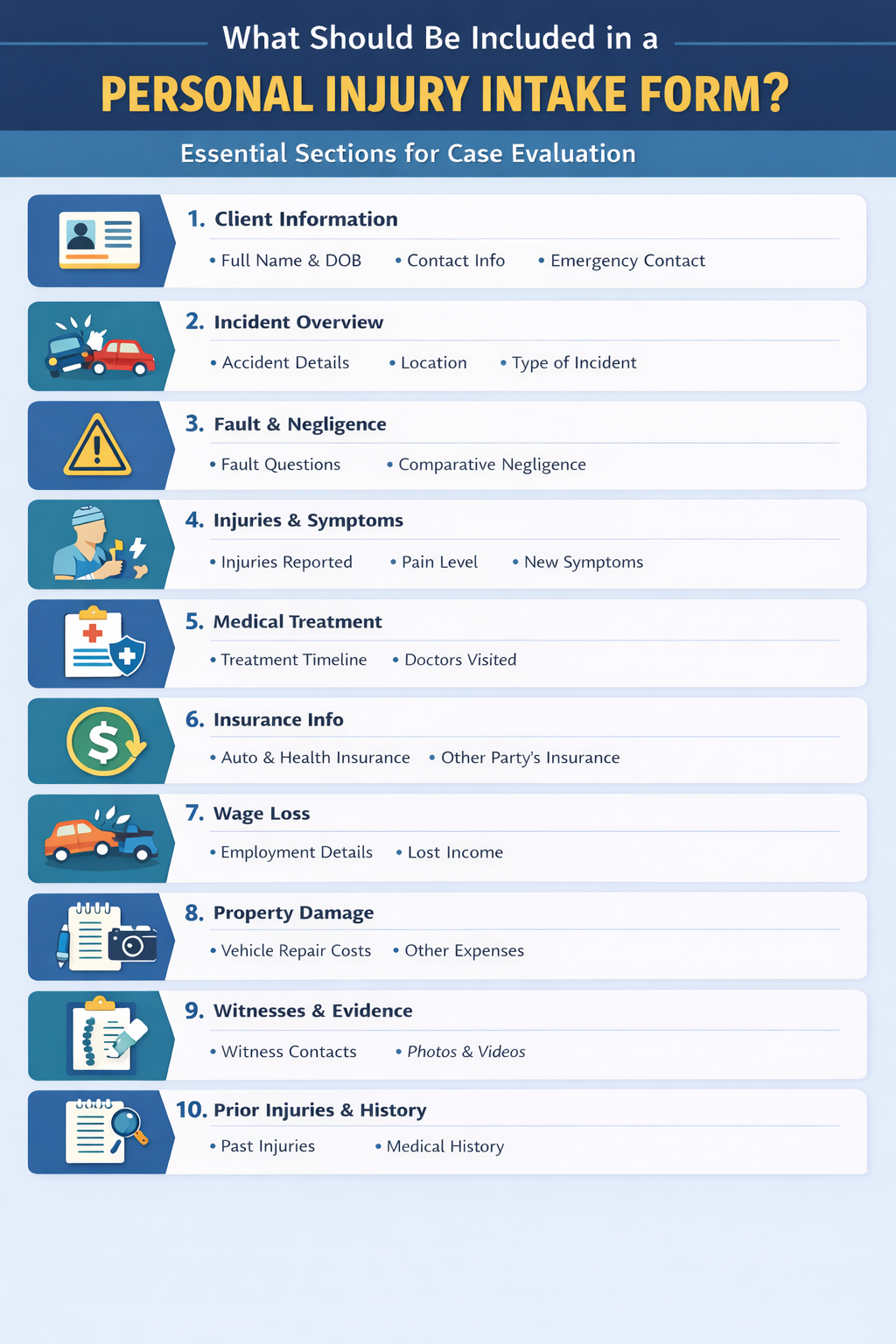
Below is a PI-intake checklist designed for high-performing firms and optimized for case evaluation accuracy.
Section 1: Client Information (Identity + Contact)
Collect:
- Full legal name + preferred name
- DOB (important for med records + HIPAA authorizations)
- Phone, email, mailing address
- Preferred communication method
- Emergency contact
Best practice: Confirm best number + permission to text.
Section 2: Incident Overview (The Core Liability Data)
This is the part of intake that determines whether the case is viable.
Include:
- Date and time of incident
- Exact location (address/intersection)
- Type of incident:
- motor vehicle accident
- slip and fall
- dog bite
- workplace injury
- medical negligence
- assault/intentional tort
- Narrative (client’s words)
- Weather/lighting conditions (if relevant)
- Parties involved + relationship (driver, business owner, employer, etc.)
Section 3: Fault + Comparative Negligence Questions
Ask:
- Who caused the accident?
- Why does client believe that person/entity is at fault?
- Was client cited/ticketed?
- Was alcohol/drugs involved?
- Were there traffic violations?
- Was the client using a seatbelt/helmet?
- Did the client sign any waiver?
Why it matters: Comparative negligence can reduce damages in many states and impacts settlement leverage early.
Section 4: Injuries, Symptoms, and Pain (Initial + Ongoing)
Capture both medical and functional impact.
Include:
- Injuries reported (head, neck, back, shoulder, knee, etc.)
- Visible injuries (bruises, cuts, swelling)
- Pain scale rating (0–10)
- Mobility limitations
- New symptoms since incident:
- headaches
- numbness/tingling
- dizziness
- cognitive issues
- sleep disruption
Section 5: Medical Treatment Timeline (Critical for Causation)
This is where weak cases fail. Your intake form must force clarity.
Ask:
- Did you go to the ER/urgent care the same day?
- Date of first medical visit after incident
- Diagnoses received (if any)
- Providers visited:
- hospital/ER
- PCP
- orthopedist
- chiropractor
- PT
- imaging center (X-ray, MRI, CT)
- Recommended future treatment
- Medications prescribed
- Gaps in treatment (and why)
Section 6: Insurance Information (Health + Auto + Liability)
Collect full details early so the attorney can evaluate coverage.
Include:
- Auto insurance (client):
- carrier
- policy number
- PIP/MedPay coverage (if applicable)
- Other driver’s insurance (if known)
- Health insurance:
- carrier
- member ID
- Uninsured/underinsured motorist coverage (UM/UIM)
- Claim numbers already opened?
Section 7: Employment and Wage Loss (Economic Damages)
Ask:
- Employer name and job title
- Pay type (hourly/salary/self-employed)
- Average weekly income
- Days missed from work
- Reduced hours or modified duties
- Loss of promotion/bonuses
Section 8: Property Damage and Out-of-Pocket Costs
Include:
- Vehicle repair estimates
- Total loss info
- Rental car expenses
- Towing/storage
- Medical supplies
- Transportation costs to appointments
Section 9: Witnesses and Evidence
Collect:
- Witness names + numbers + emails
- Police report number and agency
- Video sources:
- dashcam
- doorbell cameras
- business surveillance
- Photos uploaded
- Social media posts made? (important risk factor)
Section 10: Prior Injuries / Medical History
This must be specific.
Ask:
- Prior injuries to the same body area?
- Prior accidents (auto/workplace)?
- Existing diagnoses (back issues, migraines, arthritis)?
- Prior claims or lawsuits?
Reason: Defense counsel will use prior injuries to argue causation.
📚 Also Read: When to Hire a Legal Intake Specialist for Your Law Firm

Best Format for a Personal Injury Intake Form
A modern intake form should not be a 5-page PDF nobody completes.
Best performing formats:
- Online intake form embedded on website
- Secure client portal form
- CRM-triggered intake link after call/text
- Phone intake script + structured fields inside CMS/CRM
Why digital intake wins:
- faster completion
- fewer typos (auto-formatting)
- easier document uploads
- better data for analytics and case scoring
Common Mistakes That Weaken Personal Injury Cases During Intake
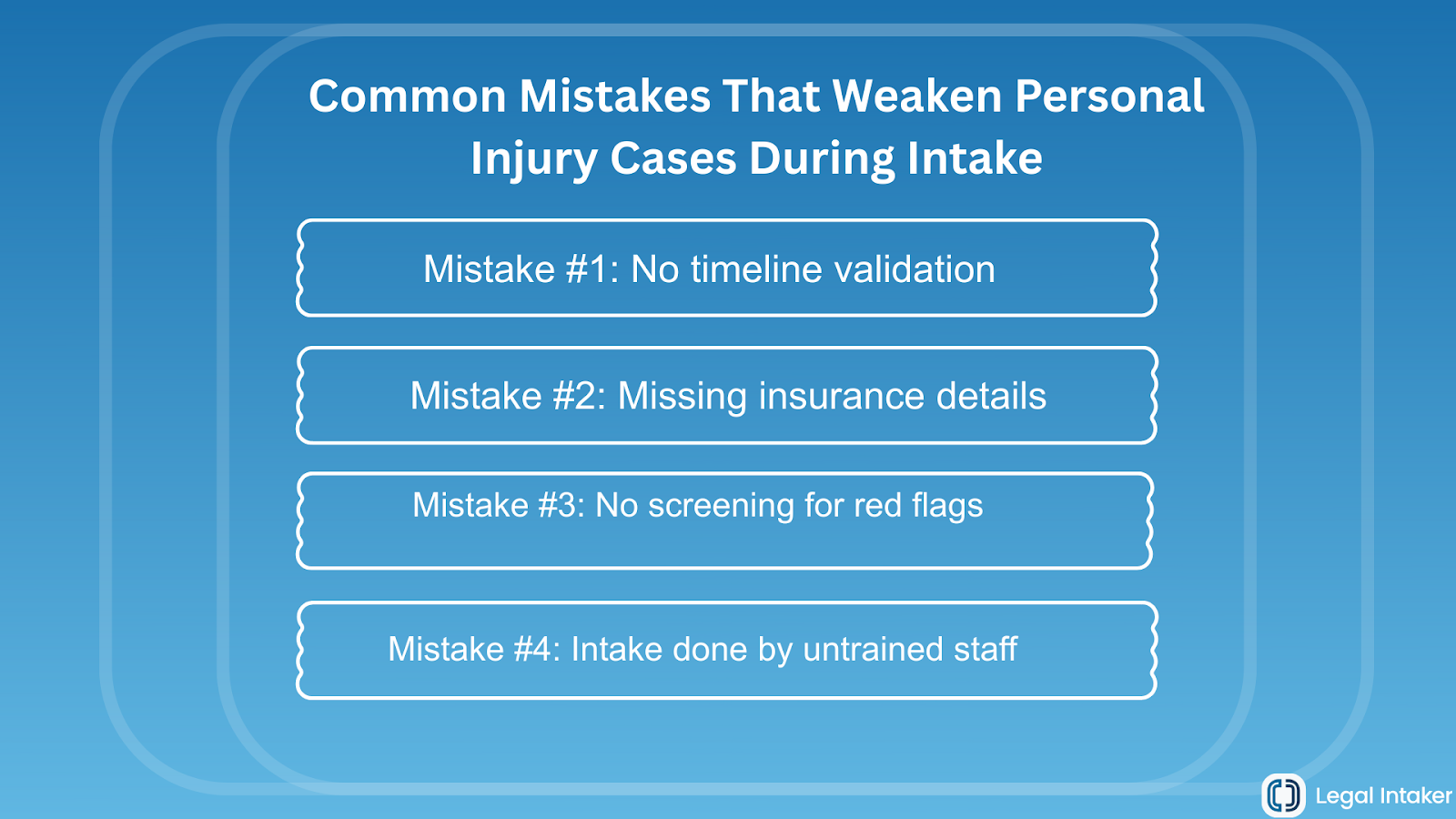
Most firms don’t lose cases in court. They lose them at intake.
Mistake #1: No timeline validation
If intake doesn’t capture exact dates (incident date, first treatment date), causation becomes easy to attack.
Mistake #2: Missing insurance details
Firms often delay collecting policy info, slowing down claim strategy.
Mistake #3: No screening for red flags
Examples:
- long treatment gaps
- unclear mechanism of injury
- inconsistent story
- suspect prior claims pattern
Mistake #4: Intake done by untrained staff
Personal injury intake requires legal-specific questioning. A receptionist-style intake can cost a firm thousands in missed opportunities.
How Legal Intaker Helps: Better Personal Injury Intake With Legal Intake Specialists
A strong personal injury intake form is only half the system.
The other half is who runs it.
Legal Intaker supports personal injury firms with pre-vetted legal intake specialists trained to:
- manage PI screening and lead qualification
- complete intake forms accurately (without missing liability details)
- gather medical and insurance information efficiently
- follow structured intake workflows consistently
- reduce attorney interruption while increasing conversion rate
For firms that handle dozens (or hundreds) of PI leads weekly, this creates measurable operational improvement:
- faster intake completion
- stronger documentation quality
- fewer missed follow-ups
- more cases signed without internal overload
If your goal is to scale, intake must be a process not a person improvising on the phone.
Final Thoughts: Turn Intake Into a Case-Strength System
The personal injury intake form is not paperwork, it’s your first evidence collection tool.
When your intake process is standardized, complete, and run by trained specialists, your firm gains:
- stronger demand packages
- fewer liability surprises
- faster claim momentum
- higher confidence in case screening
If you want to consistently outrank other firms in results and consistently outperform them in outcomes, treat intake as a serious part of litigation strategy.
Ready to improve your personal injury intake workflow?
Contact Legal Intaker today! We provide trained legal intake specialists who can help your firm qualify leads, complete intake forms accurately, and keep your pipeline moving,. so attorneys can focus on building and winning cases.

FAQs About Personal Injury Intake Form
1) What is included in a personal injury intake form?
A personal injury intake form typically includes client contact info, accident details, injury and treatment information, insurance coverage, wage loss, and evidence like police reports or witness contacts. It’s used to determine case eligibility and build an early claim strategy.
2) How long should a personal injury intake form be?
Most effective intake forms take 10–20 minutes to complete. The goal is to collect enough information for a liability and damages evaluation without overwhelming the client. Many firms use short sections with follow-up questions only when needed.
3) Can I fill out a personal injury intake form online?
Yes. Many personal injury firms offer secure online intake forms through their website or client portal. Online intake improves accuracy and speed, especially when clients can upload photos, insurance cards, and medical documents directly.
4) Why do law firms ask for medical history on an intake form?
Law firms ask for medical history because insurance companies often argue that injuries were “pre-existing.” Documenting prior injuries helps the attorney prepare for causation challenges and build a clearer medical timeline for negotiations.







.png)
.png)














.webp)















.webp)

.webp)








.webp)