Key Takeaways
- Form SS-4 is the official IRS application used to obtain an Employer Identification Number (EIN), a 9-digit federal tax ID every law firm needs before hiring staff, opening a trust account, or filing most federal returns.
- Online applications at IRS.gov issue an EIN immediately, making it the fastest method for the U.S.-based law firms with a responsible party who holds a valid SSN or ITIN.
- Law firm EIN errors on Line 7b (responsible party's SSN/ITIN) are the single most common cause of delayed or rejected applications.
- A trained virtual legal assistant can be named as a third-party designee on Line 19, allowing them to receive the EIN and manage IRS follow-up on your firm's behalf.
What Is IRS Form SS-4?
Form SS-4, Application for Employer Identification Number, is a one-page IRS form that establishes a business entity's identity in the federal tax system. The resulting EIN is a 9-digit number formatted as XX-XXXXXXX , the business equivalent of a Social Security Number.
The IRS uses the EIN to track payroll tax filings, business income returns, trust accounts, and entity elections. According to the IRS, more than 5.4 million new EIN applications were filed in 2023, a figure driven largely by LLC formations and new professional service firms, including law practices.
For law firms specifically, the EIN appears on every W-2 issued to employees, every 1099-NEC sent to contract workers, IOLTA trust account documentation, and state licensing filings. It is not optional in any practical sense.
Terminology note: EIN and FEIN (Federal Employer Identification Number) refer to the same 9-digit number. 'Tax ID number' and 'TIN' (Taxpayer Identification Number) are informal terms for the same identifier when used in a business context.
Which Law Firms and Legal Entities Must File Form SS-4?
The IRS requires an EIN in the following situations, all of which commonly apply to law practices:
• Law firms organized as LLCs, PLLCs, LLPs, or PCs. State bar rules in most jurisdictions require professional entities for attorneys practicing in groups. Each entity needs its own EIN.
• Any firm that employs staff. Hiring even one paralegal, receptionist, or associate triggers an EIN requirement for payroll tax filings (Forms 941, 940) and W-2 issuance.
• Firms that pay independent contractors. If your firm issues 1099-NECs to contract investigators, translators, or legal support vendors, an EIN is required.
• Attorneys opening IOLTA or business trust accounts. Virtually all financial institutions require an EIN to open a commercial or trust account, including IOLTA accounts required under most state bar rules.
• Solo practitioners who want to protect their personal SSN. A sole proprietor attorney is not always legally required to have an EIN, but obtaining one prevents your personal SSN from appearing on vendor contracts, court filings, and client documents.
• Estates and trusts. Law firms handling estate administration or trust creation need a separate EIN for each estate (Form 706/1041) and taxable trust.
How to Complete Form SS-4: Line-by-Line Instructions for Law Firms
The current version is Form SS-4 (Rev. December 2023). Download directly from IRS.gov before filing, third-party copies may be outdated. The form has 19 lines covering four functional areas.
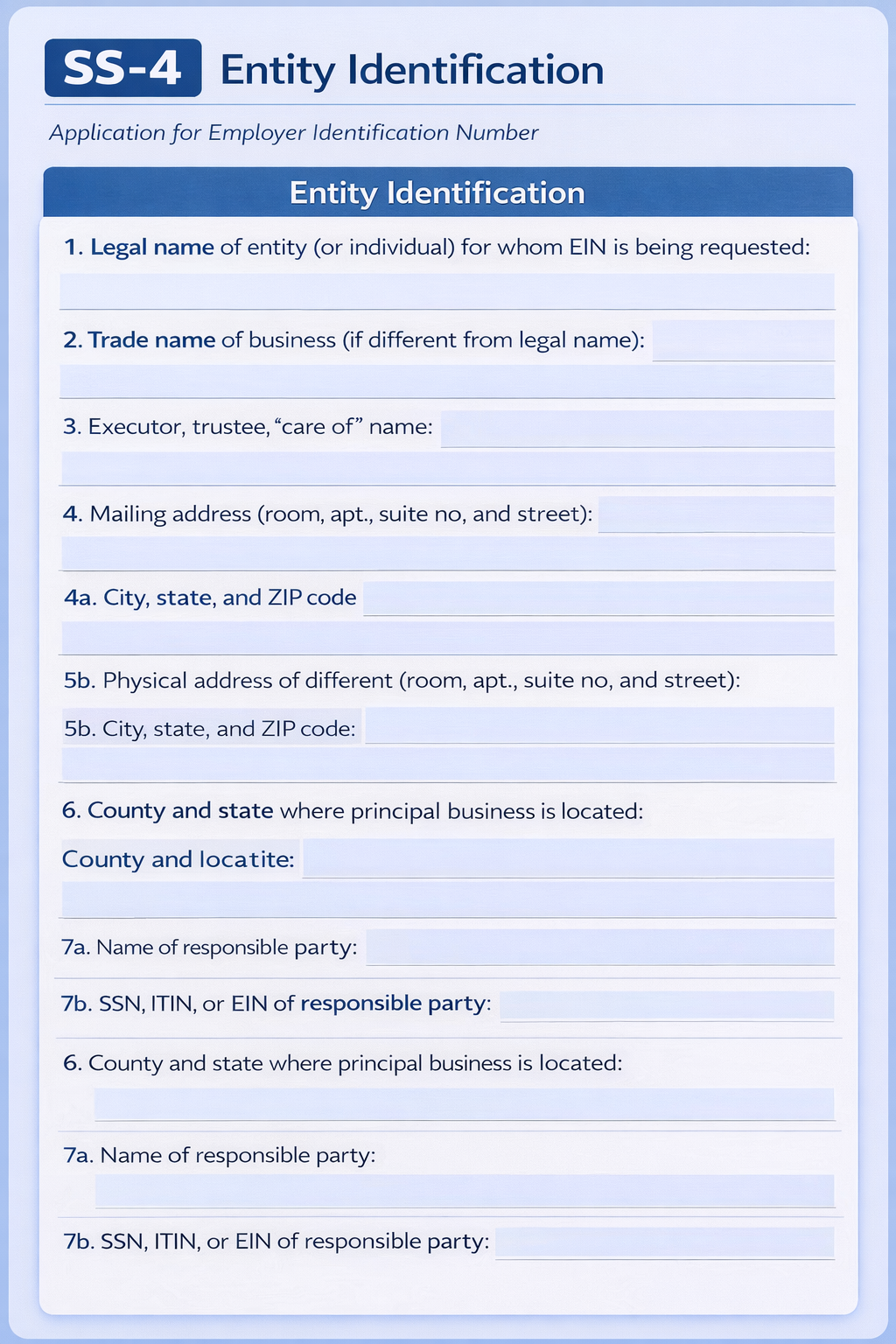
Lines 1–7b: Entity Identification
Line 1 — Legal name. Enter the firm's exact legal name as registered with the state. For an LLC: use the name on the Articles of Organization. For a PLLC or LLP: use the name on the state-issued certificate. Do not abbreviate or use a DBA here.
Line 2 — Trade name (DBA). Enter only if the firm operates under a name different from Line 1. Leave blank if the same.
Lines 4a–4b — Mailing address. The firm's primary mailing address. P.O. Boxes are accepted for mailing but not as the physical location.
Lines 5a–5b — Street address. Enter the physical office address only if it differs from the mailing address. Do not use a P.O. Box here.
Line 6 — County and state. The county where the principal office is located. Matters for state nexus and correspondence routing.
Line 7a — Responsible party. This is the individual who controls, manages, or directs the entity — typically the managing partner, sole owner, or firm administrator. The IRS now requires this to be a natural person (not another entity) for most filers. Use the person's legal name exactly as it appears on their Social Security card or ITIN documentation.
Line 7b — SSN, ITIN, or EIN of the responsible party. This field is mandatory and the most common source of processing errors. The IRS cross-references this number against its records. A mismatch will halt your application. Verify the responsible party's tax ID number before submitting.
Lines 8a–9b: Entity Type Classification
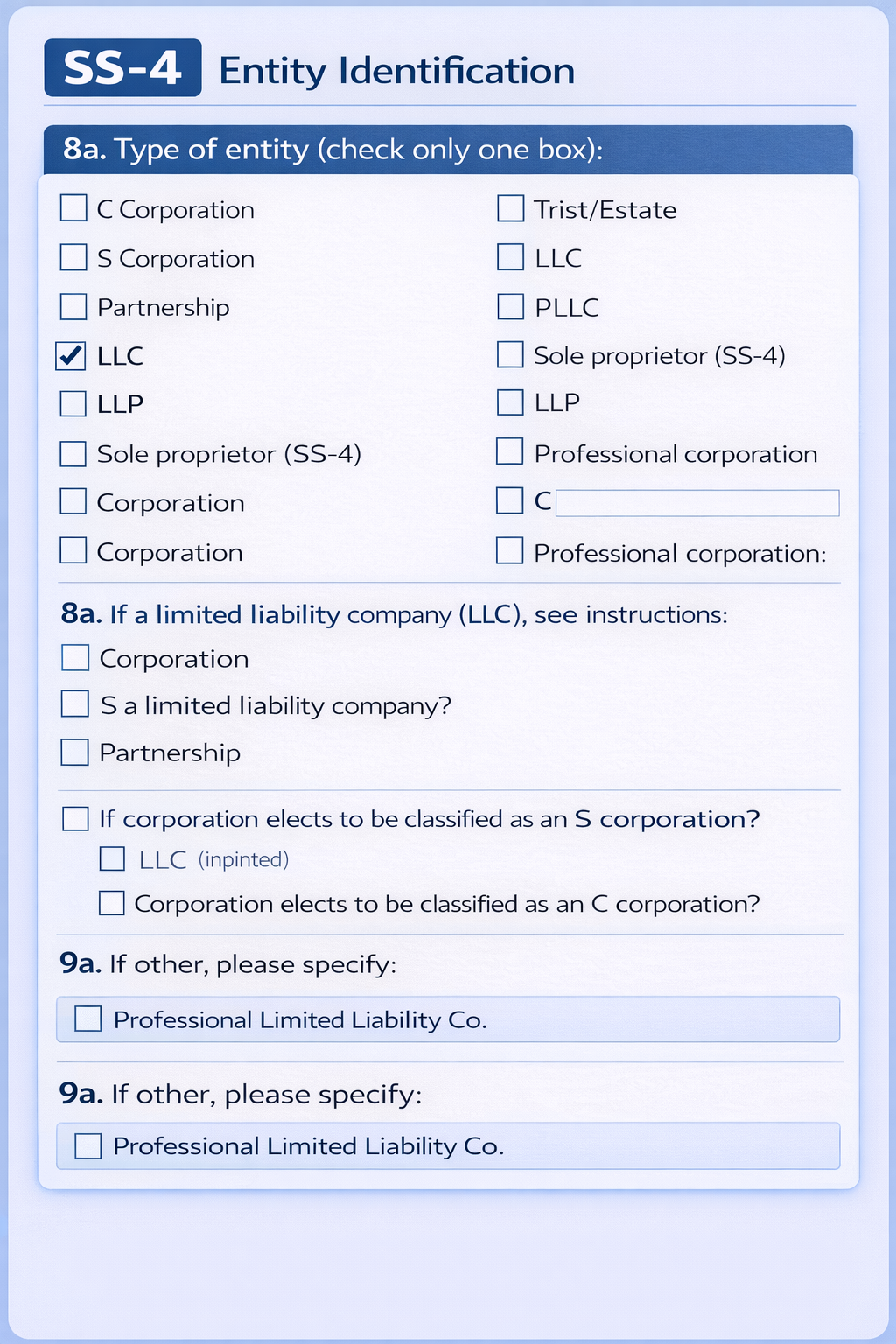
Line 8a — Type of entity. Select the entity type that matches your firm's legal structure. Common selections for law practices:
• LLC: Check 'LLC' this also triggers Lines 8b and 9a.
• LLP or PLLC: Check 'Partnership' (LLPs are partnerships for federal tax purposes) or LLC depending on state organization.
• Solo practitioner: Check 'Sole proprietor' note that personal liability is not separated from your individual tax return.
• Professional Corporation (PC): Check 'Corporation' and specify type on Line 9a.
Line 8b — Number of LLC members. Critical for tax treatment. A single-member LLC is treated as a disregarded entity (Schedule C on your personal return) unless it elects corporate treatment. A multi-member LLC defaults to partnership treatment and must file Form 1065.
Lines 9a–9b — Entity classification elections. If the LLC elects to be treated as a corporation for tax purposes, indicate that here. State-chartered banks and savings institutions complete Line 9b.
Lines 10–18: Business Details
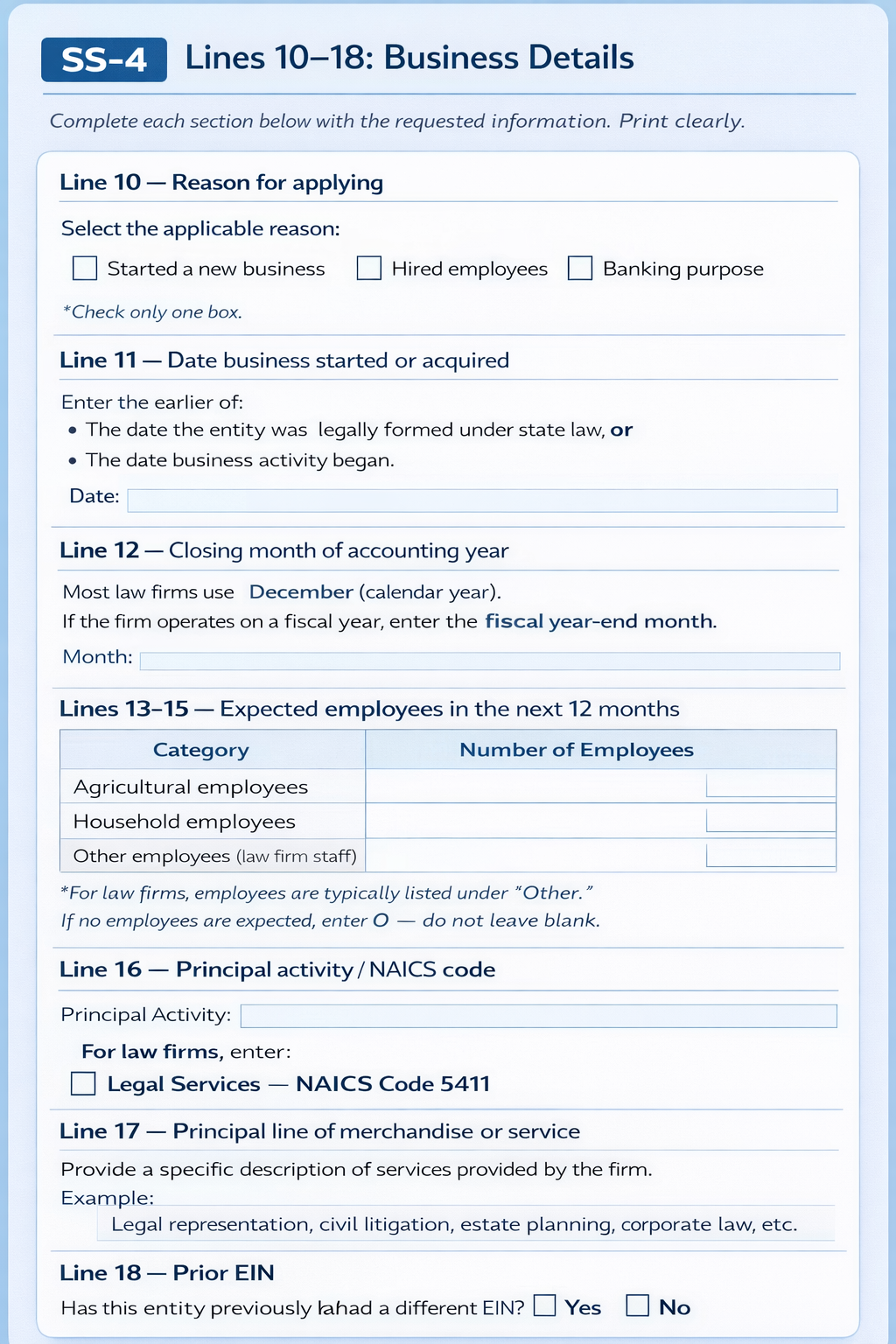
Line 10 — Reason for applying. Select the applicable reason. For new law firms: 'Started a new business.' For firms adding payroll for the first time: 'Hired employees.' For trust accounts or banking purposes: 'Banking purpose.' Check only one box.
Line 11 — Date business started or acquired. Enter the earlier of: the date the entity was legally formed under state law, or the date business activity began.
Line 12 — Closing month of accounting year. Most law firms use December (calendar year). Firms on a fiscal year should enter their fiscal year-end month. This affects which tax return due dates apply to your firm.
Lines 13–15 — Expected employees. Enter the projected number of employees in the next 12 months, separated by agricultural, household, and other. For law firms, all employees fall in the 'other' column. If you expect to hire zero employees, enter 0 and do not leave blank.
Line 16 — Principal activity / NAICS code. For law firms: enter 'Legal Services.' The IRS uses NAICS Code 5411 for Legal Services, including offices of lawyers, attorneys, and notaries.
Line 17 — Principal line of merchandise or service. Describe specifically: 'Legal representation, civil litigation, estate planning,' etc. Mirror the actual practice area.
Line 18 — Prior EIN. Answer 'Yes' only if this entity previously had a different EIN under a prior organizational structure. If switching from a sole proprietorship to an LLC, the new entity requires a new EIN.
Line 19: Third-Party Designee
If someone other than the responsible party is completing and submitting Form SS-4, a paralegal, legal administrator, CPA, or virtual legal assistant, Line 19 authorizes that person to receive the EIN and communicate with the IRS about the application.
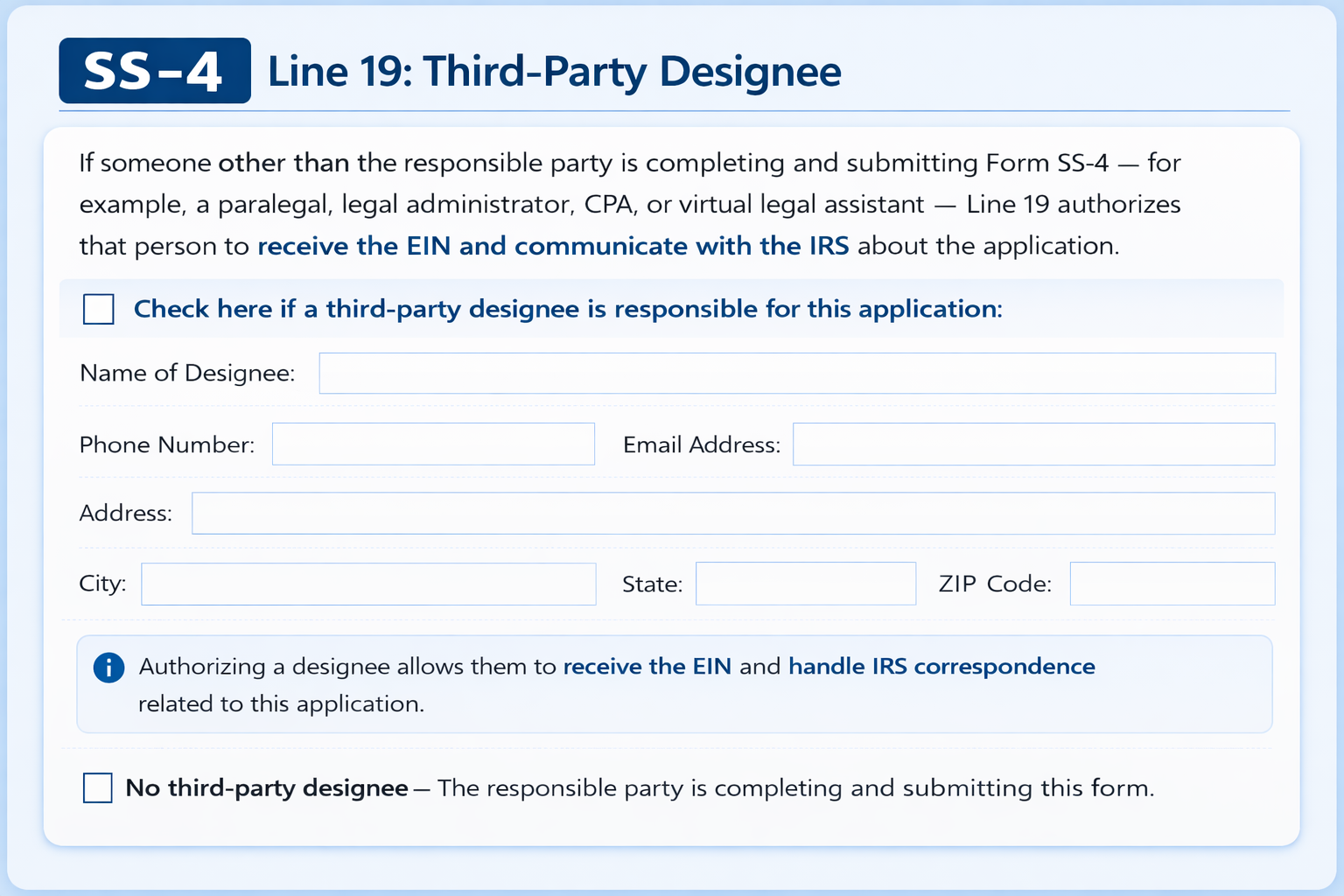
This is one of the most practical entry points for Legal Intaker's virtual legal staff. A trained remote paralegal can be designated on Line 19, take receipt of the EIN, and manage all IRS acknowledgment correspondence, removing that administrative burden from the managing partner entirely.
Important: The third-party designee authorization on Line 19 is limited to the EIN application only. For ongoing IRS representation, a Form 2848 (Power of Attorney) or Form 8821 (Tax Information Authorization) is required.
How to Submit Form SS-4
The IRS accepts Form SS-4 through four channels. For law firms with a U.S.-based managing partner and a valid SSN or ITIN, online filing is almost always the right choice.
For international applicants: Foreign entities with U.S. tax obligations but no SSN must apply by phone or fax. The online system is limited to filers with a U.S.-based Social Security Number or ITIN.
Note on EIN confirmation: Keep the IRS EIN confirmation letter (CP 575) permanently. Banks, state licensing boards, and courts may request it. If lost, request an EIN verification letter (147C) by calling 1-800-829-4933.
Common Form SS-4 Mistakes Law Firms Should Avoid
These errors account for the majority of EIN processing delays and compliance complications in legal practices:
Your EIN Is Step One, Build the Firm's Operations Right From the Start
Completing Form SS-4 is one of the first official acts of a law firm's existence. It triggers your federal tax identity, enables hiring, unlocks trust account access, and opens the door to every compliance filing that follows. Getting it right, correct entity type, accurate responsible party, the right submission channel, prevents downstream problems that can take months to untangle.
Form SS-4 is also a preview of the broader administrative reality every law firm faces: recurring filings, IRS correspondence, client intake workflows, and compliance obligations all competing for attorney time that should be spent on billable work. Virtual legal staffing is how high-performing firms solve that problem , without the overhead of in-house hiring.
Legal Intaker provides trained remote paralegals and virtual legal assistants who handle EIN applications, IRS third-party designee management, client intake, IOLTA coordination, and ongoing compliance tracking, so your firm runs efficiently from day one. Whether you're in formation, scaling, or simply overloaded, our staff operate as a direct extension of your team at a fraction of in-house cost.
Schedule a Free Consultation at Legal Intaker

FAQs About Form SS-4 for Law Firms
Does it cost money to get an EIN using Form SS-4?
No. Obtaining an EIN through Form SS-4 is completely free when applying directly with the IRS, online, by phone, by fax, or by mail. Third-party websites that charge fees for EIN applications are reselling a process the IRS offers at no cost. Always apply directly at IRS.gov or call the IRS Business & Specialty Tax Line at 1-800-829-4933.
How long does it take to receive an EIN after submitting Form SS-4?
It depends on the submission method. Online applications at IRS.gov issue an EIN immediately on screen, the entire process takes under 15 minutes. Phone applications are completed in real time during the call. Fax submissions take approximately 4 business days. Mailed applications take 4–5 weeks. The IRS confirms these timelines in its official SS-4 instructions (Rev. December 2023).
Does a single-member law firm LLC need an EIN?
In most practical situations, yes. The IRS does not require a single-member LLC (treated as a disregarded entity) to obtain an EIN unless it hires employees or files certain excise tax returns. However, virtually all banks require an EIN to open a business checking account or IOLTA trust account , mandatory under most state bar rules. Additionally, having an EIN protects the attorney's personal SSN from appearing in vendor contracts, subpoenas, and court filings. The practical and ethical case for obtaining one is strong even when it is not technically required.
Can a virtual legal assistant or paralegal complete Form SS-4 on behalf of my firm?
Yes. A virtual legal assistant or paralegal can prepare and submit Form SS-4 on the firm's behalf and be named as the third-party designee on Line 19, authorizing them to receive the EIN and field IRS questions about the application. The responsible party (typically the managing partner) must still sign and date the form to certify accuracy. LegalIntaker's virtual legal staff are trained to manage EIN applications, IRS correspondence, and administrative onboarding tasks as a core part of law firm support services.
.png)

.png)













.webp)














.webp)

.webp)









.webp)