
Key Takeaways
- Structured virtual intake increases consultation conversion and protects attorney billable time.
- Faster response times significantly improve client acquisition in competitive family law markets.
- Delegating case management reduces administrative overload and malpractice risk.
- LegalIntaker.com provides law-firm-specific virtual staffing designed to support compliant, measurable growth.
Family law is one of the most demanding practice areas in the legal industry. Divorce, custody disputes, child support, domestic violence petitions, and post-judgment modifications require constant communication, fast response times, and meticulous case management.
Yet most family law firms hit a growth ceiling.
Attorneys become overwhelmed with intake calls. Consultations are booked inconsistently. Follow-ups fall through the cracks. Administrative work consumes hours that should be billable.
Scaling a family law practice today is not simply about hiring more associates. It is about building a structured intake and case management infrastructure that increases conversion, protects attorney time, and improves operational efficiency.
This guide explains how to scale your family law practice using virtual intake and case management systems, and how firms leveraging structured virtual staffing are outperforming competitors in highly competitive markets.
Why Family Law Firms Struggle to Scale
Family law generates:
- High call volume
- Emotionally urgent prospects
- Complex screening requirements
- Frequent document exchanges
- Ongoing client communication needs
According to the 2023 Clio Legal Trends Report, lawyers spend only 2.9 hours per day on billable work, while administrative tasks consume a significant portion of their time. For small and mid-sized family law firms, this ratio is often worse due to intake and client management demands.
Additionally:
- The ABA reports that over 35% of legal consumers expect a response within one hour of contacting a firm.
- Law firms responding within the first 5 minutes are 100x more likely to connect with a lead (Harvard Business Review study on lead response time).
In family law, speed equals trust—and trust equals signed retainers.
Without structured intake systems, scaling becomes chaotic rather than profitable.

Virtual Intake: The Growth Engine of a Family Law Firm
Virtual intake is not simply answering phones remotely. It is a structured system for capturing, qualifying, and converting leads efficiently.
In family law, intake must accomplish several critical tasks. It must screen for conflicts of interest, verify jurisdiction, determine financial eligibility, identify case type, and assess urgency.
It must also establish trust and empathy during emotionally charged conversations.
When done correctly, virtual intake increases consultation show rates, improves case qualification, and protects attorney time.
Without it, scaling becomes chaotic.
📚 Also Read: Personal Injury Intake Form: Checklist for Strong Claims
The First Call Is Your Most Valuable Moment
Family law prospects are rarely casual shoppers. They are facing life-altering issues. The first interaction with your firm shapes their perception of your competence and professionalism.
If calls go unanswered or are returned hours later, prospects move on. If intake feels rushed or disorganized, trust erodes.
A structured virtual intake specialist ensures calls are answered live, information is captured accurately, and consultations are scheduled immediately. Scripts tailored to divorce, custody, and protective order matters ensure consistency without sacrificing empathy.
Responsiveness directly impacts conversion rates. Firms that implement live intake coverage frequently report double-digit increases in booked consultations within the first quarter of implementation.
Stop Wasting Time on Unqualified Consultations
Family law firms often spend unpaid time on consultations that never convert. Common issues include jurisdictional conflicts, inability to pay retainers, unrealistic expectations, or matters outside the firm’s scope.
A structured intake workflow filters these cases before they reach the attorney’s calendar.
Effective qualification includes:
- Conflict checks before scheduling
- Financial screening aligned with retainer requirements
- Case-type verification (divorce, custody, modification, DV, etc.)
- Urgency assessment for emergency filings
- Required document checklist prior to consultation
This process ensures that when attorneys sit down for a consultation, they are speaking with viable, prepared prospects.
The result is higher conversion rates and more efficient use of billable time.
Virtual Case Management: The Second Pillar of Scalability
Intake brings clients into your firm. Case management determines whether you can handle increased volume without operational breakdown.
Family law cases require constant deadline tracking, document exchange, and client communication. Missed filings or overlooked court dates can result in sanctions or malpractice exposure.
According to Clio’s research, firms using practice management software collect 37 percent more revenue than those that do not. However, software alone does not create efficiency. Systems must be executed consistently.
Virtual case management support ensures your CRM and practice management tools are updated daily, deadlines are tracked, and communication remains proactive.
This allows your firm to handle higher caseloads without hiring multiple in-house administrative staff.
Calendar Control and Deadline Protection
Family law is deadline-driven.
Missed hearings or filing deadlines can:
- Harm clients
- Trigger malpractice exposure
- Damage firm reputation
A virtual case management system:
- Syncs court dates
- Sends automated reminders
- Confirms client attendance
- Coordinates mediation schedules
- Blocks attorney availability properly
This prevents overbooking and administrative breakdown during growth phases.
CRM Management Prevents Revenue Leakage
Many family law firms invest heavily in marketing but lack systems to track every inquiry. Leads get lost in inboxes. Follow-up emails are delayed. Consultation outcomes are not recorded.
This creates silent revenue loss.
CRM systems such as Clio Grow, MyCase, or PracticePanther provide tracking capability, but they require consistent data entry and follow-up execution.
Salesforce Research, State of Sales Report, which found that CRM systems can increase sales revenue by up to 29%.. For family law firms, that growth often comes from better follow-up, improved conversion tracking, and referral source measurement.
Virtual intake and case management teams ensure every lead is logged, every consultation is tracked, and every follow-up is scheduled.
Growth becomes measurable rather than accidental.
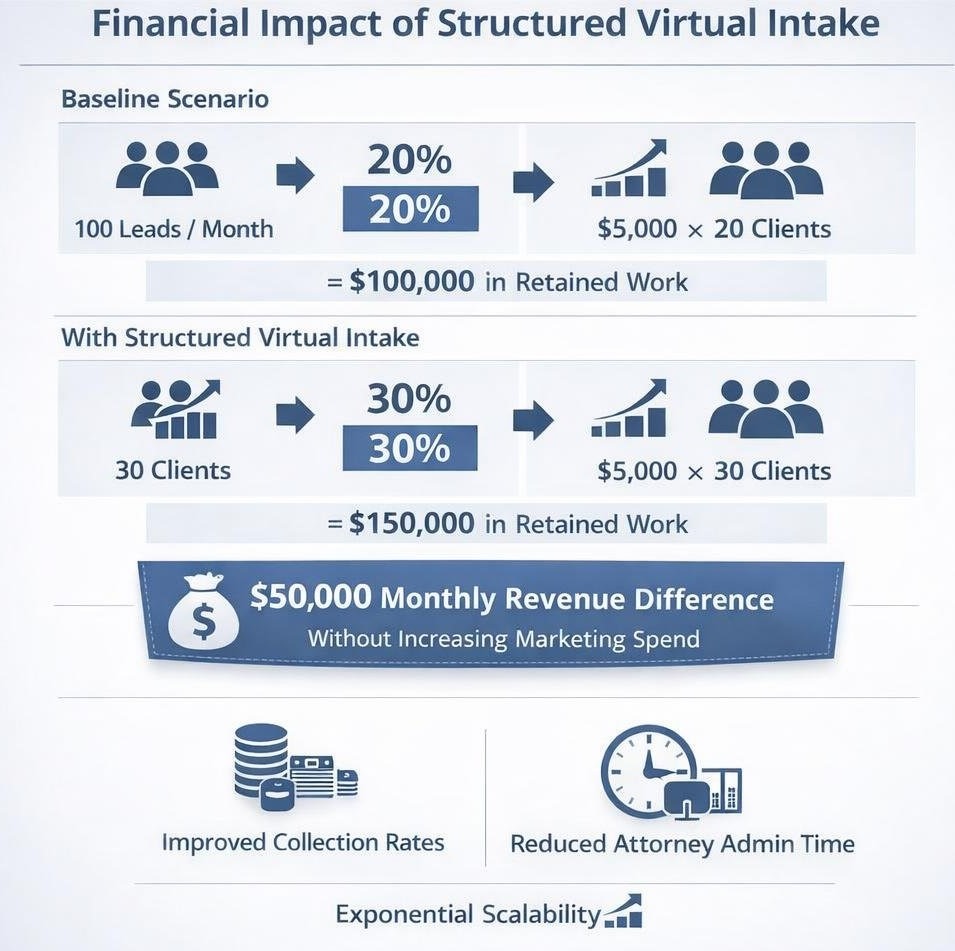
Financial Impact of Structured Virtual Intake
Let’s break this down.
If your average family law retainer is $5,000 and:
- You receive 100 leads/month
- You convert 20%
That equals $100,000 in retained work.
If structured intake increases conversion to 30%, that’s:
- 30 clients × $5,000 = $150,000
A $50,000 monthly revenue difference—without increasing marketing spend.
Add improved collection rates and reduced attorney admin time, and the scalability becomes exponential.
Reducing Burnout While Increasing Capacity
Family law has one of the highest burnout rates among legal practice areas due to emotional intensity and client demands.
When attorneys handle intake calls between hearings, respond to emails at night, and manually track deadlines, growth feels exhausting.
Delegating intake and administrative workflows allows attorneys to focus on legal strategy, negotiation, and courtroom advocacy.
Scaling should increase profitability—not stress.
Common Concerns About Virtual Intake
“Will a virtual team understand family law complexity?”
When trained specifically in family law workflows, intake specialists follow structured scripts and escalation protocols. They gather information—not provide legal advice.
“What about confidentiality?”
Reputable providers implement:
- NDA agreements
- Secure communication systems
- Encrypted CRM access
- Role-based permissions
Compliance with ABA Model Rule 1.6 (Confidentiality) remains intact.
“Will clients feel it’s impersonal?”
Data shows clients value responsiveness more than physical office presence. Fast, empathetic communication builds trust faster than delayed attorney callbacks.
📚 Also Read: 5 Signs You Need a Law Firm Intake Specialist
How Legal Intaker Supports Family Law Firm Growth
Legal Intaker specializes in virtual staffing tailored for law firms.
For family law practices, this means:
- Dedicated intake specialists trained in divorce and custody workflows
- Lead qualification frameworks aligned with your firm’s criteria
- CRM and case management integration
- Calendar coordination
- Follow-up automation
- Performance metrics tracking
Rather than hiring, training, and managing in-house intake staff, firms gain a structured, scalable system without increasing payroll complexity.
This allows partners to:
- Focus on litigation and negotiation
- Increase billable hours
- Improve client satisfaction
- Expand marketing confidently
Technology + Human Execution = Scalable Growth
Successful scaling requires both tools and people.
A modern family law firm should utilize practice management software, automated reminders, e-signature tools, secure document portals, and structured intake scripts.
But technology only delivers ROI when executed consistently.
Virtual intake and case management ensure your systems operate daily with discipline and accountability.
That is the difference between a busy firm and a scalable firm.
📚 Also Read: The 4 Steps of an Effective Client Intake
Build the Infrastructure That Supports Sustainable Growth
Scaling your family law practice is not about working longer hours or taking every case that calls.
It is about building systems that capture every qualified lead, convert consultations consistently, protect deadlines, and free attorneys to focus on high-value legal work.
Virtual intake and structured case management create predictable growth capacity.
If your firm is ready to increase conversions, reduce administrative strain, and scale with confidence, Legal Intaker delivers the virtual staffing infrastructure designed specifically for law firms.
Schedule a consultation today and transform your intake process into a scalable growth engine.

Frequently Asked Questions
How do I scale my family law practice without adding more overhead?
Focus first on optimizing intake and case management. Improving conversion rates and reclaiming attorney time often generates revenue growth without immediate attorney expansion.
Is virtual intake ethical for family law firms?
Yes, provided confidentiality safeguards, supervision protocols, and clear role boundaries are maintained in compliance with ABA Model Rules.
What is the biggest bottleneck in family law firm growth?
Inconsistent intake and delayed follow-up are the most common bottlenecks. Firms lose qualified leads before consultations even occur.
How quickly can virtual intake improve results?
Many firms observe measurable improvements in consultation bookings and response times within the first 30 to 60 days of implementation.







.png)
.png)














.webp)















.webp)

.webp)








.webp)