
Key Takeaways
- A motion to compel in discovery is how you ask a judge to force the other side to respond to discovery they've been ignoring or dodging.
- Before you file, you're required to make a genuine, documented attempt to resolve the issue directly with opposing counsel; courts call this the "meet and confer."
- Winning a motion to compel doesn't always mean recovering your attorney fees. Courts often award far less than what was spent, so plan accordingly.
- If the other side ignores a granted motion to compel, things get serious fast sanctions, evidentiary exclusions, even default judgment are all on the table.
- Most motions to compel that get denied fail on procedure, not the merits. Timing and documentation make or break these motions.
- Most failed motions to compel are lost on procedure, not merit. Documentation and timing are everything.
You served your discovery requests. The deadline came and went. And now you're staring at either a wall of silence or a response so vague it barely qualifies as one.
This is one of the most frustrating situations in civil litigation, and it happens constantly. The good news is there's a remedy: a motion to compel in discovery. This guide walks you through exactly what it is, when to use it, how to file one the right way, and what to expect once you do.
What Is a Motion to Compel in Discovery?
At its core, a motion to compel is you going to the judge and saying: "Your Honor, the other side isn't playing by the rules. We need a court order to make them comply."
More formally, it's a written request asking the court to order the opposing party, or sometimes a third party, to fulfill a discovery obligation they've refused or failed to meet. That could mean answering interrogatories, producing documents, showing up for a deposition, or responding to requests for admission.
Here's an important distinction: the motion doesn't punish anyone. It's not a sanction. It's a corrective order that says, produce this information by this date, or else. The "or else" part only kicks in if the party ignores the order, and that's when things get significantly more serious.
The governing rule in federal court is FRCP Rule 37. Every state has its own version. California uses Code of Civil Procedure §§ 2030.300 through 2031.320. Texas uses Rule 215. The specific procedures differ, but the underlying logic is the same: courts want discovery disputes resolved, and they'll step in when parties can't do it themselves.
What Triggers a Motion to Compel in Discovery?
You can file a motion to compel whenever the other side drops the ball on discovery. The most common situations are:
- A party never responded at all to interrogatories, requests for production, or requests for admission within the allowed timeframe
- Responses were served, but they're full of boilerplate objections like "overly broad and unduly burdensome" with no real substance behind them
- A party didn't show up to a properly noticed deposition or refused to answer legitimate questions during one
- A party failed to produce documents called for by a subpoena or request for production
Don't wait too long to file. Courts expect you to move promptly after the breakdown occurs, not right before trial. California requires these motions to be heard at least 15 days before the initial trial date. Most federal courts have their own local rules about timing. File late and you may be denied on procedural grounds alone, even if your underlying argument is airtight.
One nuance worth knowing: if the other side served zero responses, there's generally no deadline for filing. But if they give partial responses, the clock starts ticking to challenge the deficiencies. Check your jurisdiction's specific rules.
Types of Discovery You Can Compel
Any properly served discovery request can be the basis for a motion to compel. Here's a quick breakdown of the most common ones:
Interrogatories. These are written questions answered under oath. If the other side gives you evasive, incomplete, or objection-only answers, you can file to compel full responses.
Requests for Production. You asked for documents or electronically stored information and didn't get them, or got something clearly incomplete. A motion to compel can force proper production.
Requests for Admission. If a party fails to respond within the deadline, some jurisdictions treat that as an automatic admission. But even where that rule applies, a motion to compel is still available when the responses given are inadequate.
Depositions. If a witness doesn't show up or refuses to answer questions without asserting a valid privilege, FRCP Rule 37(a)(3)(B) gives you the right to compel their testimony.
The Meet and Confer Requirement
Before you file anything, you have to genuinely try to work it out with the other side. This is called the meet and confer requirement, and courts don't take it lightly.
"Genuine" is the key word here. Firing off one email and calling it good isn't going to cut it. Courts want to see that you:
- Reached out to opposing counsel directly, by phone, letter, or in person
- Explained specifically what was wrong with their responses
- Gave them a real opportunity to fix the problem
- Documented all of it, including dates, what was discussed, and what they agreed to or refused
When you file, you'll need to include a meet and confer declaration that lays all of this out. Judges read these. A declaration that shows one unreturned email is usually not enough. A declaration that shows a detailed letter, a follow-up call, and a written non-response is a much stronger foundation.
Why does the court care so much? Because judges don't want to spend time on disputes the parties could have resolved themselves. When your meet and confer record is solid, it tells the court you acted in good faith and the other side simply wouldn't cooperate.
How to Write a Meet and Confer Letter That Actually Works
Think of your meet and confer letter as the first exhibit in your motion. Write it like one.
It shouldn't be a vague complaint. It should identify every discovery request at issue, quote the deficient response that was given, explain specifically why that response falls short, and state exactly what you expect them to produce or correct. Set a clear deadline, typically 7 to 10 days, and let them know you'll file a motion to compel if the deficiencies aren't addressed.
When your letter is specific and your deadline is reasonable, you've made a good-faith record that's genuinely hard to argue with.
How to File a Motion to Compel in Discovery: Step-by-Step
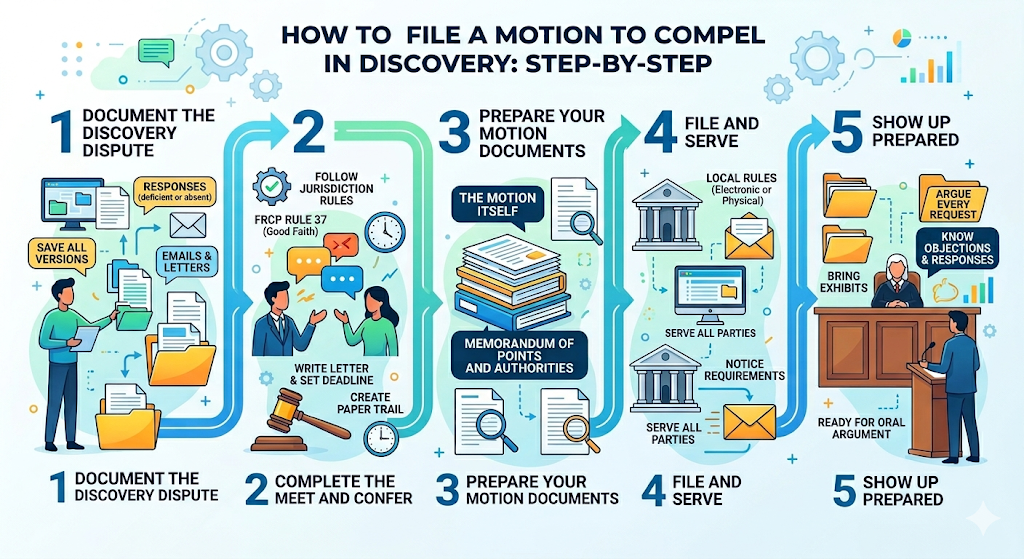
Step 1: Document the Discovery Dispute
Start building your record the moment you notice a problem. Save every version of your discovery requests, every response you received (whether deficient or completely absent), and every email and letter exchanged with opposing counsel. You'll need these as exhibits, so organize them early.
Step 2: Complete the Meet and Confer
Follow your jurisdiction's requirements to the letter. In federal court, FRCP Rule 37 requires you to certify that you "in good faith conferred or attempted to confer" with the other side before filing. Write your meet and confer letter, set a response deadline, and follow up in writing so there's a paper trail.
Step 3: Prepare Your Motion Documents
A solid motion to compel package has several components:
- The motion itself: your formal request for a court order, citing the rule that authorizes it
- Memorandum of points and authorities: where you lay out the legal argument for why the discovery is proper and the objections are invalid
- Declaration: your sworn account of what happened the requests you served, the responses you got, and your meet and confer efforts
- Proposed order: a draft of the order you want the judge to sign, ready to go
- Exhibits: copies of everything the requests, the responses, the meet and confer correspondence
- Separate statement (required in California and some other courts): a side-by-side document pairing each request with the response given and your argument for why it's inadequate
One important procedural note: if you served both interrogatories and requests for production and got no answers to either, you'll typically need to file a separate motion for each category.
Step 4: File and Serve
File according to your court's local rules. Some courts use electronic filing systems; others want physical chambers copies. Serve the motion on all parties, and pay close attention to notice requirements so the other side has time to file an opposition before the hearing.
Step 5: Show Up Prepared
At the hearing, be ready to argue every single request in dispute. Know the objection raised against each item and have a clear, direct response for it. Bring a clean copy of your exhibits. Some judges rule on the papers; others want oral argument. Prepare for both.
What Happens After You File?
Once you file, the opposing party has the right to respond with an opposition brief arguing that the discovery was improper, the objections were valid, or your motion has a procedural flaw. You'll then have the chance to file a reply. After that, the court hears the motion and issues a ruling.
If the Motion Is Granted
The court issues an order telling the other party to produce the requested discovery by a specific date. Under FRCP Rule 37(a)(5), the court may also award you attorney fees for having to bring the motion.
But here's what competitors won't tell you about fee recovery: the reality is messier than the rule suggests. Research from California litigation practice shows that the average monetary sanction awarded is roughly one-quarter of what was actually sought. Courts dig into billing rates, question time spent on the meet and confer process, and individual judges vary enormously in how willing they are to award fees at all. Factor this into your budget before you file. Winning the motion doesn't automatically mean recouping what it cost.
If the other side then ignores the court's order, the consequences get significantly worse. The court can impose terminating sanctions (dismissing the case or striking pleadings), evidentiary sanctions (locking the non-complying party out of presenting certain evidence at trial), or hold the party in contempt.
If the Motion Is Denied
The other party has no obligation to produce the disputed discovery. The court can also make you pay the other side's attorney fees for defending against your motion, unless your motion was "substantially justified" or awarding fees would be unjust.
When a motion is granted in part and denied in part, the court typically splits the fee award between the parties based on who won what.
Motion to Compel vs. Motion for Sanctions
People mix these up constantly, but they serve very different purposes at very different stages of a dispute.
The right sequence is almost always: motion to compel first, court order second, and only if that order is ignored do you escalate to sanctions. Filing both at the same time usually backfires. Courts want to give the non-complying party a chance to comply with a direct order before they start imposing punishment.
Common Mistakes That Get Motions to Compel Denied
Most motions to compel don't fail because the underlying discovery dispute wasn't real. They fail because of avoidable procedural missteps. Here are the ones that come up most often:
A weak meet and confer. One unanswered email isn't a good-faith effort. Courts will throw out your motion on this ground alone, no matter how solid your discovery argument is.
Filing too close to trial. Judges won't delay a trial date because you waited until the last minute to bring a discovery dispute. File early and give the court time to act.
Asking for too much in your original requests. If your discovery requests were obviously overbroad to begin with, the court may side with the objecting party. Targeted, specific requests are harder to challenge and easier to enforce.
Missing exhibits. If you don't attach the original requests and the deficient responses, your motion is incomplete on its face. Everything gets attached.
Grouping all disputes without specificity. Saying "all responses were deficient" isn't an argument. Each request in dispute needs its own specific argument. Give the court something concrete to act on.
Missing the filing deadline. In California, you generally have 45 days from receiving a deficient response to file your motion to compel. Miss that window and your right to compel is gone permanently.
How Legal Technology Reduces Discovery Disputes
Most discovery disputes aren't caused by bad faith. They're caused by poor systems. Missed deadlines, disorganized requests, and no tracking of what came back versus what was actually asked for these are the real culprits.
Legal teams with structured intake and discovery workflows rarely let disputes escalate to the motion-to-compel stage. When every request is logged, every deadline is on the calendar, and every response is checked against the original request the day it arrives, problems get caught early enough to handle with a phone call.
Legal intake software that connects directly to matter management closes the gap between initial client information and what ends up in your discovery requests. When case facts are organized and accessible from day one, attorneys draft better requests and spot evasive responses much faster.
The firms filing the fewest motions to compel aren't the ones who never have disputes. They're the ones who document everything, follow up consistently, and use their systems to stay on top of deadlines before the other side can exploit them.
Conclusion
A motion to compel in discovery is a powerful tool, but it only works when your documentation is airtight, your timing is right, and your meet and confer record is solid. Most motions that fail don't lose on the merits they lose because deadlines were missed, exhibits weren't attached, or the meet and confer wasn't taken seriously enough. What separates firms that consistently win these disputes isn't just litigation skill. It's an organization. And that starts long before anyone files anything.
That's where Legal Intaker makes a real difference. Our U.S.-Trained virtual paralegals, legal assistants, and case managers from our Pre-Vetted Talent Pool work inside your existing tools Clio, Filevine, MyCase, and more to keep your discovery process on track from the first request to the final response. They flag deficiencies early, draft correspondence on time, and make sure nothing slips. More than 1,000 law firms already count on Legal Intaker to keep litigation support running smoothly, with plans starting at $2,227/month and no long-term contracts.
Ready to build a discovery process that puts you ahead before any dispute starts?
Talk to Our Team at Legal Intaker

Frequently Asked Questions
What is a motion to compel in discovery in simple terms?
It's a request you file with the court asking a judge to force the other side to produce information or documents they've refused or failed to hand over during discovery. You're essentially asking the court to enforce the discovery rules the other side is ignoring.
How long does a motion to compel take?
It depends on the court. In federal court, you're typically looking at 30 to 60 days from filing to hearing, though some courts rule on the papers without a hearing, which can speed things up. Emergency motions can move faster, but courts require a real urgency to grant that status.
Can you file a motion to compel against someone who isn't a party to the case?
Yes. If a third party fails to comply with a valid subpoena for documents or testimony, you can file a motion to compel. The motion is typically filed in the district where compliance was required, not necessarily where the case is pending.
What happens if the other side just ignores a granted motion to compel?
The consequences get serious. The court can dismiss the non-complying party's claims, strike their pleadings, bar them from using certain evidence at trial, or hold them in contempt. Ignoring a court order is a much worse position than having lost the original discovery dispute.
Will there always be a court hearing on a motion to compel?
Not necessarily. A lot of courts decide these on the written submissions alone. Some courts also have informal procedures that require the parties to submit a joint letter or join a conference call with the judge before a formal motion can even be filed. Always check the local rules for your court before you file anything.
What's the difference between a motion to compel and a subpoena?
A subpoena is the initial legal command to produce documents or appear for testimony. A motion to compel is what you file after that command has been ignored or resisted. The motion asks the court to step in and enforce what the subpoena or discovery request already required.





.png)
.png)









.webp)















.webp)

.webp)









.webp)