Key Takeaways
- Voir dire is your first and only opportunity to remove biased jurors before they ever touch a verdict.
- Challenges for cause are unlimited but require you to demonstrate specific bias, while peremptory challenges give you discretion but come with strict racial and gender limits.
- Written juror questionnaires submitted before oral examination surface deeper bias than in-court questioning alone, and they save you significant courtroom time.
- Legal Intaker's Legal-Trained Virtual Assistants can handle juror research, questionnaire drafting, and pre-trial documentation so you can focus entirely on courtroom strategy.
Here is something most attorneys know but few act on: voir dire does not just help you pick a jury. Done well, it shapes the entire trial. Done poorly, you walk into the opening argument already behind.
Research published in the Journal of Applied Social Psychology found that jurors form strong first impressions of a case within minutes of hearing the facts. Those impressions, built on personal history and deeply held beliefs, are very hard to undo once deliberations begin. Your voir dire strategy is the one tool you have to remove the most dangerous jurors before that process ever starts.
This guide gives you a practical, fact-checked framework for building and executing voir dire strategies that actually work, from juror profiling through challenge decisions and everything in between.
What Voir Dire Strategies Actually Win Cases
Voir dire is French for "to speak the truth." In legal practice, it refers to the structured questioning of prospective jurors (the venire) to identify bias before a jury is seated. Courts require it to satisfy the Sixth Amendment right to an impartial jury, a standard affirmed in Irvin v. Dowd, 366 U.S. 717 (1961).
The data on why this matters is striking:
- A 2017 analysis by the National Center for State Courts found that juror pre-trial bias is the most common grounds for post-verdict appeals in criminal cases.
- Trial consulting firm DecisionQuest estimates that effective voir dire strategies reduce hung jury risk by up to 30% in complex civil litigation.
- The American Bar Association reports that attorneys spend an average of 4 to 8 hours in voir dire for a standard civil trial, and substantially more in high-profile criminal matters.
Every one of those hours, directed by a clear strategy, determines who decides your case.
The Legal Rules You Need to Know Before You Start
Before you draft a single question, you need to understand what the rules allow in your jurisdiction. Getting this wrong does not just hurt your voir dire. It can cost you an appellate issue.
Federal courts operate under Federal Rule of Criminal Procedure 24 and Federal Rule of Civil Procedure 47. In most federal courtrooms, the judge leads questioning and controls how much attorney-conducted voir dire is permitted. This varies significantly by district and by individual judge, so check standing orders early.
State courts are a different story. States like California, Texas, and Florida give attorneys broad latitude to conduct voir dire directly. Others limit you to supplemental questions after the judge finishes. Know exactly where you stand before you walk in.
Two Supreme Court decisions define the outer limits of what you can do with peremptory challenges. Batson v. Kentucky, 476 U.S. 79 (1986), prohibits using peremptory challenges to exclude jurors based on race. J.E.B. v. Alabama, 511 U.S. 127 (1994), extended that prohibition to sex. A Batson violation does not just hurt your case in the moment; it is a reversible error on appeal.
What courts consistently allow:
- Questions about prior jury service
- Questions about familiarity with parties, witnesses, or attorneys
- Questions exploring attitudes toward the specific law at issue
- Questions that probe pre-existing opinions about the case or similar situations
What courts restrict or prohibit:
- Using voir dire to argue the merits of your case
- Questions that educate rather than identify bias
- Repetitive or harassing lines of questioning
Once you know the rules in your jurisdiction, you can build a strategy that uses every inch of the space you are given.
How to Build Your Voir Dire Strategy Before Trial
The biggest mistake attorneys make is treating voir dire preparation as something that happens the night before. The strongest voir dire strategies are built over weeks, not hours.
Start With the Juror Who Scares You Most
Begin by identifying the juror profile that threatens your case theory the most. Think about who is least likely to accept your client's story and why. Is it someone with a specific professional background? A particular life experience? A set of values that conflicts with your case?
In a personal injury case where your client alleges chronic pain, the most dangerous juror might be someone who views pain as subjective or who is skeptical of medical testimony. Your voir dire strategy needs to surface those attitudes directly, not with vague fairness questions that tell you nothing.
Use Juror Questionnaires Whenever You Can
Written questionnaires submitted to the venire before oral questioning are one of the highest-leverage tools in your arsenal. Here is why they work:
- Jurors answer more honestly in writing than they do in front of a full courtroom
- Questionnaires capture education level, media exposure, prior litigation history, and other relevant background before you ever speak
- They let you and your team review answers and plan targeted follow-up before live examination begins
- They cut courtroom time significantly by surfacing issues you can address efficiently rather than starting from scratch
Many federal districts and state courts allow them by stipulation or court order. File your motion to use them early in the pre-trial process.
Research the Venire Within Ethical Limits
In jurisdictions where juror lists are provided in advance, background research is a legitimate and valuable part of voir dire strategy. Review public records, prior jury service history, and social media where your state bar's ethics rules permit it. The point is not to surveil anyone. It is to walk into the room prepared.
Legal Intaker's Legal-Trained Virtual Assistants can organize this research into clear, reviewable juror profiles for trial counsel, saving hours of preparation time before a single question is asked.
The Question Structures That Surface Real Bias
"Can you be fair?" is the worst voir dire question you can ask. You will get "yes" from every juror in the box, including the ones who are anything but. Effective voir dire strategies depend on question structures that get past the socially acceptable answer and into what a juror actually believes.
Here are the four question types that work:
Commitment questions ask jurors to commit to a legal standard before hearing any evidence:
"Our client will not testify. The law says you cannot hold that against him. Is there anyone here who would find that difficult, even a little?"
Experience-based questions surface relevant bias through personal history rather than abstract belief:
"Has anyone here, or someone close to you, been a party to a lawsuit? Tell me what that was like."
Normalization questions reduce the social pressure to give the approved answer by framing honesty as acceptable:
"It is completely natural to have opinions about situations like this one. Raise your hand if this is something you have thought about before."
Looping questions follow a disclosure deeper to understand its actual impact:
"You mentioned a difficult experience with an insurance company. Help me understand how that might affect the way you evaluate the evidence in this case."
Questions That Waste Your Time
Avoid these entirely:
- "Would you follow the law?" Almost universally answered with yes, regardless of actual intent.
- "Can you be fair and impartial?" Same problem, zero useful information.
- Compound questions that bundle multiple issues together. Jurors will answer the easy part and skip the uncomfortable part entirely.
What to Do Once You Are in the Room
Your objectives in the room are the same regardless of jurisdiction. You need to identify jurors who cannot be fair and remove them for cause, prioritize your peremptory challenges for the jurors who are unfavorable but do not meet the cause threshold, and build enough rapport that the jury you seat is inclined to listen to you.
A few strategies that separate good voir dire from great voir dire:
Sequence your questions deliberately
Start with group questions to watch how the panel responds collectively, then move to individual follow-up on disclosures. Jurors take cues from each other. One honest disclosure from an outspoken panelist often opens the door for others who were hesitant.
Let the jurors do the talking
Attorneys who treat voir dire as an opportunity to present their case lose the room quickly. Your job is to ask questions and listen carefully. The more a juror reveals, the better your decision-making.
Document everything in real time
A seating chart with shorthand codes for each juror's disclosures is the minimum. Trial software like Jury Duty Pro or TrialDirector keeps things organized when you have 40 or more panelists in the box. An undocumented disclosure is nearly impossible to use for a mid-trial challenge or appellate argument.
Challenges for Cause vs. Peremptory Challenges
Understanding when to use each type of challenge is central to any voir dire strategy. They are not interchangeable, and spending one in the wrong place is a cost you cannot recover.
When to Use a Challenge for Cause
A challenge for cause needs to be grounded in specific bias you can articulate clearly. Common grounds include:
- A personal relationship with any party, witness, or attorney
- A financial stake in the outcome
- Prior exposure to case facts that has locked in a fixed opinion
- A stated inability to apply the law as instructed, such as refusing to use the reasonable doubt standard
- Employment in a field that creates a direct conflict with the issues in the case
To protect the challenge for appeal, you need to make a clean record. State the specific basis out loud. If the judge denies it, use a peremptory challenge on that juror and note your objection explicitly so the record shows you were forced to burn a peremptory as a result.
How to Use Peremptory Challenges Strategically
Peremptory challenges give you discretion, but that discretion has real limits. In federal criminal cases, defendants typically receive 10 peremptories in felony cases and 20 in capital cases, with the prosecution receiving 6 and 10 respectively. Federal civil cases default to 3 per side. State numbers vary significantly.
To get the most out of the peremptories you have:
- Reserve them for the jurors who carry the highest unfavorable risk even without clear cause to strike
- Always track who would replace a struck juror, because the replacement pool is part of your strategy too
- Do not spend a peremptory on a juror you have a strong chance of removing for cause
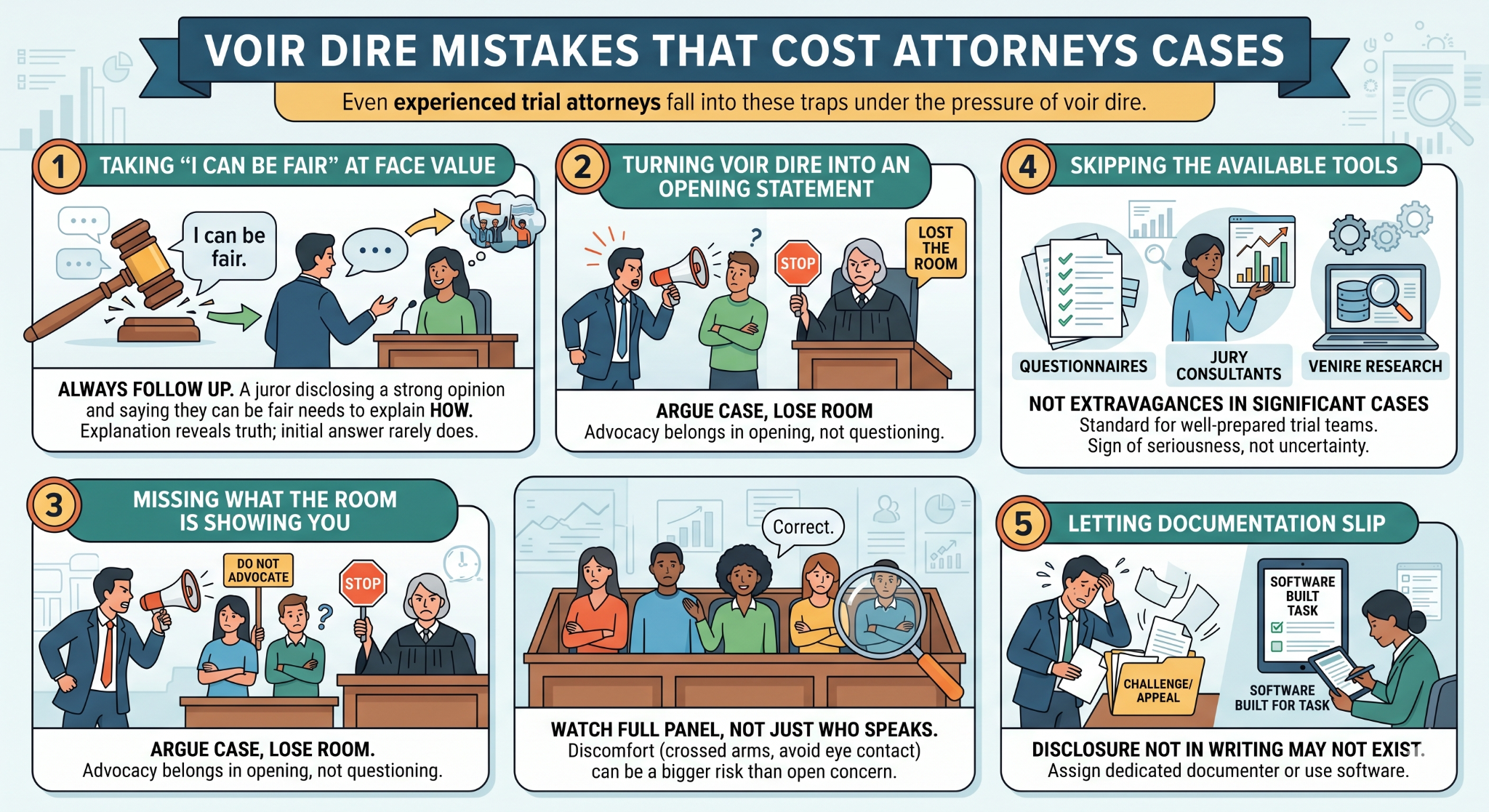
Voir Dire Mistakes That Cost Attorneys Cases
Even experienced trial attorneys fall into these traps under the pressure of voir dire.
Taking "I can be fair" at face value
Always follow up. A juror who discloses a strong prior opinion and then says they can be fair needs to explain how. The explanation tells you the truth. The initial answer rarely does.
Turning voir dire into an opening statement
The moment you start arguing your case, you lose the room. Judges will stop you and jurors will distrust you. Advocacy belongs in opening, not in questioning.
Missing what the room is showing you
A juror who says all the right things but crosses their arms, avoids eye contact, or gives one-word answers to open-ended questions may be a bigger risk than the one who openly discloses a concern. Watch the full panel, not just whoever is speaking.
Skipping the available tools
Questionnaires, jury consultants, and venire research are not extravagances in significant cases. They are standard for any well-prepared trial team. Using them is not a sign of uncertainty; it is a sign of seriousness.
Letting documentation slip
If a juror's disclosure is not in writing, it may not exist for purposes of a challenge or an appeal. Either assign someone dedicated to documentation or use software built for the task.
How Legal Intaker Frees You Up for What Matters in Court
Voir dire strategy is where you need to be sharp. The hours of preparation work that make that strategy possible do not require you to be the one doing it.
Building questionnaires, researching the venue, organizing juror profiles, drafting challenge records, preparing motions related to jury selection: all of that work is exactly what Legal Intaker's Legal-Trained Virtual Assistants handle. They are U.S. Law Experienced professionals who work remotely and integrate directly with your trial preparation workflow.
Specifically, they support trial attorneys with:
- Juror questionnaire drafting tailored to the case type and jurisdiction
- Venire background research compiled into organized, reviewable profiles within ethical limits
- Voir dire question bank development structured around case theory, key witnesses, and specific issues
- Challenge documentation tracking disclosures and challenge decisions in real time during voir dire
- Pre-trial filing support including motions to permit juror questionnaires and voir dire-related motions in limine
Attorneys who work with Legal Intaker's Pre-Vetted Talent Pool walk into voir dire better prepared than opposing counsel, with fewer hours spent on tasks that did not require their personal attention.
Your Voir Dire Strategy Starts Before You Walk In
Voir dire is not a warm-up. It is one of the most consequential strategic exercises in a trial, and the attorneys who treat it that way win more often. Jurors with unresolved bias do not neutralize themselves during deliberations. The case law, the research, and decades of trial practice all confirm the same thing: the attorney who prepares for voir dire with the same seriousness they bring to opening and closing walks in with a structural advantage.
The preparation that makes that possible includes questionnaire development, venire research, question bank building, and challenge documentation. That is exactly the kind of work Legal Intaker's Legal-Trained Virtual Assistants take off your plate. They are U.S. Law Experienced, drawn from a Pre-Vetted Talent Pool, and ready to support your trial team remotely from the moment pre-trial preparation begins.
Ready to go into voir dire fully prepared? Connect with a Legal Intaker Virtual Assistant today and put your pre-trial hours where they belong.

Frequently Asked Questions
What is the main purpose of voir dire?
Voir dire gives attorneys and judges the opportunity to question prospective jurors and identify bias before anyone is seated. The core purpose is to protect the Sixth Amendment right to an impartial jury and to give both sides a fair chance to assess who will actually decide the case. It is also your best opportunity to begin building credibility with the panel.
How many peremptory challenges does each side get?
The number depends on the jurisdiction and the type of case. In federal criminal trials, defendants receive 10 peremptory challenges in felony cases and 20 in capital cases, while prosecutors receive 6 and 10 respectively. Federal civil cases default to 3 per side. State rules vary widely, so always confirm the specific number with your jurisdiction's rules before jury selection begins.
Can a judge deny a challenge for cause?
Yes, and it happens. Judges have discretion to deny a challenge for cause if the grounds you present are not sufficient, or if the juror convincingly rehabilitates themselves during additional questioning. When that happens, use a peremptory challenge on that juror, state your objection clearly on the record, and document that you were required to spend a peremptory as a direct result of the denial. That record is what supports an appeal if the issue becomes material.
What is the difference between voir dire and jury selection?
Jury selection is the full process of seating a jury, which covers summoning the venire, distributing and reviewing questionnaires, conducting voir dire questioning, and making final seating decisions. Voir dire is specifically the examination phase within that process, where bias is identified and challenges are exercised. Think of jury selection as the process and voir dire as the strategy that drives it.






.png)
.png)








.webp)















.webp)

.webp)







.webp)