
Key Takeaways
- eCheck processing for law firms means accepting electronic check payments through the ACH network, ideally with a processor built to keep IOLTA accounts clean.
- The right processor routes its fees to your operating account, never to the IOLTA, and provides per-matter reporting your state bar will recognize.
- A solid setup needs ten steps, from picking the processor to monthly reconciliation and staff training.
- The American Bar Association Model Rule 1.15 and state bar trust rules still apply. eCheck just makes following them easier than paper checks.
- The fastest ROI is on retainers and settlements, where eCheck fees of a dollar or two replace credit card costs of $100 or more.
What is eCheck Processing?
eCheck processing for law firms is the system for accepting electronic check payments from clients through the ACH network. The client provides routing and account numbers, the processor sends the request to ACH, and the funds settle in the firm's bank account within 1 to 3 business days.
With the right legal processor, the full client payment lands in the IOLTA account, and processing fees come out of the firm's operating account. That fee routing is what makes eChecks the closest electronic equivalent to a paper check for trust accounting.
Why Law Firms Choose eCheck Processing
Law firms choose eCheck processing because it lowers payment friction, reduces processing costs, and fits cleanly into IOLTA rules. It also lifts the speed of payment compared to paper checks without inviting the chargeback risk of credit cards.
The strongest fit profiles:
- Retainers and settlements in the $1,000 to $50,000 range
- Court filing fees pulled from advanced client funds
- Recurring monthly engagements where credit card fees stack up
- Refunds back to clients with a clear paper trail
- Mid-size and growing firms that want to retire paper checks
eChecks rarely replace every payment method. Most firms keep credit cards for smaller consults and wires for very large settlements. eChecks dominate the middle.
eCheck Processing And IOLTA: What The Rules Require
eCheck processing and IOLTA fit together better than most electronic payments, but the trust account rules still apply. The American Bar Association Model Rule 1.15 requires lawyers to hold client funds separate from firm funds and to maintain complete records.
The non-negotiables most state bars enforce:
- Client funds and firm funds stay in separate accounts
- Each client matter gets its own ledger
- Processor fees never come out of the IOLTA account
- Settled funds stay in the IOLTA until earned, then move to the operating account
- The IOLTA account is reconciled at least monthly against bank statements and ledgers
- Records are kept for the period the state bar requires (usually 5 to 7 years)
The American Bar Association publishes ongoing IOLTA compliance guidance. Each state bar adds specific requirements on deposit timing, ledger format, and reconciliation cadence.
Choosing An eCheck Processor For Your Law Firm
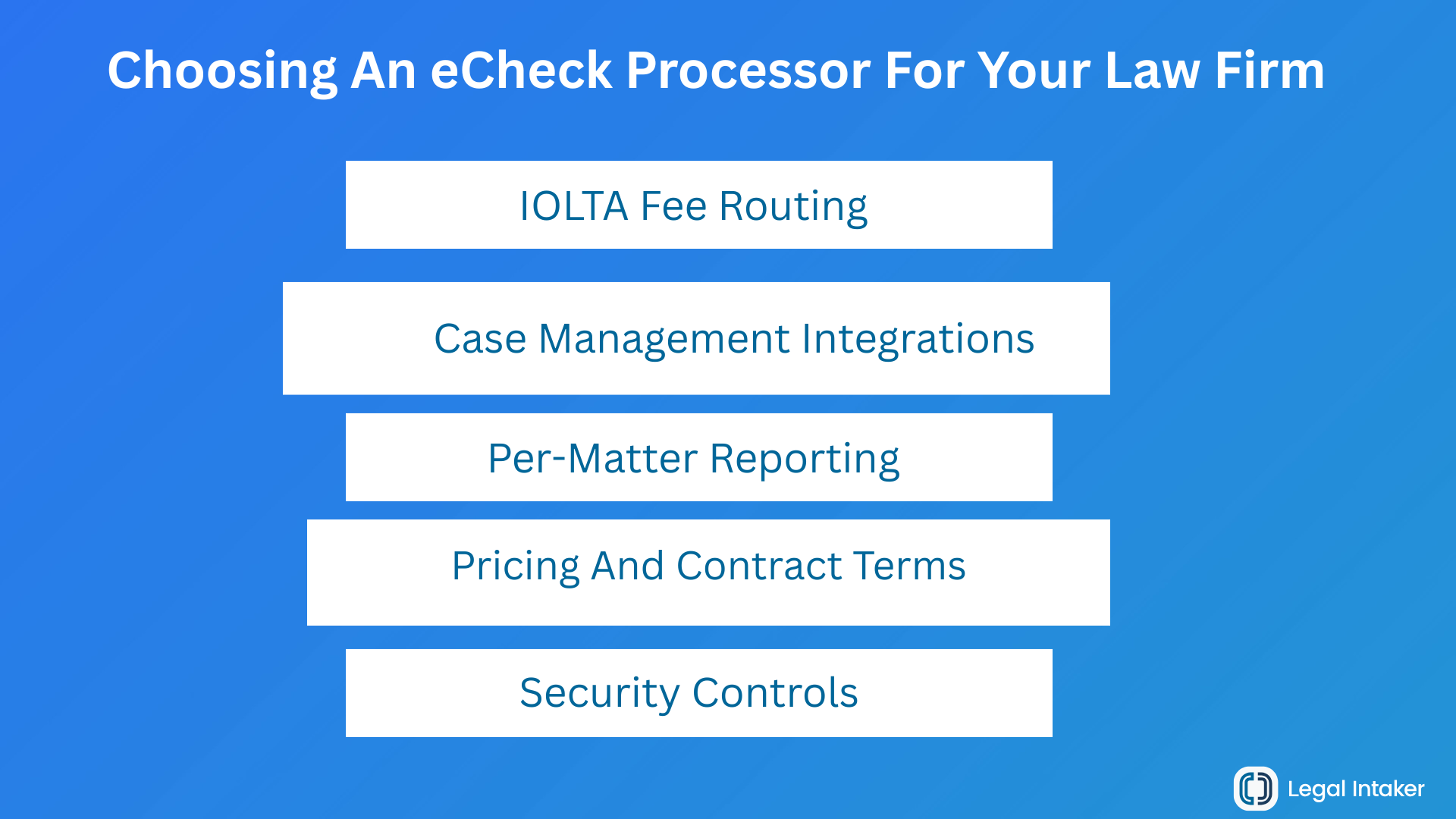
Choosing an eCheck processor comes down to five criteria: IOLTA fee routing, integrations with your case management system, per-matter reporting, pricing and contract terms, and security controls. Most legal-specific processors clear these. Most generic processors do not.
IOLTA Fee Routing
Confirm in writing that processor fees and chargebacks are debited from the firm's operating account, never from the trust account. This is the single biggest reason to choose a legal-specific processor over a general one like Stripe or Square.
Case Management Integrations
Verify native integrations with the firm's case management software (Clio, MyCase, Filevine, Litify, PracticePanther, or Smokeball). Native integrations sync clients, matters, invoices, and payments without manual entry and reduce reconciliation errors.
Per-Matter Reporting
The processor's reporting must support per-client-matter ledgers, not just aggregate firm reports. State bar audits routinely ask for matter-level activity. The reports should export to your accounting software and bar audit format.
Pricing And Contract Terms
Watch for:
- Per-transaction fee (usually $0.30 to $1.50 for eCheck)
- Monthly platform or gateway fee
- ACH return fee
- Chargeback fee
- Contract length and cancellation
- PCI and SOC 2 attestation
- Data ownership and exit terms
Security Controls
The processor should offer encryption at rest and in transit, role-based access for staff, multi-factor authentication, fraud monitoring, and ACH return alerts. Confidentiality also matters under ABA Model Rule 1.6.
Comparing eCheck Processors For Law Firms
The processors below are the most common legal-specific options in 2026. The table is a starting shortlist, not a recommendation. Pricing changes often. Confirm directly with each vendor.
Generic processors like Stripe, Square, and PayPal are widely used outside law, but they typically pull fees from whichever account is configured for billing, which breaks IOLTA compliance if the trust account is wired in.
How To Set Up eCheck Processing In 10 Steps
Set up eCheck processing in ten steps. Most firms can be live within seven to ten business days.
- Open two bank accounts. One IOLTA for client funds, one operating for earned fees and expenses.
- Confirm IOLTA bank eligibility. Use a bank approved by your state's IOLTA program.
- Pick a legal-specific processor. Use the five criteria above.
- Sign the processor agreement. Verify fee routing language in writing.
- Connect the processor to your case management system. Use the native integration, not a Zapier workaround.
- Build your invoice templates. Add a clear "pay by eCheck" link or button.
- Update the engagement letter. Include eCheck payment disclosure and authorization language.
- Train intake and billing staff. Cover phone-taken eChecks, recorded consent, IOLTA vs operating handling, and refund workflow.
- Run a pilot week. Process three to five small payments end to end, then audit each step.
- Set up monthly reconciliation. Three-way reconciliation across bank statement, client ledger, and IOLTA balance, signed off by an attorney each month.
Document each step in a written policy. A short policy keeps the team aligned and protects the firm during a bar audit.
eCheck Best Practices For Law Firms
Best practices group into five areas: intake, trust accounting, reconciliation, security, and operations. The firms that audit cleanly are the firms that follow all five.
Intake And Engagement Letter Practices
- Add eCheck payment disclosure to every engagement letter
- Capture written or recorded consent for every eCheck, no exceptions
- Use a standardized intake script when taking eChecks by phone
- Confirm bank account ownership against ID on larger first payments
- Tag every payment to a specific client matter at the moment of intake
Trust Accounting Best Practices
- Deposit unearned client funds into IOLTA only, never the operating account
- Move funds from IOLTA to operating only after fees are earned and invoiced
- Keep a separate ledger for every client matter, not just per client
- Refund unearned funds promptly from the IOLTA at matter close
- Never let processor fees, monthly platform fees, or chargebacks touch the IOLTA
Reconciliation And Audit Practices
- Reconcile monthly across three sources: bank statement, processor report, and client ledgers
- Investigate any variance the same day it appears
- Have an attorney sign off on monthly reconciliation
- Retain records for the period your state bar requires (5 to 7 years is common)
- Run a mock audit annually, with an outside CPA or bookkeeper
Security And Fraud Prevention Practices
- Encrypt eCheck data at rest and in transit
- Require multi-factor authentication on processor and case management logins
- Use role-based access so only billing staff can issue refunds
- Set ACH return and chargeback alerts to email the office manager
- Verify any change to a vendor or client bank account by phone, never by email
- Train staff to recognize wire and ACH fraud attempts
Operational And Staff Training Practices
- Document every payment workflow in a written runbook
- Run a 20-minute refresher every quarter
- Onboard new staff with a checklist that covers IOLTA basics, intake script, and processor login
- Test the disclosure script in a mock client call before going live
- Keep a printed escalation contact list near the front desk
A solid law firm client intake process is the foundation. Payment practices ride on top of it.
Sample Workflow: From Lead To Paid Retainer
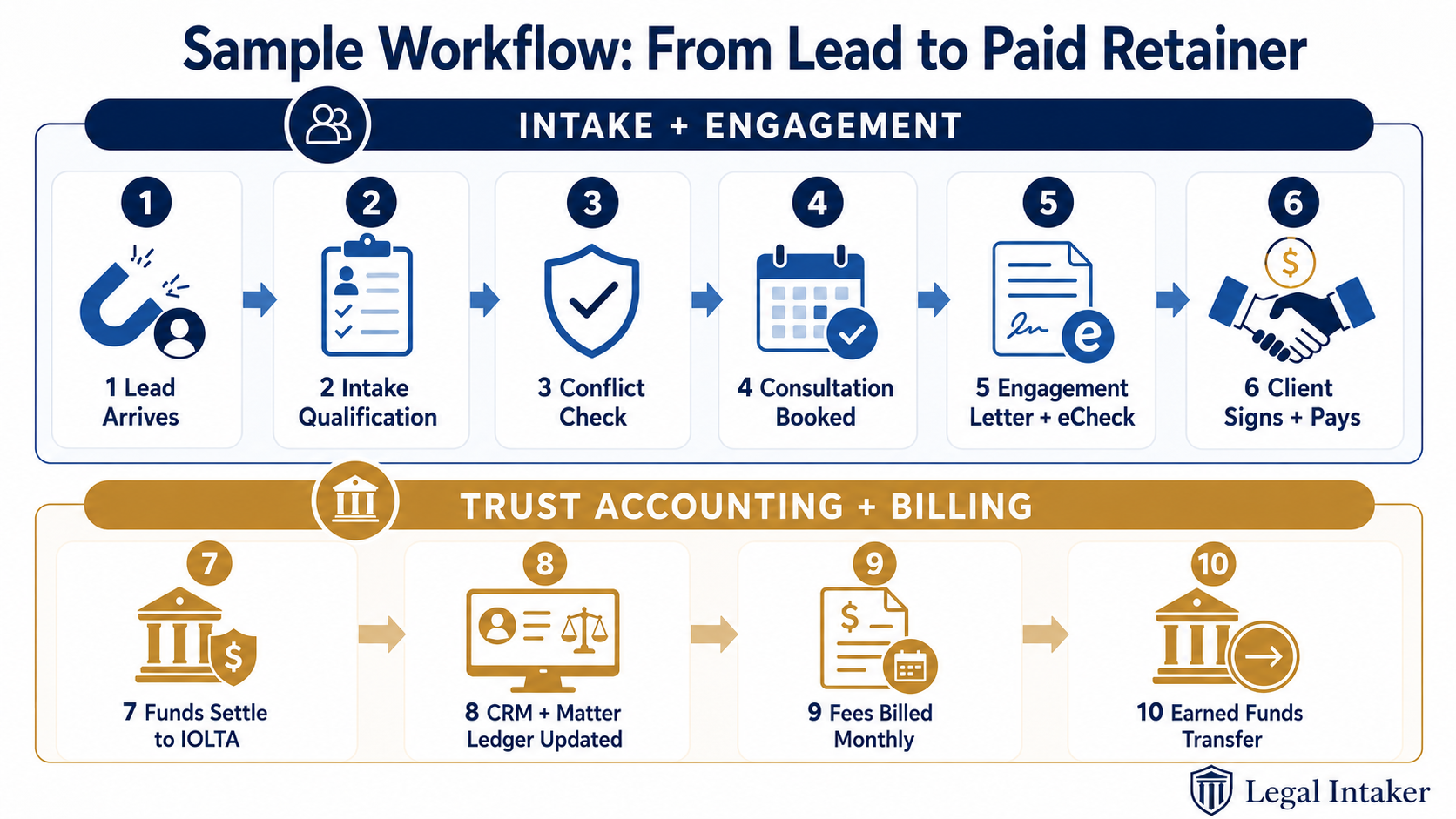
The workflow below ties intake to payment without manual handoffs. Use it as a template, then tune to your firm's stack.
- Lead arrives via web form, ad, or phone call.
- Intake specialist answers live and runs the qualification script.
- Conflict check runs against the case management system.
- Consultation booked directly into the attorney's calendar.
- Engagement letter sent with eCheck payment button.
- Client signs and pays the retainer by eCheck.
- Processor settles funds into the IOLTA in 1 to 3 business days.
- CRM updated with payment status, matter ledger created.
- Attorney earns fees over the matter, billed monthly.
- Earned funds move from IOLTA to operating with a written transfer authorization.
For coverage when intake staff are off the clock, see Legal Intaker's blog on legal intake phone services.
Common Pitfalls That Trigger Bar Complaints
Most trust-accounting bar complaints share the same root causes. eCheck setups are no exception.
- Letting processor fees come out of the IOLTA
- Mixing earned and unearned funds in one bank account
- No separate ledger per client matter
- Treating retainers as firm revenue before fees are earned
- Skipping monthly reconciliation
- Failing to refund unearned funds at matter close
- No documented payment policy or staff training
- Taking eChecks by phone without recorded consent
- Storing bank account details in unsecured email or chat
Fixing these patterns alone keeps most firms out of bar trouble. A 30-day audit of current practices is usually enough to surface the gaps.
eCheck Processing Costs And ROI
The ROI math for eCheck processing is usually decisive on retainers and settlements. The table below compares a typical $5,000 retainer across payment methods.
A 50-retainer-per-month firm switching from credit card to eCheck on those retainers saves roughly $5,000 to $7,000 per year before any operational efficiency gains.
Budget for a small monthly platform fee and the occasional return. Even with those, eCheck is the cheapest reliable digital option for the middle of the retainer range.
Compliance And Confidentiality Notes
eCheck processing data is sensitive. Bank routing numbers, account numbers, and authorization records require the same controls as other client information under ABA Model Rule 1.6 (confidentiality) and Model Rule 5.3 (supervision of non-lawyer assistants).
Practical checklist:
- Encryption at rest and in transit
- Signed business associate or data processing agreement with the processor
- Role-based access in the processor and CRM
- Recorded consent on phone-taken eChecks
- Annual review of vendor SOC 2 or equivalent attestation
- Refresh of staff training every quarter
- A documented incident response plan if data is exposed
For more on confidentiality and access controls when intake is outsourced, see Legal Intaker's HIPAA-compliant virtual legal intake specialists.
Run Intake And Payment As One Motion
The cleanest law firm payment systems are not built from the processor down. They are built from intake up. Every new lead that turns into a signed matter should pay with as little friction as possible.
See how Legal Intaker pairs bilingual legal intake specialists with HIPAA-grade workflows so new matters get qualified, scheduled, and ready for payment without bottlenecking on the front desk. Review Legal Intaker pricing or book a walkthrough to see how it fits your billing stack.

Frequently Asked Questions (FAQs):
How do you set up eCheck processing for a law firm?
Set up eCheck processing in ten steps. Open separate IOLTA and operating accounts, pick a legal-specific processor, sign an agreement that routes fees to the operating account, integrate the processor with your case management software, update invoices and engagement letters, train intake and billing staff, run a pilot week, and set up monthly three-way reconciliation.
Is eCheck processing IOLTA-compliant?
eCheck processing is IOLTA-compliant when paired with a processor built for law firms. The full client payment must land in the IOLTA account, and processor fees and chargebacks must come from the operating account. Generic processors that pull fees from whichever account is configured can break IOLTA rules.
What is the best eCheck processor for law firms?
The most common legal-specific options are LawPay, CPACharge, AffiniPay, Headnote, Gravity Legal, and ClientPay. The right choice depends on firm size, practice area, case management software, and whether you need additional billing tools. Compare them on IOLTA fee routing, integrations, per-matter reporting, pricing, and security controls.
How much does it cost to accept eChecks at a law firm?
eCheck transaction fees typically run $0.30 to $1.50 per payment, with monthly platform fees of $10 to $50 and ACH return fees of $5 to $25. For a $5,000 retainer, eCheck costs about a dollar, compared with $125 to $175 on a credit card.
How long does it take for an eCheck to clear at a law firm?
Standard eCheck settlement runs 1 to 3 business days through the ACH network. Same-day ACH is available through some processors for an added fee. Bank returns can take additional days to surface and may require manual handling, so most firms wait until full settlement before treating funds as cleared.
Can a law firm refund a client by eCheck?
Yes. Refunds from the IOLTA back to the client should be issued by eCheck or paper check from the trust account, never from the operating account if the original funds were trust funds. Document the refund with a written authorization, an updated client ledger, and a receipt.
Do eChecks have chargebacks like credit cards?
eChecks have lower chargeback risk than credit cards but are not chargeback-free. ACH returns can happen for insufficient funds, closed accounts, or disputed authorizations. Most ACH returns surface within a few business days. Set processor alerts so returns reach the office manager the same day.
What records does a law firm need to keep for eCheck payments?
Most state bars require records of the deposit, the client matter ledger entry, the authorization, and the reconciliation for 5 to 7 years. Keep the authorization (signed form, click consent log, or call recording), the processor's transaction record, the bank statement, and the client ledger together for each payment.





.png)
.png)










.webp)















.webp)

.webp)









.webp)