
Key Takeaways
- AI intake chatbots win on speed, cost, and 24/7 coverage. Human intake specialists win on emotional intelligence, judgment, and high-value conversions.
- Most firms should not pick one. A hybrid model, where AI captures and screens leads and humans qualify and close them, delivers the best of both.
- AI intake tools typically cost $80 to $500 per month. Human intake, whether in-house or virtual, runs $2,000 to $6,500 per month, and pays for itself when case values are meaningful.
- Ethics rules make disclosure and privilege awareness non-negotiable. AI-mediated intake must be disclosed, must not give legal advice, and must not create the illusion of privilege.
- The right choice depends on practice area, average case value, call volume, and whether the firm has bilingual clients or after-hours urgency.
What Is An AI Intake Chatbot?
AI intake chatbots capture leads fast and cheap. Human intake specialists convert them, especially on high-value or emotional matters. The strongest law firms use both.
An AI intake chatbot is a software tool that talks to prospective clients through a firm's website, text messaging, or messaging apps. Modern chatbots use large language models to ask conversational questions, collect facts about the matter, and route the lead into a CRM or intake system.
Typical capabilities include:
- 24/7 first-touch response on web, SMS, and social channels
- Structured qualification against practice-area criteria
- Conflict-check triggers, though the human still verifies
- Booking consultations into an attorney calendar
- Escalation to a human when the conversation exceeds the bot's scope
Costs typically run $80 to $500 per month for a small-firm chatbot, with enterprise setups higher.
What Is A Human Intake Specialist?
A human intake specialist is a trained person who answers calls, emails, and messages from prospective clients and runs the firm's intake process. The role can be in-house or delivered by a virtual staffing partner.
Typical capabilities include:
- Live-answer coverage during firm hours, after-hours, or 24/7 depending on setup
- Practice-area-specific qualification scripts
- Real judgment on urgent, ambiguous, or emotional matters
- Bilingual coverage (usually Spanish, sometimes more)
- Warm transfers to the attorney when a lead qualifies
- Full-context CRM entry, follow-up on open intakes, and light case management
Costs typically run $2,000 to $4,500 per month for a virtual legal staffing partner, or $4,500 to $6,500 loaded for a full-time in-house hire.
Head-To-Head Comparison
The table below maps AI intake chatbots and human intake specialists across the dimensions that matter most for law firms.
Read the table with the practice area in mind. A high-volume PI intake team and a boutique estate planning firm will not weigh these rows the same.
Where AI Intake Chatbots Win
AI intake chatbots win on speed, availability, and cost. The strongest use cases are the ones where volume is high and case values are moderate.
Best fits for AI-heavy intake:
- After-hours first response when the firm has no human coverage
- Consumer practice areas with predictable intake questions (traffic, small immigration matters, template estate documents)
- Firms drowning in unqualified web leads
- Multichannel presence (chat widget, SMS, Instagram, Facebook Messenger)
- Firms that already spend heavily on ads and need faster first-touch to protect conversion
Industry research supports the speed argument. According to Clio's 2024 Legal Trends Report, a secret shopper study of 500 law firms found that only 40 percent answered phone calls directly, and once callbacks are counted, 48 percent were essentially unreachable by phone at all. That gap is exactly where AI first-touch closes the biggest hole in a firm's intake funnel.
Human Intake Specialists Win
Human intake specialists win on judgment, empathy, and conversion at the moment a lead is deciding whether to hire your firm. The strongest use cases are practice areas with high case values, emotional stakes, or complex qualifications.
Best fits for human-led intake:
- Personal injury and mass tort where speed-to-live-conversation drives signup
- Family law where clients are frequently in crisis
- Immigration where bilingual empathy is essential
- Criminal defense where the caller may be in custody or under stress
- High-net-worth estate planning and business formation
- Any matter where the client's first live conversation is with the firm's face
A 2023 McKinsey Customer Care Survey of 3,500 consumers found that 71 percent of Gen Z respondents and 94 percent of respondents 59 and older said live phone conversations were the quickest, easiest way to reach customer support (McKinsey). Legal matters, with their emotional and financial stakes, sit squarely in the category where that preference matters most. Live human answer within a few minutes of a form fill dramatically outperforms voicemail or AI-only follow-up.
The Ethics And Privilege Reality Check
AI-mediated intake is permissible in most jurisdictions when the firm handles disclosure, scope, and confidentiality properly. Get any of those wrong and the firm is exposed.
Most U.S. state bar guidance as of 2026 points toward three requirements, though the specifics and level of formality vary by jurisdiction:
- The prospect is informed they are communicating with an AI, not a lawyer
- The AI does not provide legal advice or assess case merit
- Confidential information shared with the AI is handled in a way that does not breach client confidentiality
The American Bar Association's Formal Opinion 512 on generative AI tools, issued in July 2024, is the ABA's first formal guidance in this area and applies Model Rules 1.1 (competence), 1.6 (confidentiality), 5.3 (supervision of non-lawyer assistance), and 5.5 (unauthorized practice of law) to AI use. Florida's Advisory Opinion 24-1 goes further on the intake-specific point, requiring that any chatbot interacting with prospective clients disclose that they are talking to AI, not a human lawyer. State guidance is still evolving, so check your specific state bar's position before launching an AI intake tool.
Human intake specialists carry their own compliance framework, but the guardrails are simpler. Confidentiality training, confidential handling of medical information consistent with your firm's data obligations, and TCPA-compliant SMS practices cover most of the risk.
Cost Comparison Over 12 Months
The table below compares three intake setups for a mid-size law firm over 12 months. Numbers are planning benchmarks.
The math almost always favors humans or hybrids in practice areas where a single signed case pays for a year of service. Personal injury, family law, immigration, criminal defense, and business formation typically qualify.
For AI-only to make sense, the firm's average case value has to be low enough that the added conversion from a human does not justify the spend.
Conversion Rates: What The Data Actually Says
Independent research and vendor data both show clear patterns on conversion.
- The 2007 MIT/InsideSales.com Lead Response Management Study, led by Dr. James Oldroyd, analyzed over 15,000 leads and found that contacting a lead within 5 minutes makes a business 100 times more likely to make contact and 21 times more likely to qualify that lead, compared with waiting 30 minutes.
- Only 40 percent of law firms answer their phones live during business hours, per Clio's 2024 secret shopper study, which is where AI first-touch closes the biggest gap.
- Live human follow-up within a short window still outperforms AI-only follow-up on high-intent, high-value legal matters.
The takeaway is directional but consistent. AI wins the first-touch war. Humans win the conversion war. Firms that combine the two capture both.
The Hybrid Model: How Modern Law Firms Combine Both
The hybrid intake model uses AI for first-touch and screening, and humans for qualification and closing. Most growing law firms end up here after trying one side or the other alone.
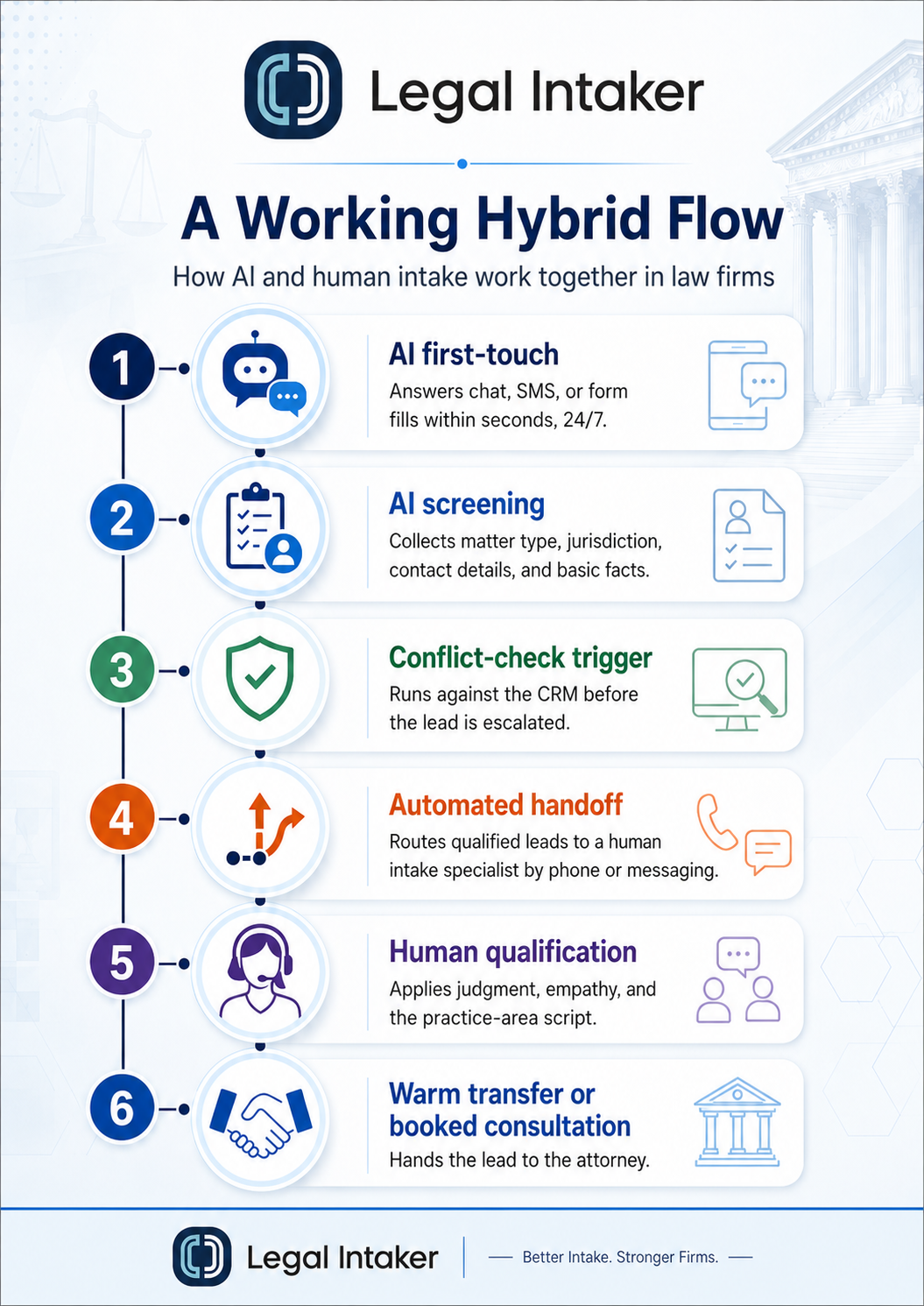
A working hybrid flow:
- AI first-touch answers the chat, SMS, or form fill within seconds, 24/7
- AI screening collects matter type, jurisdiction, contact details, and basic facts
- Conflict-check trigger runs against the CRM before the lead is escalated
- Automated handoff routes qualified leads to a human intake specialist by phone or messaging
- Human qualification applies judgment, empathy, and the practice-area script
- Warm transfer or booked consultation hands the lead to the attorney
- Follow-up happens on a mixed schedule with automated reminders and human calls
The best hybrid setups do not treat AI and humans as competitors. They treat them as two shifts of the same intake team.
When To Choose AI-Only Intake
AI-only intake fits a narrow band of firm profiles. Choose it if all five hold true.
- Average case value is low enough that human conversion gains do not clear the added cost
- Practice area is high-volume, low-complexity (traffic, template documents)
- Emotional context is low (few crisis calls)
- Bilingual capacity is either not needed or well-handled by modern AI
- The firm has strict budget constraints and needs to stay under a few hundred dollars per month
Even in those cases, add a fallback to a human for edge cases and complaints.

When To Choose A Human Intake Team
A human intake team fits any firm where case values are meaningful, empathy matters, or complexity is high. Choose humans if two or more hold true.
- Average case value is $2,000 or more
- Practice area is emotionally charged (family, criminal, immigration, PI)
- Clients often speak a language other than English
- Cases turn on nuance and judgment
- Ad spend is high and every missed lead is costly
- The firm wants the human handoff to feel like part of the firm, not a vendor
Most consumer-facing law firms in 2026 fit at least two of these. Add AI first-touch on top rather than replace humans with it.
How To Set Up A Hybrid Intake Workflow
Set up a hybrid intake workflow in eight steps. Most firms can be live within three to four weeks.
- Map the current intake funnel. Where do leads come in, and where do they drop off?
- Pick the AI first-touch tool. Choose one that offers legal-specific templates, disclosure, and a warm handoff to a human.
- Pick the human intake team. In-house, virtual staffing partner, or a mix. Bilingual coverage is usually worth the modest premium.
- Write the AI script. Cover disclosure, matter type, contact details, urgency triggers, and the handoff moment.
- Write the human intake script. Practice-area qualification, conflict check confirmation, consultation booking, and follow-up rules.
- Configure the CRM. Every AI conversation and human call lands in the same matter file with source tracking.
- Train both sides. The AI on the script, the humans on the handoff, and everyone on ABA Model Rule 1.6 confidentiality.
- Review weekly for the first 60 days. Adjust the script, the handoff triggers, and the follow-up cadence based on real conversations.
For the human side of the loop, see Legal Intaker's blog on why remote intake specialists drive law firm growth and the operational blueprint for a law firm client intake process.
Common Mistakes Firms Make Choosing Between AI And Human Intake
Most firms make the same mistakes when picking between these two options.
- Choosing AI because it is cheap, then losing high-value cases to weak handoffs
- Choosing humans and skipping first-touch coverage after hours
- Skipping disclosure that the visitor is talking to an AI
- Letting the AI collect confidential facts without a clear privacy policy
- Treating the AI as a decision-maker instead of a screener
- Assigning intake to attorneys as a stopgap and burning them out
- Failing to track cost per signed case by intake source
The fix is usually the hybrid model plus a written intake policy. Both take a week of setup and pay back for years.
Pick The Intake Model That Signs More Clients
The choice between AI intake chatbots and human intake specialists is rarely one or the other. It is a question of what each part of the funnel needs. Fast first-touch belongs to AI. Judgment, empathy, and conversion belong to humans.
See how Legal Intaker pairs bilingual human intake specialists with HIPAA-grade workflows that plug directly into any AI-first funnel. Review Legal Intaker pricing or book a walkthrough to see how the hybrid model fits your firm.

Frequently Asked Questions (FAQs):
What is the main difference between an AI intake chatbot and a human intake specialist?
An AI intake chatbot is software that talks to prospective clients through chat, SMS, or forms, 24/7, at low cost. A human intake specialist is a trained person who handles live calls and messages with judgment, empathy, and practice-area knowledge. AI wins on speed and cost. Humans win on complex conversations and high-value conversion.
Which converts better: AI chatbots or human intake specialists?
Both improve conversion over voicemail and static forms, but on different parts of the funnel. AI chatbots increase first-touch capture by up to 30 percent because they respond within seconds. Human intake specialists convert higher-value leads because they apply judgment, empathy, and warm handoffs to the attorney. The strongest results usually come from combining both.
Do state bars allow AI chatbots for legal intake?
Most U.S. state bars in 2026 allow AI-mediated intake if three conditions hold: the prospect is informed they are communicating with AI, the AI does not provide legal advice or assess case merit, and confidential information is handled in a way that does not breach client confidentiality. Check your specific state bar opinion before launching.
How much does an AI intake chatbot cost for a law firm?
AI intake chatbot pricing typically runs $80 to $500 per month for small firms. Enterprise tools with deeper legal templates, integrations, and analytics can run $1,000 to $3,000 per month. Add setup and monthly platform fees to the base price. Legal-specific tools cost more than generic chatbots.
How much does a human intake team cost for a law firm?
A virtual legal intake staffing partner typically costs $2,000 to $4,500 per month, depending on hours covered and bilingual capacity. A full-time in-house intake specialist runs $4,500 to $6,500 per month once salary, benefits, and overhead are included. Many firms combine a smaller in-house presence with a virtual partner for after-hours and overflow.
Can AI chatbots handle emotional or urgent legal matters?
AI chatbots handle emotional or urgent matters poorly. They can recognize urgency keywords and escalate to a human, but they cannot deliver the empathy, judgment, and reassurance a caller in crisis needs. Family law, criminal defense, and personal injury firms should route these matters to a human as soon as urgency is detected.
Is a hybrid intake model right for most law firms?
Yes for most consumer-facing law firms. A hybrid model uses AI for 24/7 first-touch and screening, then hands qualified leads to a human specialist for qualification and closing. It captures the speed benefit of AI and the conversion benefit of humans without a full jump in either direction.
What are the ethics risks of using AI for legal intake?
The main risks are unauthorized practice of law if the AI gives legal advice, breach of confidentiality if the AI stores or shares client information improperly, and inadequate supervision under ABA Model Rules 5.3 and 5.5. Every AI intake setup should include a clear disclosure, a scope limit, a data protection agreement with the vendor, and documented supervision by an attorney.





.png)
.png)









.webp)














.webp)

.webp)









.webp)