Disclosure: Legal Intaker publishes this review and is one of the options below. We scored every provider, including ourselves, on the same six criteria, using each company's public pricing and independent reviews.
Answering Legal's main pricing page asks for your phone number before it shows a price. An older rate card still on its site starts at $3.91 a minute. Its client reviews average 4.8 out of 5. All three are true at once, and together they explain why firms look for alternatives: the service is well liked, but the bill is hard to predict.
Firms that leave rarely complain about the receptionists. They complain about the invoice in their busiest month, or about leads that were answered politely and then never called back.
Answering Legal is one of the best-known legal answering services in the country, and for many firms it does exactly what they need. But it's one model among several. Some firms want per-minute live answering. Others want an AI receptionist that costs the same in a busy month as a quiet one, or a dedicated intake specialist who follows up until the lead signs.
This guide starts with a fair Answering Legal review, then compares 7 alternatives by price, coverage and fit.
Answering Legal review: quick summary
Answering Legal is a good legal-only answering service with an unpredictable bill. U.S. receptionists answer 24/7 and clients rate it 4.8/5, but you pay per minute, overages included. Choose it if you want a human on every call and steady volume. Look elsewhere if busy months spike your bill or answered leads go unsigned.
What is Answering Legal?
Answering Legal is a legal answering service based in Long Island, New York, that has provided 24/7 receptionist services exclusively for law firms since 2013. Its bilingual English- and Spanish-speaking receptionists answer incoming calls, conduct client intake, take messages, schedule consultations, and transfer urgent calls based on each firm's instructions.
Answering Legal supports transferring intake records to legal software through integrations with Clio Grow, MyCase, PracticePanther, Smokeball, Lawmatics, Lead Docket, Litify, and SmartAdvocate. The service offers a free trial for new firms and does not require long-term contracts.
How we evaluated the alternatives
We scored each provider from 1 to 10 on six criteria, for a total out of 60. Answering Legal is scored the same way as a baseline.
- Coverage: can it answer every call, nights and weekends included, without extra hires?
- Intake quality: does it qualify leads and book consultations, or mostly take messages?
- Price transparency: can you see the price before a sales call?
- Cost at volume: what happens to the bill in a busy month?
- Spanish support: can Spanish-speaking callers complete intake without a callback?
- Integrations: does intake data reach your CRM or case management system?
Pricing comes from each company's own website where it's published, and from named third-party sources where it isn't. Prices are as of November 2026.
7 Answering Legal alternatives at a glance
Prices as of November 2026. "Reported" means the price comes from a third-party source because the provider doesn't publish it.
The 7 best Answering Legal alternatives
The list runs by model (dedicated staff, then AI and hybrid, then live answering) rather than by score. Scores are in the scorecard below.
1. Legal Intaker
Best for: firms that want one trained person who owns intake from first call to signed client.
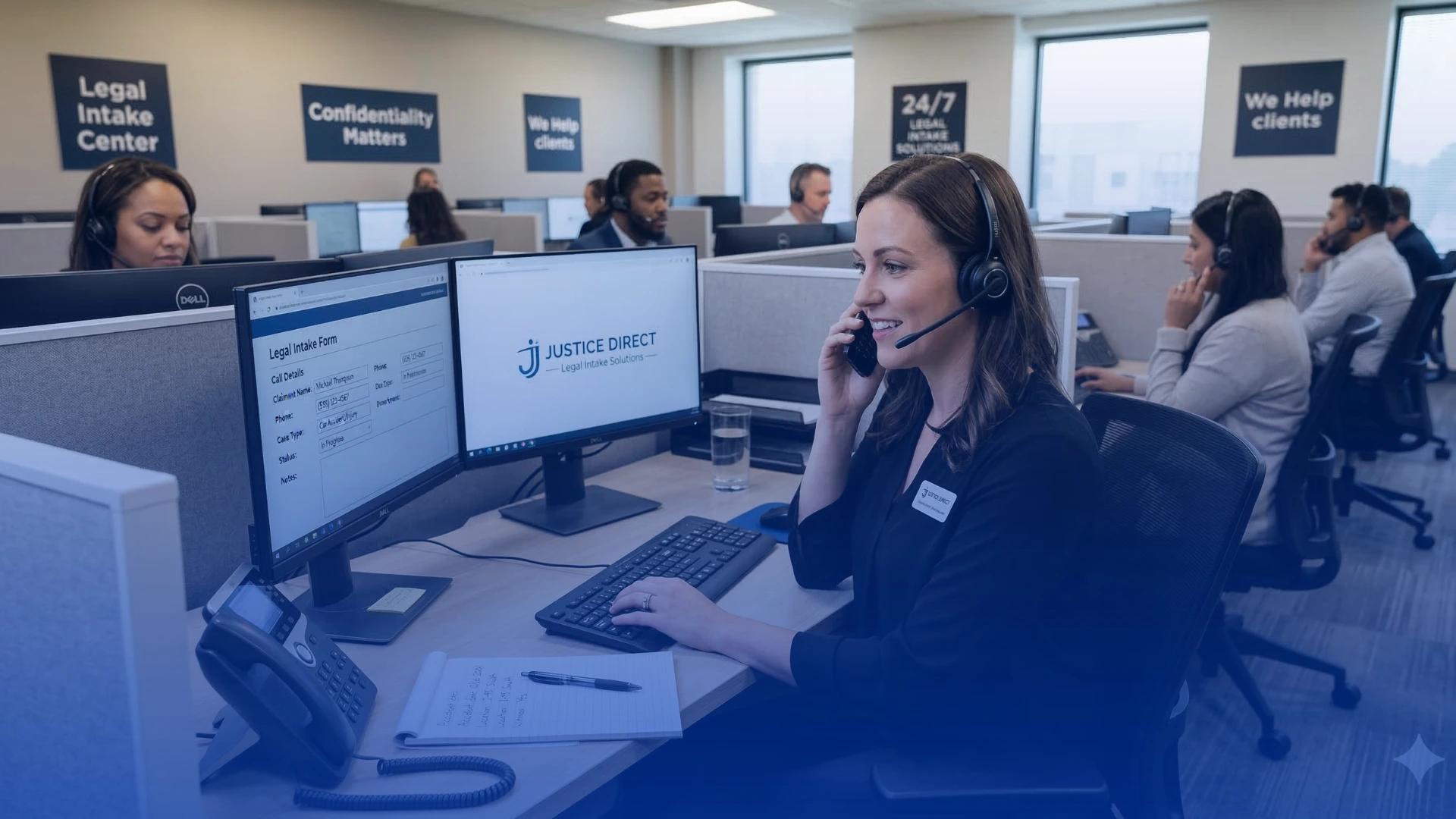
Legal Intaker places remote legal intake specialists from Latin America and the Philippines with U.S. law firms. Specialists are trained by U.S.-based attorneys, work your scripts, CRM and calendar, and follow up with leads that don't sign on the first call.
Pricing: from $13/hour (Philippines) or $15/hour (Latin America), month-to-month.
Pros
- Intake is the only job, so screening and follow-up get full attention
- Fixed hourly cost, so a busy month doesn't raise the bill
- English and Spanish specialists
Cons
- One specialist covers one shift, so 24/7 means several hires or a backup service
- Offshore staff, which some firms or clients prefer to avoid
Overall: 46/60
2. Legal Soft
Best for: firms that want one full-time remote hire who covers intake plus admin or case support.
Legal Soft is a legal staffing company that places full-time remote intake specialists, legal assistants, case managers and paralegals with U.S. firms, and manages them on its own platform.
Pricing: flat monthly, from $10 per hour for a full-time assistant.
Pros
- Flat monthly price is easy to budget
- One hire can cover intake, scheduling and admin
- Bilingual staff available
Cons
- Same one-shift limit as any staffing model
- Not intake-only, so intake competes with other tasks
Overall: 44/60
3. Smith.ai
Best for: firms that want an AI receptionist with live agents as backup.
Smith.ai offers an AI receptionist that answers, screens and books, with escalation to live agents, plus a separate human receptionist service.
Pricing: AI receptionist free for 25 calls a month, then $150 for 75 calls or $500 for 300 calls. Human receptionists from $300/month for 30 calls.
Pros
- Answers instantly, 24/7
- Charges per call, so long intake calls don't cost more
- Broad CRM and calendar integrations
Cons
- Add-ons (Spanish, scheduling, live handoff) can raise the real cost
- Not legal-only, so intake scripts need careful setup
Overall: 49/60
4. AI Answering
Best for: small and mid-size firms that want AI intake priced per call, not per minute.
AI Answering is an AI voice agent platform for inbound and outbound calls. It handles lead capture, intake, scheduling and follow-up, escalates complex calls to live agents with context attached, and supports English and Spanish.
Pricing: pay as you go at $1.50 per AI call, or monthly plans: Starter $45 (30 calls), Growth $150 (100 calls), Business $450 (300 calls) and Unlimited $997. Live human agents cost $3.50 per call; Enterprise is custom.
Pros
- Billed per call, so long intake calls don't cost more
- Answers every call, 24/7
- Outbound follow-up as well as inbound
Cons
- Callers who want a human may hang up on an AI
- Fewer published legal integrations than the legal-only services
Overall: 48/60
5. Ruby
Best for: firms that want a polished human voice and will pay for it.
Ruby is a U.S.-based live virtual receptionist service used by many law firms, with bilingual receptionists and optional live chat.
Pricing: $250/month for 50 minutes, $395 for 100, $720 for 200 and $1,725 for 500.
Pros
- Consistently strong call quality
- Published prices
- Spanish included
Cons
- Highest per-minute cost on this list at low volume ($5.00/minute on the 50-minute plan)
- General answering service, not legal-only
Overall: 44/60
6. LEX Reception
Best for: firms that want legal-focused live answering with deep software integrations.
LEX Reception is a live virtual receptionist service built mainly for law firms. Receptionists handle intake, scheduling, payment intake and outbound follow-up calls, and sync with Clio, MyCase and Lawmatics.
Pricing: reported at $425/month for 150 minutes, with overages around $2.75/minute.
Pros
- Built around law firm workflows
- Strong integrations with legal software
- Makes outbound calls, not just inbound
Cons
- Still per-minute, so busy months cost more
- Prices aren't fully published
Overall: 46/60
7. Back Office Betties
Best for: small firms that want U.S.-based receptionists and billing to the second.
Back Office Betties provides U.S.-based virtual receptionists for law firms, plus optional virtual assistant hours. It bills the actual length of each call rather than rounding up.
Pricing: $360/month for 100 minutes, up to $1,400/month for 500 minutes. 1-week free trial.
Pros
- Billed to the second, not rounded up
- Law firm focus
- Published prices
Cons
- Third-party comparisons list business-hours coverage, not 24/7
- Per-minute costs rise with volume
Overall: 42/60
Scorecard: how the alternatives compare
Each criterion is scored 1–10. Answering Legal is included as the baseline.
A high total doesn't make a provider right for you. A PI firm with most new-lead calls after hours should weight coverage far above price transparency.
Answering Legal pricing
Answering Legal bills by the minute: you buy a monthly bucket of minutes, and minutes over the bucket are charged at an overage rate set in your agreement.
An older Answering Legal rate card still on its site lists $3.91/minute on a 50-minute plan, falling to $2.48/minute at 400 minutes and $2.25/minute above 1,500 minutes. Its main pricing page now asks for your details before showing packages, and the company says it sets your plan from your call volume during a free trial. Treat the rate card as a guide, not a quote.
There are no long-term contracts or setup fees. Trial terms vary across Answering Legal's own pages (7 days, 14 days or 400 free minutes), so confirm them before you start.
What it costs at real volume
Estimated monthly cost at three call volumes, using each provider's published or reported plan and an average call of 3 minutes.
Per-minute services get more expensive as calls grow. AI receptionists stay cheap but don't follow up like a person. Dedicated staff cost the most of these options, but the price doesn't change with call volume, and the same person can chase leads between calls.
What Answering Legal does well
Legal-only receptionists
Answering Legal answers only for law firms, so its receptionists know intake terms and how a distressed caller sounds. Reviews consistently praise call quality, and many say callers can't tell they've reached an answering service.
U.S.-based coverage, 24/7
Live receptionists in the U.S. answer around the clock, including holidays, in English and Spanish. That matters for criminal defense and PI, where the best calls often come at night.
Integrations with legal software
Intake can flow straight into Clio Grow, MyCase, Lawmatics, Smokeball, Litify and other legal tools, which saves retyping and keeps leads from slipping.
No long-term contract
Service is month-to-month with no setup fee, and you start with a free trial, so the risk of trying it is low.
Where Answering Legal falls short
Costs rise with your busiest months
Per-minute billing means a strong marketing month is also an expensive answering month. Long intake calls, spam and wrong numbers all use minutes.
The overage rate isn't published
The rate for minutes over your plan is set in your agreement, so you can't compare a busy month's cost before signing. Ask for it in writing.
Receptionists answer; they don't own the lead
A shared receptionist team follows your script, then hands the lead back. Someone at your firm still has to call back, chase and sign the client.
Billing and accuracy complaints
Most reviews are positive, but the negative ones cluster around a few themes: unexpected overages, pressure to move to bigger plans, slow cancellations, and receptionists booking matters the firm doesn't handle. Check recent reviews before you sign.
Which type of Answering Legal alternative do you need?
Pick the model before the brand.
Live answering service
- Examples: Ruby, LEX Reception, Back Office Betties
- How it works: a shared team of receptionists answers on your script
- How cost behaves: per minute, so it rises with call volume
- Best for: firms that want a human on every call and have steady volume
AI receptionist
- Example: AI Answering
- How it works: AI answers, screens and books, 24/7
- How cost behaves: per call or a monthly call allowance, not per minute
- Best for: cost-conscious firms with high or spiky call volume
Hybrid AI and live agents
- Example: Smith.ai
- How it works: AI answers first, and live agents take harder calls
- How cost behaves: per call, plus add-ons
- Best for: firms that want AI speed with a human fallback
Dedicated intake staff
- Examples: Legal Intaker, Legal Soft
- How it works: one trained person works your intake and follow-up every day
- How cost behaves: fixed hourly or monthly
- Best for: firms whose problem is converting leads, not just answering
Many firms combine two: dedicated staff for business hours and an AI or answering service for nights and weekends. To see the dedicated-staff model in practice, read how Legal Intaker's intake specialists work.
How to choose an Answering Legal alternative
Start from the problem you're trying to fix.
Before you sign with anyone, ask four questions:
- What will a month with twice our normal calls cost, in writing?
- Do spam, wrong numbers and short calls count toward our bill?
- Who follows up with a lead who doesn't book on the first call?
- How do we cancel, and how much notice is needed?
Should you stay with Answering Legal or switch?
Stay if your call volume is steady, your bills rarely include overages, and you want a legal-trained human on every call. Answering Legal is well reviewed and does that job well.
Switch if busy months keep producing surprise bills, if most of your minutes go to calls that don't need a person, or if leads are being answered but not signed. In the first two cases, an AI receptionist will likely cost less. In the third, the gap isn't answering at all; it's follow-up, which is where dedicated intake staff earn their cost.
Where Legal Intaker fits
Legal Intaker gives your firm a dedicated, intake-only specialist who answers your calls, qualifies leads, books consultations and follows up until each lead signs or says no. Specialists are bilingual, trained by U.S.-based attorneys, and billed hourly with no long-term contract.
If leads are reaching your firm but not turning into clients, see Legal Intaker pricing or learn how Legal Intaker's intake specialists work.