Estate planning and probate intake is the process a law firm uses to turn an inquiry into a signed client. A clear process answers every call, screens the lead, and books a consultation in one conversation. According to the Clio Legal Trends Report 2024, only 40% of firms answered a prospective client's phone call.
Estate planning and probate leads need different handling. Planning clients tend to put off decisions. Probate callers are often grieving and facing court deadlines they don't know about yet.
This guide covers both intake workflows step by step. You'll find the questions to ask, documents to request, red flags to catch, and numbers to track. We also compare in-house intake with dedicated intake services.
What is estate planning and probate intake?
Estate planning and probate intake is how a law firm turns a call or web inquiry into a signed client. Before looking at intake, it helps to define the two practice areas it serves.
What is estate planning?
Estate planning is deciding who gets your property and who makes decisions for you if you die or can't act for yourself. A basic plan includes a will, a financial power of attorney, and a health care directive. Many plans also use a trust to avoid probate or manage assets for children.
What is probate?
Probate is the court process for settling a person's estate after they die. The court validates the will, appoints an executor, and oversees paying debts and distributing property. Assets in a trust, joint accounts, and accounts with named beneficiaries usually skip probate.
What intake covers
Intake runs from the first contact to the signed engagement letter. It has six parts:
- Respond: Answer the call or form quickly.
- Screen: Check that the matter fits your practice and location.
- Check conflicts: Make sure the firm can take the case.
- Gather facts: Collect family, asset, and document details.
- Schedule: Book the consultation.
- Convert: Send the fee quote and engagement letter, then follow up.
Intake ends when the client signs. What happens after that, like collecting documents and starting the work, is called onboarding.
Why this practice area needs its own intake process
Generic intake scripts don't ask the right questions. Estate planning needs details like marital status, children, and how property is owned. Probate needs the date of death, whether there's a will, and who the executor is.
Probate callers are also often grieving and unsure what to do next. A script built for this practice area helps staff guide them to a booked consultation.
Estate planning vs probate intake: key differences
Estate planning intake is proactive and sales-driven, while probate intake is reactive and deadline-driven. The planning client is deciding whether to act at all. The probate client already has a problem and is deciding who to trust with it.
What this means for your intake team
You need two scripts, two follow-up cadences, and two sets of qualifying questions. A single "estate" script tends to rush planning leads and under-serve probate callers.
Planning leads need patience and a reason to act now. Probate leads need a calm voice, a simple explanation of what happens next, and a booked appointment before they hang up.
Some matters sit in between. A trust administration after death looks like probate on the phone but may never touch a court. A caller with an aging parent may need incapacity planning, guardianship, or both. Train intake staff to route these hybrid cases to the right attorney instead of forcing them into one bucket.
Why intake decides whether leads become clients
Most estate planning and probate leads are lost to slow or missing responses, not to price. The secret shopper study in the Clio Legal Trends Report 2024 contacted 500 US law firms posing as prospective clients. The results show how wide the gap is.
Here's what the 2024 secret shopper study found:
Phone calls
Only 40% of firms answered the phone, down from 56% in 2019. Just 52% answered or called back, which left 48% unreachable by phone.
Only 33% of firms replied to email, down from 40% in 2019.
Client experience
73% of shoppers would not recommend the firm they contacted. Phone contact performed best, with 39% of shoppers willing to recommend a firm they reached by phone.
Sources: Clio Legal Trends Report 2024 highlights; Illinois Supreme Court Commission on Professionalism summary.
The demand is there, but it's fragile
The market for estate planning is large and mostly untapped. According to the Caring.com 2025 Wills and Estate Planning Study, only 24% of US adults have a will. The same study found that parents of children under 18 are the largest group without any planning documents.
That gap cuts both ways for intake. Plenty of people need a plan, but most have put it off for years. When one finally calls, a missed call or a slow reply gives them an easy reason to put it off again.
Probate leads have a short window
Probate callers usually contact several firms in the same afternoon. The first firm that answers, explains the process clearly, and offers a time slot tends to win the matter. A voicemail greeting rarely competes with a live person who can say, "Here's what happens next."
Step-by-step intake workflow for estate planning cases
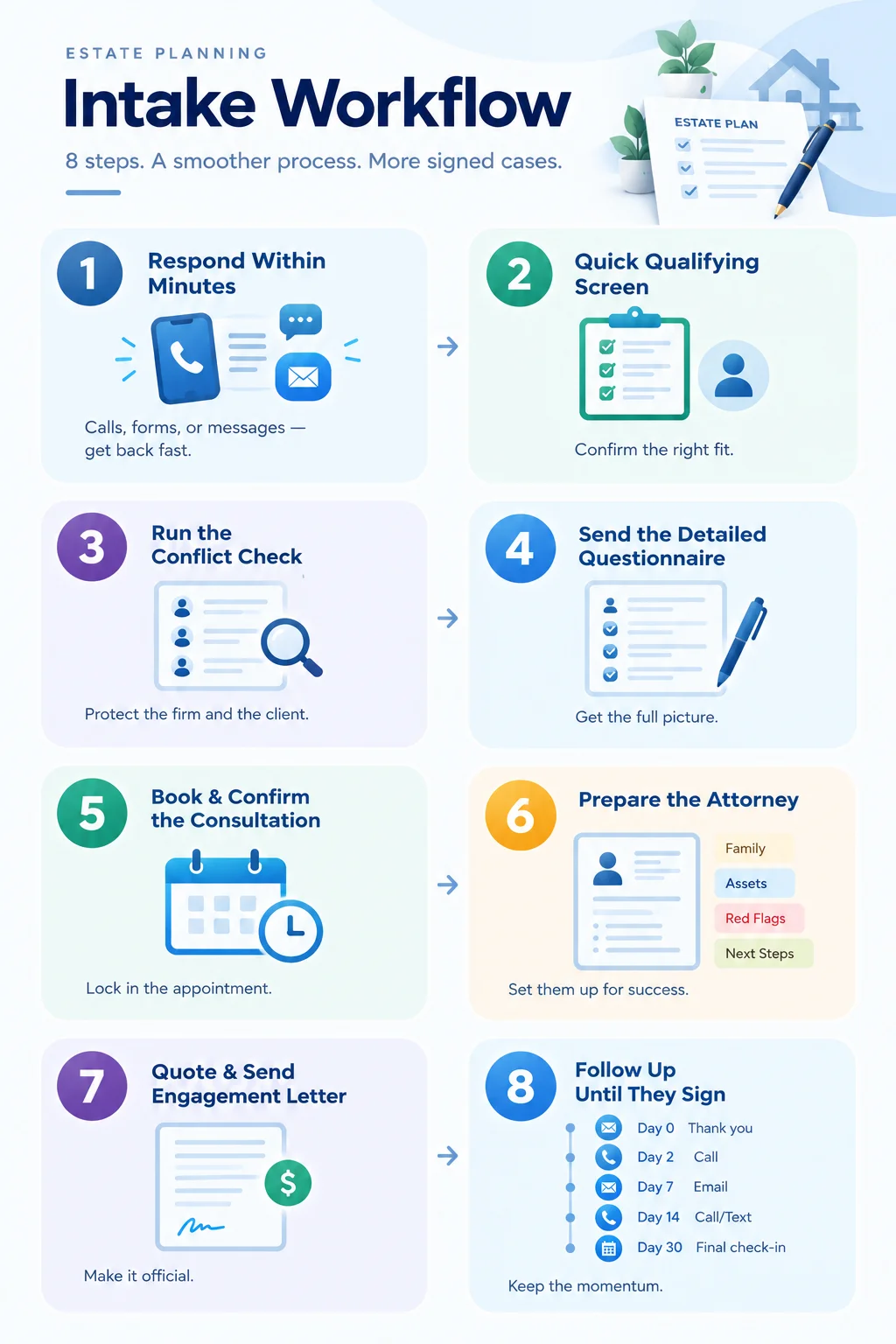
An estate planning intake workflow has eight steps, from first contact to signed engagement. Each step has one goal, and skipping any of them usually shows up later as a no-show, a scope dispute, or a lead who disappears.
Step 1: Respond within minutes on every channel
Answer calls live during business hours and reply to web forms within five minutes. After hours, use a live answering service or an instant text and email reply that offers a booking link.
Planning leads often reach out at night or on weekends, after a family conversation or a health scare. That moment of motivation fades fast. Capture the lead's name, phone, email, and how they heard about you before anything else, so you can follow up even if the call drops.
Step 2: Run a quick qualifying screen
The first screen confirms the lead is a fit before anyone spends time on details. Keep it to five or six questions:
- What prompted you to reach out now?
- Which state do you live in, and do you own property in any other state?
- Are you married or in a long-term partnership?
- Do you have children, including stepchildren or children from a prior relationship?
- Do you already have a will, trust, or power of attorney?
- Roughly what is the value of your home, savings, retirement accounts, and life insurance combined?
The "why now" question matters most. A new baby, a diagnosis, a home purchase, an inheritance, or a divorce each point to a different plan and a different level of urgency.
Step 3: Run the conflict check
Run a conflict check before collecting sensitive details. Search the client, spouse or partner, children, and anyone they plan to name as executor, trustee, or guardian.
This step protects the firm under ABA Model Rule 1.18, which covers duties owed to prospective clients. Even if the person never hires you, information they share can disqualify you from representing someone else in a related matter. Limit early questions to what you need for the conflict check and fit screen.
Step 4: Send the detailed intake questionnaire
Once the lead passes the screen and conflict check, send a full questionnaire before the consultation. Use an online form with branching logic, so a renter never sees real estate questions and a client without minors skips guardianship.
A strong estate planning questionnaire covers these areas:
- Personal details: Full legal names, dates of birth, addresses, citizenship
- Family: Spouse, children, stepchildren, grandchildren, prior marriages
- Special circumstances: Beneficiaries with disabilities, addiction, or creditor issues
- Real estate: Address, estimated value, how title is held, property in other states
- Financial accounts: Bank, brokerage, retirement, and HSA accounts with approximate values
- Beneficiary designations: Who is named on retirement accounts, life insurance, and TOD or POD accounts
- Fiduciaries: Choices for executor, trustee, guardian, and agents under a POA and health care directive
- Existing documents: Copies of prior wills, trusts, POAs, and health care directives
Write questions in plain English. "Do you own a home?" works better than "Provide a schedule of real property." Short explanations next to sensitive questions, such as why you need asset values, improve completion rates.
Step 5: Book the consultation and confirm it
Book the consultation on the same call whenever you can. Offer two specific time slots instead of asking "When works for you?"
Send a confirmation right away, then reminders 48 hours and 2 hours before the meeting. Include what to bring, how long the meeting runs, and whether both spouses need to attend. For couples, confirm that both partners will be present, since a plan signed by one spouse often stalls.
Step 6: Prepare the attorney before the meeting
The intake team should hand the attorney a one-page summary before the consultation. It should cover the reason for calling, family structure, estimated estate size, existing documents, red flags, and the likely package.
A prepared attorney spends the meeting on goals and options, not on spelling children's names. Clients notice the difference and are more likely to sign the same day.
Step 7: Quote a clear fee and send the engagement letter
Most estate planning firms sell flat fee packages, such as a will package, a revocable trust package, and an advanced planning tier. Present the recommended package and price at the end of the consultation, in writing.
Send the engagement letter and payment link within an hour of the meeting while the client is still motivated. The letter should define scope, what's excluded (such as trust funding or tax returns), and, for couples, the terms of joint representation.
Step 8: Follow up on every unsigned lead
Planning leads rarely sign on the first touch. Use a follow-up sequence such as:
- Same day: thank-you email with the quote and engagement link.
- Day 2: phone call to answer questions.
- Day 7: short email addressing a common concern, such as cost or "we're too young."
- Day 14: phone call or text offering a short follow-up meeting.
- Day 30: final check-in, then move the lead to a monthly newsletter.
Track why leads don't sign. If the price comes up often, review your packages. If "we need to think about it" is common, your consultation may need a clearer recommendation and next step.
Step-by-step intake workflow for probate cases
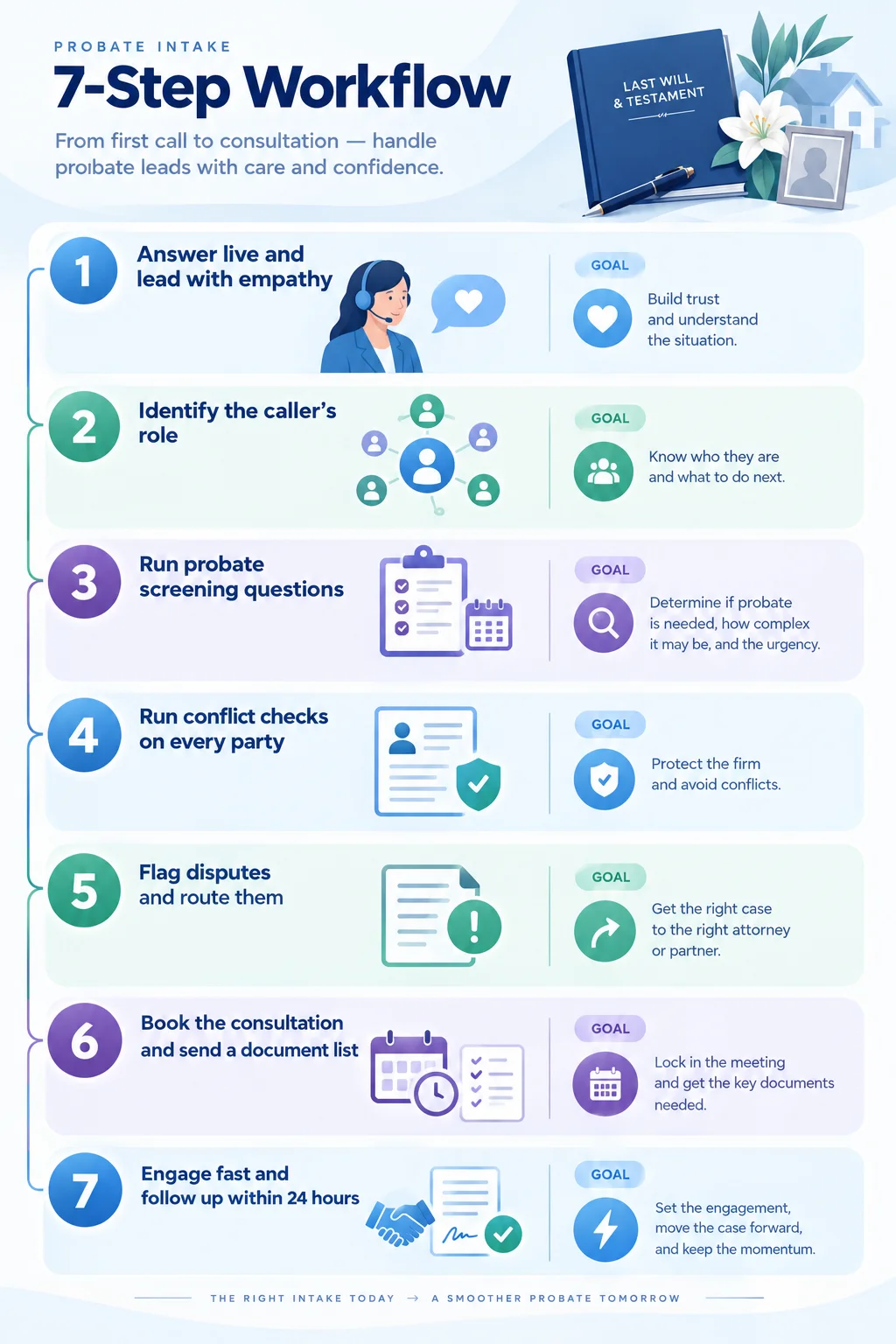
A probate intake workflow has seven steps, and the first call does most of the work. The goal is to show empathy, find out whether probate is needed, catch deadlines and disputes, and book a consultation before the caller hangs up.
Step 1: Answer live and lead with empathy
Probate callers should reach a live person whenever possible. Open with condolences and let the caller explain the situation before you start asking questions.
Many callers don't know what probate is or why they're calling a lawyer. A short, calm explanation such as "Probate is the court process for transferring a person's property after death" builds trust fast.
Step 2: Identify the caller's role
Find out how the caller is connected to the person who died. Their role decides who your client would be and which questions come next.
- Named executor or personal representative: Usually the client in an estate administration.
- Heir or beneficiary: May need advice about their rights, or may be contesting the will.
- Family member with no formal role: May need to petition for appointment if there's no will.
- Trustee of a living trust: May need trust administration rather than probate.
- Creditor or business partner: Usually a different practice area or a conflict.
In most states, the probate attorney represents the personal representative, not the heirs. Explain this early so beneficiaries don't assume the firm also represents them.
Step 3: Run the probate screening questions
The screening questions tell you whether probate is needed, how complex the estate is, and how urgent the matter is.
- What was the date of death? Starts the clock for filing, creditor, and tax deadlines.
- In which state and county did they live? Confirms jurisdiction and local court rules.
- Did they leave a will or a trust? Do you have the original? Shows whether the estate is testate or intestate. A missing original adds steps.
- Who is named as executor or trustee? Confirms who can petition and who the client is.
- What assets did they own, and how were they titled? Shows what passes through probate and what passes outside it.
- Did they own real estate in other states? May trigger ancillary probate.
- Were there beneficiary designations or joint accounts? These assets usually skip probate.
- Roughly what is the estate worth? Decides between formal probate and a small estate or summary procedure.
- Are there known debts, a mortgage, or a business? Affects how long and complex the administration will be.
- Is anyone disputing the will or the executor? Flags litigation and possible conflicts.
- Has anything been filed with the court yet? Shows whether another attorney or a deadline is involved.
- Is there property at risk, such as a vacant house or a running business? Signals urgent protective steps.
Many states have simplified procedures for small estates, and the dollar limits vary by state. Your intake team should know your state's threshold so they can set expectations on the first call.
Step 4: Run conflict checks on every party
Probate conflict checks cover more names than estate planning. Search the decedent, the caller, the named executor, every heir and beneficiary, and any known creditors or opposing parties.
Check whether your firm drafted the decedent's estate plan. That history is common in this practice area and can be helpful or create conflicts if a beneficiary is challenging the documents.
Step 5: Flag disputes and route them
Separate estate administration from contested matters during intake. Signs of a contested case include:
- A will signed shortly before death or after a major change in health
- A caregiver or new partner who received an unexpectedly large share
- Siblings who disagree about who should serve as executor
- Missing assets or suspicious withdrawals before death
- Claims that the decedent lacked capacity or was pressured
Route these to a probate litigator if your firm handles them. If not, have a referral partner ready, since a warm referral protects your reputation even when you can't take the case.
Step 6: Book the consultation and send a document list
Book the consultation during the call, ideally within two to three business days. Send a confirmation with a short document checklist the caller can gather.
A probate document checklist usually includes:
- Several certified copies of the death certificate
- The original will and any codicils, plus any trust documents
- Recent statements for bank, brokerage, and retirement accounts
- Deeds, mortgage statements, and property tax bills
- Life insurance policies and beneficiary forms
- Vehicle titles
- The decedent's last two years of tax returns
- Recent bills and known debts
- Names and contact details for all heirs and beneficiaries
- Any court papers already received
Tell callers not to distribute assets, sell property, or pay large debts before speaking with the attorney. Early mistakes can create personal liability for an executor.
Step 7: Engage fast and follow up within 24 hours
Present the fee structure during or right after the consultation. Probate fees vary widely: some states set statutory fees based on estate value, while others allow hourly or flat fee arrangements.
Send the engagement letter the same day. If the caller hasn't signed within 24 hours, call them. Probate leads that go quiet have often hired another firm, so speed matters more here than in planning matters.
Turn probate clients into planning clients
Many probate clients realize they need their own estate plan after handling a parent's estate. Add a planning offer to your probate closing letter, or flag the client for a follow-up call once the estate is settled. This builds a referral loop between your two intake workflows.
Ethics and red flags to catch during intake

Intake is where most ethics problems in estate planning and probate first show up. Intake staff don't decide how to handle them, but they should spot them and flag them in the consultation summary for the attorney.
Third parties driving the plan
The most common warning sign is a third party driving the plan. When an adult child calls to "set up Mom's will," ask to speak with the parent directly and note who will attend the meeting. The same applies when a new caregiver or partner pushes for changes, since both can point to undue influence or elder financial abuse.
Signs of diminished capacity
Capacity is another concern. If a client seems confused about dates, assets, or family members, flag it for the attorney under ABA Model Rule 1.14 on clients with diminished capacity. Intake staff should never comment on or try to judge the client's mental state.
Family situations that raise conflicts
Some family situations raise conflict questions. Couples with children from prior relationships may have competing interests, so flag them for a joint representation disclosure under ABA Model Rule 1.7. A client who wants to disinherit a child or spouse is also worth flagging, because the attorney may want to document capacity in case of a future contest.
Probate red flags
Probate calls carry their own red flags. A caller who mentions a recent will change may be heading toward a will contest, so route the matter to the litigation track. If another attorney is already involved, get that attorney's name and include it in the conflict check.
Requests for legal advice
Finally, watch for callers who ask for legal advice on the phone. Non-lawyer staff should share only general process information and book the consultation. Answering legal questions creates a risk of unauthorized practice of law.
Protect prospective client information
Information a prospective client shares is confidential even if they never hire you. Collect only what you need for the conflict check and screen until the conflict is cleared.
Use secure forms and client portals instead of plain email for Social Security numbers, account numbers, and medical details. Tell callers how their information will be stored and who can see it.
Send non-engagement letters
When the firm declines a matter, send a short non-engagement letter. It should state that the firm does not represent the person and mention any deadlines they should be aware of in general terms.
This matters most in probate, where filing and creditor deadlines can pass while a caller assumes your firm is handling the case.
Intake metrics to track
You can't fix an intake process you don't measure. Track these eight numbers monthly, split by estate planning and probate, since the two behave differently.
How to read the numbers
Each metric points to a specific fix. A low answer rate means you need more phone coverage. A low show rate means your reminders or booking lead time need work.
A high booking rate with a low close rate points to the consultation itself. The attorney may need a clearer recommendation, firmer pricing, or a same-day engagement process.
Record a reason for every lost lead, such as price, no response, went elsewhere, not a fit, or not ready. After three months, the pattern usually shows where your process breaks.
Pros and cons of in-house vs dedicated intake services
In-house intake gives you the most control, while a dedicated intake service gives you the most coverage. Many estate planning and probate firms end up with a mix of both.
In-house intake
In-house intake means your own staff, often a receptionist, paralegal, or client care coordinator, handle calls and forms.
Pros
- Staff know your attorneys, packages, and local probate court well.
- You control the script, tone, and every client interaction.
- Intake staff can also help with onboarding and document collection.
- Callers speak with the same people they'll work with later.
Cons
- Coverage usually ends at 5 p.m. and on weekends, when many planning leads call.
- Calls go to voicemail during lunch, sick days, and busy periods.
- Staff split time between intake and other work, so follow-up slips.
- Hiring, training, and turnover costs fall on the firm.
Dedicated intake service
A dedicated legal intake service uses trained agents, software, or both to answer calls and forms, screen leads, and book consultations for your firm.
Pros
- Calls are answered live day, night, and weekend.
- Agents follow your estate planning and probate scripts on every call.
- Coverage scales up during marketing pushes or seasonal spikes.
- Intake data can be entered into your case management or CRM system on each call.
Cons
- Agents need time and good scripts to learn your firm and state rules.
- Generic answering services may only take messages instead of qualifying leads.
- Monthly fees add a fixed cost, which matters for small solo practices.
- You give up some control over the caller's first impression.
The hybrid model
A common setup is in-house staff during business hours and a dedicated service for overflow, lunch breaks, evenings, and weekends. The firm keeps a personal touch for most calls and stops losing leads at the edges of the day.
The key to a hybrid model is one shared script and one shared system. If the service and your staff use different questions or record data in different places, leads fall through the gap.
Conclusion
A strong estate planning and probate intake process comes down to answering fast, asking the right questions, and following up until the lead decides. Firms that do those three things consistently sign more of the leads they already pay for.
Start with the basics. Use separate scripts for estate planning, probate, and trust administration calls. Run conflict checks before collecting sensitive details, and flag red flags for the attorney.
Then measure what happens. Track your answer rate, booking rate, show rate, and close rate every month. The weakest number tells you where to fix the process first.
Finally, decide who answers the phone. In-house staff give you control during business hours. A dedicated intake service covers evenings, weekends, and busy periods, when many estate planning and probate leads call.
Stop losing estate planning and probate leads to voicemail
Legal Intaker answers your calls live, screens every lead with your estate planning and probate questions, and books consultations on your calendar. Every intake is logged in [your case management system] so your attorneys walk into each consultation prepared.
- Calls answered within a ring, day, night, and weekend
- Separate scripts for estate planning, probate, and trust administration
- Conflict check details captured on every call
- Consultations booked directly on your calendar
- Monthly reports on answer, booking, and close rates
[Book a free intake review] to see how many leads your firm is missing and what it would take to catch them.





.png)
.png)













.webp)















.webp)

.webp)









.webp)