
What Law Firms Should Look for in Estate Planning Client Intake Specialists
Key Takeaways
- Estate planning client intake specialists are trained to guide prospective clients through emotional, document-heavy conversations about wills, trusts, and long-term care.
- The role demands eight core traits: empathy, discretion, terminology fluency, comfort with wealth conversations, HIPAA awareness, coordination skills, follow-up discipline, and bilingual capacity where the client base requires it.
- Estate planning intake looks different from personal injury or family law intake. Sales cycles run longer, clients are often older, and family dynamics shape every conversation.
- Costs range from $45,000 to $70,000 per year in-house or $2,000 to $4,500 per month for a virtual estate planning intake specialist.
Quick Answer
Estate planning client intake specialists guide older, often emotional clients through the process of hiring a lawyer for wills, trusts, and long-term care. The best specialists combine empathy, terminology fluency, and follow-up discipline.
Why Estate Planning Intake Is Different
Estate planning intake is different from every other practice area. The client is usually older. The conversation touches death, disability, and family conflict. The sales cycle spans weeks or months. And the deliverable is a bundle of six to ten documents that a non-lawyer client has never seen before.
Personal injury intake rewards speed. Family law intake rewards emotional care in the moment. Estate planning intake rewards patience, discretion, and long-term follow-up.
The specialists who do this well treat the first call as the start of a decades-long relationship. They know that today's simple will client may become tomorrow's trust client, next year's Medicaid planning client, and eventually the executor of a family member's estate.
Who Estate Planning Intake Specialists Work With
Estate planning intake specialists talk to a range of client types across a client's lifetime. Each type carries different intake needs.
- Younger families setting up a first will and guardianship plan
- Middle-aged clients funding a revocable trust and coordinating with a financial advisor
- Older clients revisiting an existing estate plan after a life event
- High-net-worth clients requiring irrevocable trust, tax, and business succession planning
- Elder law clients navigating Medicaid, long-term care, or capacity questions
- Adult children calling on behalf of a parent, sometimes in a health crisis
- Executors and trustees needing help administering an estate
A strong intake specialist adjusts language, pace, and empathy to each type without losing structure.
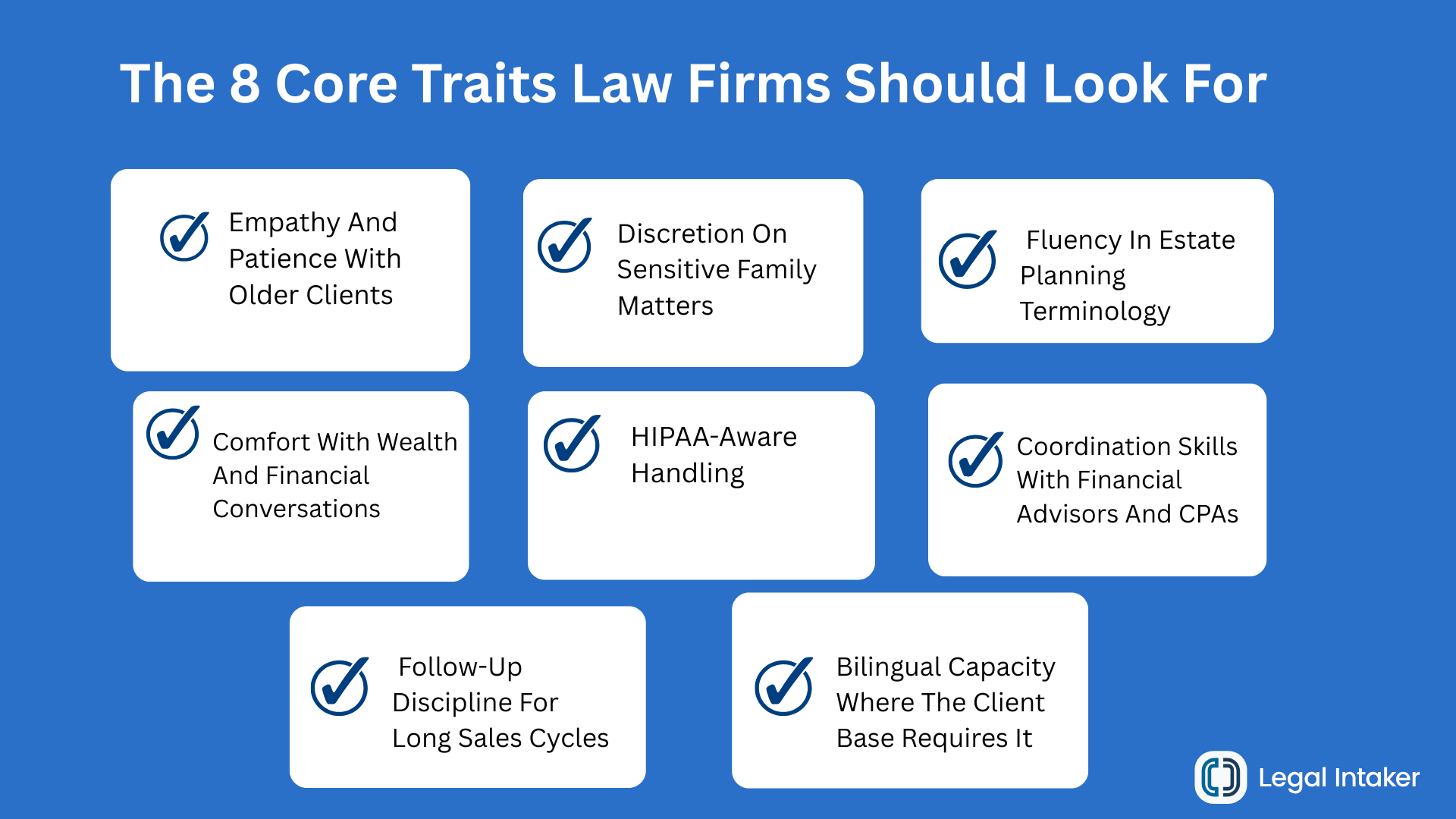
The 8 Core Traits Law Firms Should Look For
The best estate planning client intake specialists share eight traits. Screen for all eight during hiring, whether the role is in-house or virtual.
1. Empathy And Patience With Older Clients
Older clients often need more time on the phone. They may repeat questions, ask for clarifications, or share stories that seem tangential. The strongest intake specialists treat that time as investment, not friction, and never rush the caller.
2. Discretion On Sensitive Family Matters
Estate planning conversations surface hard family dynamics: blended families, estranged children, disinherited siblings, second marriages. The specialist must handle these with a steady, non-judgmental voice, and never share details across matters or households.
3. Fluency In Estate Planning Terminology
Basic fluency in the vocabulary is table stakes. The specialist should recognize and know how to describe revocable and irrevocable trusts, powers of attorney, healthcare directives, HIPAA releases, executor and trustee roles, beneficiary designations, and the difference between probate and non-probate assets.
4. Comfort With Wealth And Financial Conversations
Estate planning is a financial conversation. The specialist should be able to ask about approximate net worth, real estate holdings, retirement accounts, and family business ownership without hesitation. Discomfort in the intake call becomes discomfort in the consultation.
5. HIPAA-Aware Handling
Healthcare directives, HIPAA releases, and medical planning discussions often surface protected health information. The specialist should follow HIPAA-aware handling, including limited access, encrypted storage, and clear escalation. For more, see Legal Intaker's HIPAA-compliant virtual legal intake specialists.
6. Coordination Skills With Financial Advisors And CPAs
Most estate planning matters involve a client's financial advisor and CPA. The specialist should collect those contacts at intake, understand when to loop them in, and know how to route documents and updates to the right person on the client's team.
7. Follow-Up Discipline For Long Sales Cycles
Estate planning sales cycles routinely run four to twelve weeks from first call to signed engagement. The specialist needs a follow-up rhythm the practice trusts, including scheduled check-ins, reminders on missing documents, and a warm re-engagement path for prospects who go quiet.
8. Bilingual Capacity Where The Client Base Requires It
For firms in markets with meaningful Spanish-speaking populations, bilingual intake is not a nice-to-have. It is the difference between capturing and losing a large share of prospective clients. Chinese, Korean, Vietnamese, and other languages matter in specific markets.
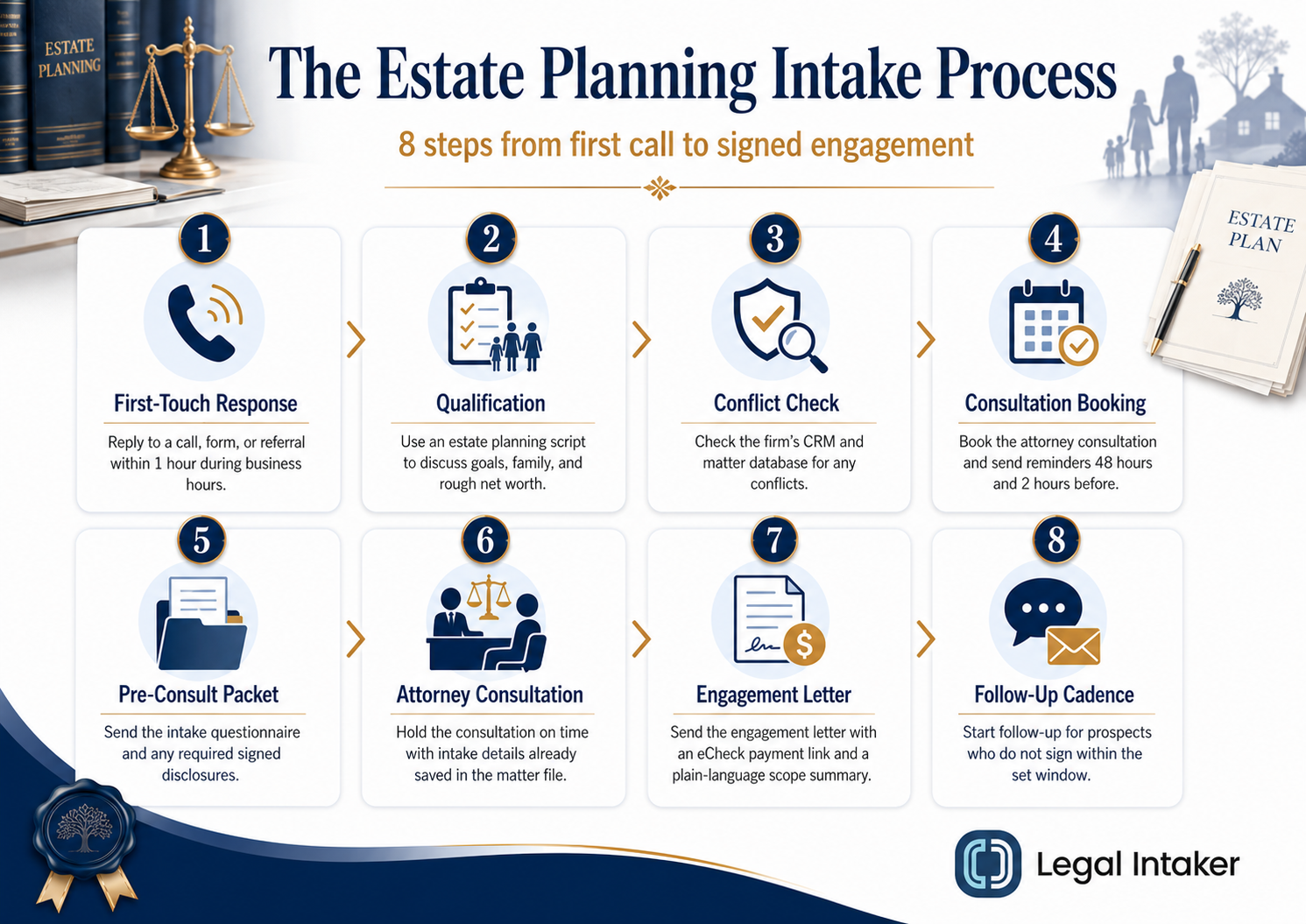
The Estate Planning Intake Process
The estate planning intake process usually runs eight steps from first call to signed engagement. Use it as a template.
- First-touch response to a call, form, or referral within an hour during business hours.
- Qualification using an estate planning script that asks about goals, family, and rough net worth.
- Conflict check against the firm's CRM and matter database.
- Consultation booked into an attorney's calendar with reminders 48 hours and 2 hours out.
- Pre-consultation packet sent with an intake questionnaire and any signed disclosures.
- Attorney consultation delivered on time, with intake data already in the matter file.
- Engagement letter sent with an eCheck payment link and a plain-language explanation of scope.
- Follow-up cadence started for any prospect who does not sign within a set window.
The specialist owns the workflow. The attorney owns the legal judgment.
Estate Planning Intake By Client Type
Intake conversations vary a lot by client type. The table below shows the emphasis for each.
Client Type
Simple will and guardianship
Revocable trust
High-net-worth
Blended family
Elder Law
Executor or trustee support
Intake Emphasis
Speed and clarity
Financial coordination and asset details
Discretion and multi-advisor coordination
Sensitive family dynamics
Health, capacity, Medicaid planning
Deceased client, administration questions
Common Document Referenced
Will, HIPAA release, healthcare directive
Revocable trust, pour-over will, funding schedule
Irrevocable trust, GRAT, ILIT, family LLC
Trust with subtrust, beneficiary designation
Long-term care planning, Medicaid trust
Probate filings, trust administration checklists
Train intake staff on all six categories, and let the caller's language drive which script to follow.
Skills And Certifications Checklist
Beyond the eight traits, look for a compact skill checklist during hiring or vendor evaluation.
- Two or more years of law firm client-facing experience preferred
- Familiarity with common case management systems (Clio, MyCase, Filevine, Litify, Smokeball)
- Comfort with intake CRMs (Clio Grow, Lawmatics, PracticePanther)
- Written communication that reads warm and clear
- Basic estate planning coursework or certificate (helpful, not required)
- Notary commission (helpful for firms doing hybrid remote signings)
- HIPAA training and secure-handling certification
- Bar-familiar confidentiality training
Certificates matter less than track record. Ask for references from previous law firm employers or vendor clients.
In-House Vs Virtual Estate Planning Intake Specialists
Firms can hire in-house, hire remotely, or use a virtual staffing partner. The comparison below covers the trade-offs.
Option
Full-time-in-house
Part-time-in-house
Freelance or remote hire
Virtual estate planning intake partner
Typical Monthly Cost
$4,500 to $6,500 loaded
$2,000 to $3,500
$1,500 to $4,000
$2,000 to $4,500
Strengths
Fully embedded, on-site presence for signing
Lower cost for smaller firms
Direct hire, lower overhead
Vetted talent, coverage, bilingual options
Trade-Offs
Fixed cost, PTO gaps, turnover
Coverage gaps
Screening and management burden
Less on-site presence
Many estate planning firms combine an in-house administrator with a virtual intake partner for after-hours and overflow. That mix protects the client experience while controlling fixed costs.
Interview Questions To Ask
Ten questions surface most fit problems during hiring or vendor evaluation.
- Describe the last emotional intake conversation you handled. What went well?
- How do you explain the difference between a will and a revocable trust in plain language?
- A caller's adult child is asking about their parent's plan. How do you handle authority and consent?
- Walk me through how you would collect approximate net worth from a hesitant caller.
- How do you follow up with a prospect who has not responded in three weeks?
- What CRM and case management systems have you used, and which fields do you always fill in first?
- How do you handle a caller who wants immediate legal advice on the phone?
- What is your process when a caller mentions a HIPAA release or healthcare directive?
- How do you route a caller who mentions dementia or capacity questions?
- Tell me about a time you noticed something the attorney would want to know before the consultation.
Confident answers show real reps. Vague or hesitant answers show a candidate not yet ready for estate planning intake.
Red Flags To Avoid
Some patterns signal a poor fit for estate planning intake work. Watch for these during hiring or vendor evaluation.
- Rushing the caller off the phone in under three minutes
- Discomfort with wealth or family questions
- Weak grasp of basic estate planning vocabulary
- No demonstrated follow-up discipline for prospects who go quiet
- No secure workflow for HIPAA-adjacent information
- Sales pressure that pushes callers into consultations they do not want
- Any suggestion of giving legal advice during the intake
A single red flag is not disqualifying. Two or more usually is.
Cost Ranges For Estate Planning Intake Specialists
Cost ranges for estate planning intake specialists in 2026 sit inside these bands, depending on region, experience, and model.
- U.S. average in-house salary: $50,000 to $70,000
- Major metro salary (NY, LA, SF, DC): $65,000 to $95,000
- Senior specialist with estate planning depth: $65,000 to $95,000
- Virtual estate planning intake specialist: $2,000 to $4,500 per month
- Bilingual Spanish, virtual: modest premium above baseline
- Fully loaded in-house cost per month: $4,500 to $6,500
Loaded cost adds 20 to 30 percent above base salary once benefits, payroll taxes, and tools are counted. Compare loaded cost against any outsourced quote before choosing.
Sources: ZipRecruiter, JobzMall, Virtual Staffing

Ethics And Confidentiality Considerations
Estate planning intake sits at the intersection of law, health, and finance. The American Bar Association Model Rules of Professional Conduct apply, particularly around confidentiality and competence when discussing sensitive family and financial matters.
Practical checklist for firms:
- Model Rule 1.1 (Competence): the specialist and supervising attorney both understand the tools and workflow
- Model Rule 1.6 (Confidentiality): client information stays protected across the intake system
- Model Rule 5.3 (Supervision): the attorney supervises the specialist's work on client matters
- Model Rule 5.5 (Unauthorized practice): the specialist collects facts, not legal advice
- HIPAA-aware handling: encrypted storage, limited access, and clear retention rules
- Written intake policy and staff training refreshed annually
The American Bar Association publishes ongoing law practice management guidance worth tracking. State bars may add specific requirements.
Common Mistakes When Hiring Estate Planning Intake Support
Most failed estate planning intake hires share the same causes. Watch for these before making an offer.
- Hiring for personality with no legal or estate planning background
- Skipping the interview questions above and going with a generic script
- Failing to give the specialist access to the case management system on day one
- Underinvesting in follow-up discipline for long sales cycles
- Assigning attorney overflow work without a clear scope
- Ignoring HIPAA handling requirements during onboarding
- Failing to review conversion metrics for the first 90 days
The fix is usually a tighter written scope and a documented onboarding plan. Both take a few hours to build and pay back for years.

Build The Intake Team Your Estate Planning Clients Deserve
Estate planning clients remember how they were treated on the first call for a long time. A warm, patient, well-prepared intake specialist is often the reason a family chooses your firm and comes back a decade later with the next generation.
See how Legal Intaker pairs bilingual estate planning intake specialists with HIPAA-grade workflows built for older clients, blended families, and long sales cycles. Review Legal Intaker pricing or book a walkthrough to see how the role plugs into your practice.
Frequently Asked Questions (FAQs):
What does an estate planning client intake specialist do?
An estate planning client intake specialist is the first person a prospective client speaks to at an estate planning law firm. They answer inbound calls and forms, qualify the caller against the firm's practice profile, run a conflict check, book the consultation, send engagement documents, and follow up on any lead that has not signed. The role blends administrative work, client communication, and light coordination with financial advisors and CPAs.
How does estate planning intake differ from other practice areas?
Estate planning intake tends to involve older callers, longer sales cycles, and emotional conversations about death, disability, and family conflict. Personal injury intake rewards speed. Family law intake rewards emotional care in the moment. Estate planning intake rewards patience, discretion, and long-term follow-up across weeks or months.
What skills should an estate planning intake specialist have?
The strongest estate planning intake specialists show empathy with older clients, discretion on family matters, fluency in estate planning terminology, comfort with wealth conversations, HIPAA-aware handling, coordination skills with financial advisors and CPAs, follow-up discipline, and bilingual capacity when the client base requires it.
How much does an estate planning intake specialist cost?
In-house estate planning intake specialists typically earn $45,000 to $70,000 per year in most U.S. markets, up to $90,000 in major metros. Virtual estate planning intake specialists usually cost $2,000 to $4,500 per month, depending on hours covered, bilingual capacity, and skill level. Loaded in-house cost per month runs $4,500 to $6,500.
Can estate planning intake be handled virtually?
Yes. Many estate planning law firms use virtual or remote intake specialists for first-touch response, qualification, and follow-up. Signing appointments and notarization can happen in person or through remote online notarization where the state allows it. Virtual staffing partners often deliver bilingual coverage and after-hours support.
Should the intake specialist collect financial information?
Yes, at a summary level. Estate planning attorneys need approximate net worth, real estate holdings, and family situation to prepare for the consultation. The intake specialist collects the summary. Detailed financial documents come during or after the consultation, once the client has signed and engaged.
How does a firm supervise an intake specialist under ABA rules?
Under ABA Model Rule 5.3, the supervising attorney is responsible for the intake specialist's work on client matters. Supervision usually includes written scripts, a documented intake process, weekly quality reviews, quarterly training, and a policy that intake staff never give legal advice or set fees.
What is the biggest mistake law firms make with estate planning intake?
The biggest mistake is treating estate planning intake like personal injury or family law intake. Rushing older callers, skipping follow-up on long sales cycles, and hiring for generic customer service instead of practice-area empathy all cost firms real matters. The fix is a written intake policy and staff trained specifically for estate planning conversations.





.png)
.png)












.webp)















.webp)

.webp)









.webp)