
Key Takeaways
- Harvey AI is a purpose-built legal AI platform designed for law firms, corporate legal teams, and enterprise environments.
- Major law firms are adopting Harvey to accelerate legal research, drafting, document review, and due diligence.
- AI improves productivity and reduces time spent on repetitive legal work, but attorneys remain fully responsible for verification and compliance.
- The strongest ROI comes when firms combine AI tools with structured processes, enterprise grade security, and supervised implementation.
- Harvey is not replacing lawyers. It is reshaping how legal professionals allocate time toward high value work.
-
If you've followed legal technology over the past few years, one name keeps surfacing in partner meetings, legal conferences, and boardroom discussions: Harvey AI.
Often described as AI built specifically for lawyers, it’s being piloted by major law firms and backed by investors like Sequoia Capital and the OpenAI Startup Fund. But beyond litigation and legal research, firm leaders are asking a more operational question: How does legal AI strengthen the intake process?
Legal intake specialists sit at the front line of revenue. They qualify leads, capture critical case details, and ensure accurate documentation before attorneys ever review a file. When integrated strategically, tools like Harvey can support faster document analysis, summarize client narratives, and assist with early case assessment — helping intake teams reduce friction and improve accuracy without replacing human judgment.
This is where legal AI shifts from being a research tool to becoming an operational asset. By supporting intake workflows, reducing manual review time, and helping surface key facts early, AI allows legal specialists and attorneys to focus on higher-value legal work instead of repetitive administrative tasks.
In 2026, the real advantage isn’t AI replacing legal professionals. It’s AI complementing legal intake specialists and attorneys to drive efficiency, smarter workflows, and measurable results from the very first client interaction.
What Harvey AI and Why It's Different
Harvey is a generative legal AI platform designed specifically for legal work. Launched in 2022 and backed by major investors including Sequoia Capital and the OpenAI Startup Fund, it was developed to operate within professional legal environments, not as a consumer chatbot.
Public reporting from Reuters and the Financial Times confirms that big firms such as Allen & Overy (now A&O Shearman) have tested or deployed Harvey in various practice areas. The company has secured brand partnerships that signal enterprise-grade adoption across the legal industry.
At its core, Harvey uses large language models to assist with:
- Contract drafting and document analysis
- Legal research and case law summarization
- Due diligence review across large volumes of documents
- Regulatory comparisons
- Internal memoranda and structured legal writing
It is not a replacement for lawyers. It is a drafting and analytical accelerator that allows legal professionals to focus on high value work rather than repetitive tasks.
That distinction matters.

Why the Legal Profession Is Paying Attention
The legal industry is under sustained pressure.
Clients expect faster turnaround times and increasingly scrutinize billing. Alternative legal service providers continue to expand. Associates are demanding better work-life balance. Meanwhile, both law firms and corporate legal teams face competitive pressure to deliver more value without eroding margins.
According to Thomson Reuters' Future of Professionals Report, professionals estimate AI could save up to four hours per week. Across a large firm, that represents significant time saved and productivity gains. The global legal tech market itself is projected to exceed $35 billion by 2030.
Harvey sits directly at the intersection of this demand for speed, scale, and legal reasoning support.
But efficiency gains only materialize when implementation is disciplined and when adopting Harvey is paired with structured operational support.
What Harvey Actually Does Inside a Law Firm
Legal AI is often discussed in broad terms. Here’s what Harvey actually does in day-to-day law firm operations.
At its core, Harvey functions as an AI drafting and analysis assistant. It reduces first-draft friction, accelerates document review, and organizes legal information. It does not replace legal judgment. It reduces administrative and drafting drag.
Drafting & Transactional Support
What does Harvey do in transactional law?
Harvey helps attorneys generate structured first drafts, compare contract provisions, and flag unusual risk language.
Common use cases include:
- Drafting NDAs and commercial agreements
- Suggesting fallback clauses
- Comparing indemnification provisions
- Identifying unusual liability exposure
Why it matters:
Attorneys start with a structured draft instead of a blank page, saving time and shifting focus to strategic deal issues rather than formatting in Microsoft Word.
Litigation & Legal Research Acceleration
How does Harvey support litigation teams?
Harvey summarizes case law, extracts legal standards, identifies key holdings, and compares precedent across jurisdictions.
Typical outputs include:
- Judicial opinion summaries
- Extracted legal tests
- Side-by-side precedent comparisons
Important limitation:
AI outputs must be verified. The 2023 Mata v. Avianca case — where lawyers submitted AI-generated fictitious citations — reinforced that responsibility rests with counsel, not software.
Due Diligence & M&A Review
Can Harvey assist in large-scale document review?
Yes. Harvey can extract specific clauses and identify risk exposures across large volumes of documents.
Common extractions:
- Change-of-control clauses
- Termination provisions
- Exclusivity language
- Risk indicators
Operational impact:
When paired with trained legal review teams, this can compress due diligence timelines and increase efficiency in high-volume transactions.
Cross-Border & Regulatory Analysis
How is Harvey used in multinational legal matters?
Harvey can compare regulatory frameworks across jurisdictions.
Examples include:
- Employment standards analysis
- Data privacy rule comparison
- Multi-country compliance reviews
Strategic value:
This gives cross-border firms and in-house legal teams analytical leverage when navigating complex regulatory environments.
The Non-Negotiable: Human Oversight
Harvey increases speed, structure, and analytical efficiency.
It does not replace professional responsibility.
Every output must be reviewed, validated, and contextualized by qualified legal professionals.
If you'd like, I can now add a short section connecting these capabilities directly to legal intake specialists and early-stage case assessment workflows for stronger operational positioning.
Security, Ethics, and Professional Responsibility
For law firms and corporate legal teams, the question is never just "Does it work?" It is "Is it defensible?"
Enterprise-grade security is essential when handling sensitive client data. Harvey's implementation typically emphasizes secure environments, access controls, and contractual safeguards regarding legal data handling. However, no tool is automatically compliant simply because it is marketed to the legal industry.
Under ABA Model Rule 1.1, lawyers have a duty of technological competence. Model Rule 1.6 requires safeguarding client confidentiality. Supervisory obligations under Rules 5.1 and 5.3 apply not only to associates and staff, but to the AI tools firms deploy.
If your firm uses Harvey, leadership must understand:
- Where data is stored and processed
- Whether client data is used for model training
- What encryption standards are in place
- How access is controlled internally
- How outputs are verified before client delivery
No court has accepted "the AI generated it" as a defense.
Adopting Harvey must be governed, documented, and supervised.
Where Firms Get It Wrong
After decades observing law firm operations, a consistent pattern emerges.
Firms invest in back-end technology, drafting tools, document automation, legal AI, but ignore front-end inefficiencies.
They accelerate document production while still:
- Missing intake calls
- Delaying client follow-up
- Manually re-entering data
- Inconsistently screening conflicts
- Overloading associates with administrative tasks
AI tools improve document generation. They do not fix intake chaos.
If potential clients wait 48 hours for a response, efficiency gains on the drafting side will not compensate for lost matters.
Technology without operational structure creates uneven results. Many lawyers appreciate the power of one platform, but struggle when separate tools and disconnected systems undermine productivity gains.
The Operational Gap: Why Legal AI Alone Is Not Enough
The firms seeing meaningful ROI from Harvey are not simply installing software. They are redesigning workflows.
According to Clio's Legal Trends Report, firms that respond quickly to inquiries significantly improve conversion rates. Yet many firms still rely on voicemail-based intake systems and manual scheduling.
If your intake data is inconsistent, AI outputs will be inconsistent.
Garbage in, garbage out applies directly to generative legal AI.
Structured intake and standardized data collection dramatically improve downstream AI performance. Clean matter summaries, verified documents, and organized client information create better prompts, and better prompts generate stronger outputs.
Harvey amplifies process quality. It does not replace it.
How Legal Intaker Strengthens AI Adoption
This is where many firms either succeed or struggle.
When associates use AI tools in isolation, firms risk inconsistent usage, uneven quality control, and ethical exposure. But when Harvey is paired with trained support staff and structured oversight, measurable results improve substantially.
Our virtual receptionists and intake specialists can pre-screen leads in real time, gather structured information, verify documents, and conduct preliminary conflict checks. That structured legal data feeds directly into more accurate drafting and research workflows. With 24/7 live answering, no call goes to voicemail — ensuring every potential client receives immediate, professional attention.
Our virtual legal assistants can cross-check AI-generated citations, verify jurisdictional references, format memoranda, and prepare drafts for attorney review. Instead of replacing staff, Harvey shifts their focus toward higher-value validation and coordination work. Our bilingual team provides seamless support in English and Spanish, expanding your firm's ability to serve diverse client bases.
Our administrative support handles CRM updates, appointment scheduling, document organization, and follow-up coordination — eliminating the bottlenecks that prevent AI efficiencies from translating into real productivity gains. By managing the operational details, our virtual staff free your attorneys to focus on substantive legal work.
The right model is layered:
Harvey accelerates drafting and analysis
Virtual staff verify, structure, and coordinate
Attorneys exercise judgment on high value work
That is how enterprise teams scale responsibly — whether in major law firms or smaller practices. Legal Intaker provides the human infrastructure that makes AI adoption not just possible, but sustainable and profitable.
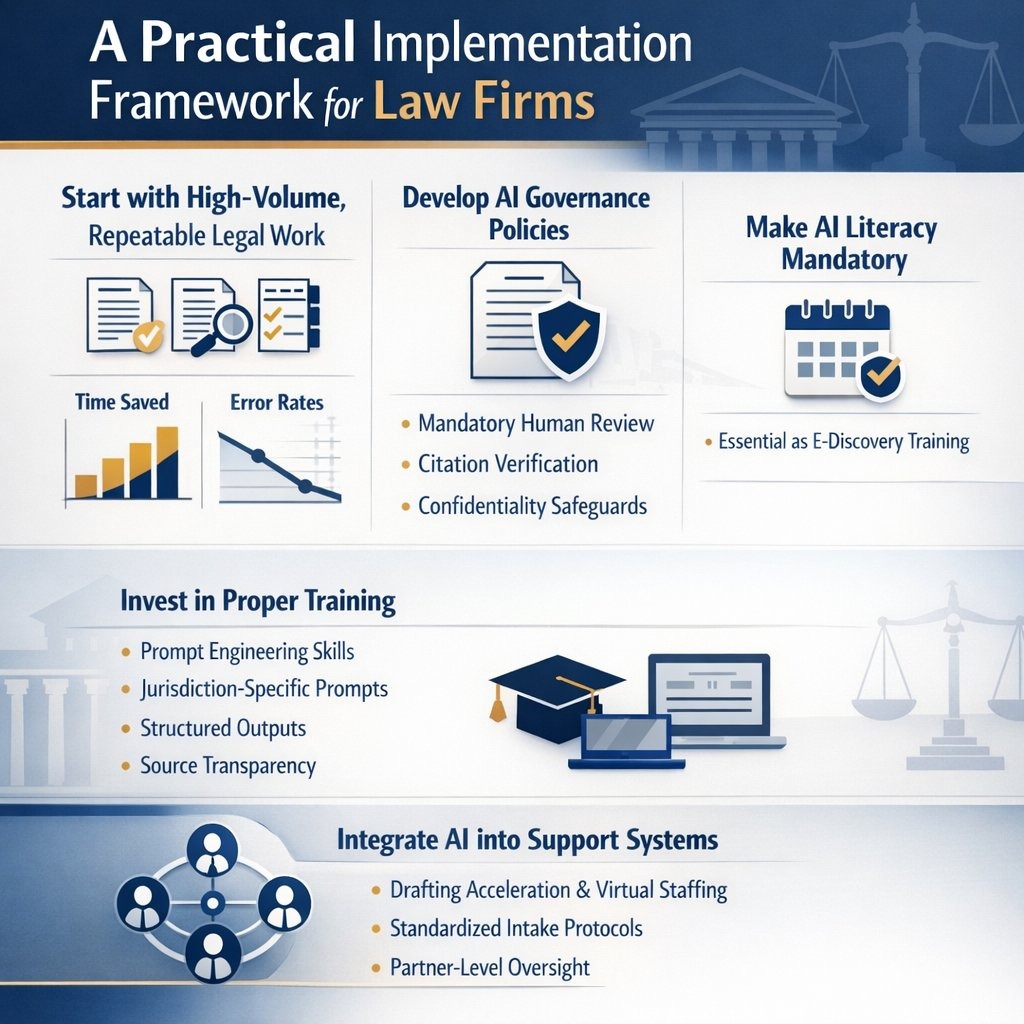
A Practical Implementation Framework for Law Firms
AI adoption succeeds through discipline — not enthusiasm.
For managing partners considering Harvey, structured rollout and governance matter more than speed.
1. Start With High-Volume, Repeatable Work
Where should firms begin implementing Harvey?
Start with predictable, high-volume legal tasks where efficiency gains are measurable.
Best initial use cases include:
- Contract review
- Due diligence summaries
- Research memoranda
- Standardized drafting workflows
Implementation rule:
Establish baseline metrics before rollout. Measure time saved, drafting cycles reduced, and error rates before expanding adoption firmwide.
2. Establish Formal AI Governance Policies
What governance framework should law firms create?
Firms must develop written AI policies that clearly define responsible use.
Core policy components should include:
- Acceptable AI use cases
- Mandatory human review standards
- Citation verification procedures
- Confidentiality and client data safeguards
This should not be informal guidance. It must be documented firm policy and treated as a compliance requirement.
3. Invest in Structured AI Training
Is prompt engineering intuitive for lawyers?
No. Effective AI use requires structured training.
Lawyers should be trained to:
- Craft jurisdiction-specific prompts
- Request structured outputs
- Demand source transparency
- Independently verify case law in Westlaw, Lexis, or official court databases
AI literacy should be treated the way e-discovery training was treated fifteen years ago — mandatory, not optional.
4. Integrate AI Into Operational Systems
How should Harvey be integrated into firm workflows?
AI tools should be embedded within structured operational systems — not used in isolation.
Best practices include:
- Pairing drafting acceleration with virtual staffing support
- Aligning AI use with standardized intake protocols
- Maintaining partner-level oversight on strategic matters
Risk to avoid:
Isolated experimentation that bypasses governance and oversight.
The Core Principle
AI implementation is not a technology project.
It is an operational redesign initiative.
Firms that treat it as structured process improvement — rather than informal experimentation , are far more likely to achieve measurable results.
What Harvey Does Not Replace
There is understandable anxiety around AI displacement. In reality, Harvey does not replace the core functions that define legal practice.
- It does not replace strategic negotiation.
- It does not replace courtroom advocacy or litigation strategy.
- It does not replace nuanced client counseling.
- It does not replace ethical accountability.
Generative legal AI is probabilistic. Legal practice is precision-driven.
The tension between those two realities is why supervision remains essential and why many lawyers view Harvey as a partner in creating better work product, not a replacement for judgment.
Understanding the Real ROI
Too many ROI calculations focus exclusively on billable-hour efficiency. That is only part of the picture.
The more meaningful return often comes from improved turnaround times, increased client responsiveness, reduced drafting fatigue, and better allocation of junior talent. Even a modest 10 to 15 percent acceleration in high-volume transactional workflows can materially affect profitability and allow attorneys to handle complexity at scale.
However, ROI collapses quickly if intake remains disorganized, AI outputs are not validated, staff are overwhelmed, or governance policies are unclear.
Technology must align with operations to deliver measurable results across the future of the firm.
The Emerging Hybrid Model of Legal Service Delivery
The firms gaining competitive advantage are not simply "AI firms." They are hybrid firms.
In this emerging model, Harvey handles repetitive drafting and large-scale document analysis. Virtual staff manage intake, workflow coordination, and validation. Lawyers focus on strategy, advocacy, and high-level client advisory work.
AI without process creates chaos.
Process without AI limits growth.
Together, they scale — and this model applies equally to major law firms, smaller practices, and in-house legal teams seeking integration with existing resources and a simple way to modernize.
Building the Infrastructure for Sustainable AI Adoption
Harvey represents a meaningful advancement in legal technology. It can accelerate drafting, streamline research, and enhance analytical capacity across the world of legal practice.
But Harvey alone will not modernize your firm or in-house legal team.
Transformation happens when advanced technology is combined with structured intake systems, trained support staff, governance frameworks, and leadership oversight. Technology accelerates legal work. Systems and people protect its quality and ensure compliance.
At Legal Intaker, we work with law firms and corporate legal teams to build the operational foundation that makes adopting Harvey effective and defensible. Our virtual intake specialists and legal support professionals ensure that no lead goes unanswered, no file is incomplete, no conflict check is missed, and no AI-generated output goes unverified.
If your firm is investing in Harvey — or evaluating other legal AI tools — your intake and staffing infrastructure must be strong enough to support compliant, scalable growth.
The firms that thrive in 2026 and beyond will not simply adopt AI. They will integrate it intelligently as one platform within a broader operational system designed to free attorneys to focus on clients, not complexity.
Ready to build a smarter, AI-enabled law firm? Contact Legal Intaker today and discover how virtual staffing can elevate your intake, compliance, and operational efficiency.

FAQs About Harvey AI in Modern Law Firms
What is Harvey AI primarily used for in law firms?
Harvey assists with contract drafting, legal research, due diligence analysis, regulatory comparisons, and structured internal memoranda. It accelerates drafting and document review workflows but requires attorney oversight.
Is Harvey replacing lawyers?
No. Harvey supports drafting and analysis. Attorneys remain fully responsible for legal judgment, ethical compliance, and client representation.
Is it secure for confidential matters?
Harvey offers enterprise-grade security with data protections and access controls, but each firm must conduct independent cybersecurity, compliance, and vendor due diligence before adoption to protect client data.
How is Harvey different from general AI tools?
Harvey is tailored specifically for enterprise legal teams, whereas general-purpose AI tools are not developed for law firm environments or structured legal processes involving case law, litigation, and compliance.








.webp)